All posts by Miranda Hassett

Sermon, June 18

When have you felt welcome? What made you feel that way? In today’s passage from Matthew’s Gospel, Jesus sends out the Twelve to preach the Kingdom, to spread the good news that God is still present, still acting, still saving. The way he tells them to do it is really interesting. He says, Stay in people’s homes. Matthew says, ‘whoever is worthy,’ but in Luke’s parallel passage, Jesus says, Just stay with whoever will welcome you. Whoever lets you in, and gives you a corner to sleep in. (And honor their hospitality by staying with them until it’s time to move on; don’t move to a nicer house even if it’s offered!) Don’t bring money, or food, or even extra clothes or shoes. Don’t be self-sufficient. Depend on the kindness of strangers. Jesus knows this will be hard and scary! – “See, I am sending you out like sheep into the midst of wolves!” But he’s very clear about it.

We name welcoming as one of the discipleship practices of our congregation. Receiving one another, for the first or the thousandth time, with warmth and generosity. Embracing people in the fullness of who they are, the scars they carry, the gifts they bring. And we have an icon of welcome hanging near the door to our nave: this little icon, a reproduction of an icon that was painted for St. Francis house, our sister faith community over on campus. Iconographer Drazen Dupor painted that image for St. Francis House, based loosely on very famous icon of the Three Angels visiting Abraham and Sarah, today’s Old Testament passage. This story is especially significant in Christian thought because those three angels have long been seen as foreshadowing the Trinity. The scene becomes an icon of hospitality because of Abraham’s ready, no-questions-asked welcome for these three strange guests. It joins countless folktales from around the world of people who responded with kindness towards strangers who turned out to be powerful beings, and rewarded hospitality with blessings – in Abraham and Sarah’s case, their much-wanted, long-awaited child.

The artist told me something about this image that I really enjoy, a significant detail: the napkins are messy. He explained that according to Near Eastern tradition, at the end of the meal, if you’re the guest, and you fold your napkin and neatly place it on the table, it means that you still feel like a guest. Whereas if you just toss your napkin on the table any old how, it means that your hosts succeeded in making you feel like family. You felt truly welcomed. It’s hard to see in this small version, but the iconographer painted the napkins in this image as messy napkins. A detail that calls our attention to the grace and responsibility of being a guest, rather than a host.

This story from the book of Genesis is just one of many examples in Scripture when God comes to humanity as a guest. When God allows humans to set the table, and preside at the feast. Jesus is fundamentally God incarnate as a guest among us. And he’s constantly a guest at some feast or another. Even at the Last Supper, where we imagine him at the head of the table, it was not his table, not his home, not his food. Someone else prepared that meal and made that room available for Jesus and his friends, that evening. God makes Godself our guest, in Genesis, in Jesus; and in today’s Gospel Jesus tells his followers to do the same. Welcoming is well and good; a few verses later Jesus will promise God’s favor to those who practice hospitality. But here he his directions are: Go be a guest. Why?

It would be so easy to take today’s Scriptures and preach on the virtues and practices of hospitality and welcome. I feel the gravity of it, like a coin circling one of those big plastic funnels at a science museum. But this gospel is not calling us to hospitality. In the language of our Discipleship Practices – conveniently listed on our church fans – this lesson is about proclamation rather than about welcoming. About proclaiming, by word and example, the good news of God’s love and God’s hope for the world, to those outside our community of faith. Evangelism: which means that we take what this all means to us, how it’s touched our lives, given us strength or hope, whatever it is that keeps us coming back, and we carry that with us as part of the story we tell about ourselves, part of the answer we give when someone asks us, How are you? What’s giving you joy? What’s keeping you strong? Evangelism, which in its simplest shyest gentlest form simply means letting the people around you know that God has a place in your life.

Churches, at least mainline Protestant churches like the Episcopal Church, are by and large much more comfortable with welcoming than with proclamation. In fact we’d sort of like to think that the former can substitute for the latter. And for the people who actually walk up to our doors looking for a community with which to puzzle out this whole God business, maybe it can. But there are a whole lot of people wondering and seeking and struggling who are not going to walk up to these doors, for all kinds of reasons. They’ve been burned by church in the past, or simply found it boring and irrelevant. Or their lives have just never taken them close enough to church and faith for it to occur to them that they might find strength, solace, grace, purpose, in a community of faith and in relationship with the Divine. And there are people who are genuinely not in the market for a church, but who might still be looking for God.

Think about the task of evangelism that Jesus gives the disciples. It would have been much easier to go to each village, rent the Elks lodge, hold a big dinner, invite everybody, and then while they’re sitting there between dinner and dessert, and feel like they owe you their attention in exchange for the meal, that’s when you stand up and talk about Jesus.

Being the host is a position of power. Being the guest means making yourself beholden. Entering someone else’s home, and life, and story. When we are the guest – whether it’s at a meal in someone’s home, or out at a coffee shop, or hanging out at a community picnic, or any time when the setting and occasion are not our own – when we are the guest, we set aside the security of our own familiar space, and the comfort of being the people who called the meeting, with the implicit right to frame the conversation and set the agenda. When we’re the guest, we feel keenly that we can’t sit at someone’s table, eat their food, and then push back our plate and say, I’d like to tell you about Jesus. You can’t demand your host’s attention or cooperation. That’s not how hospitality works, for host or guest.

Jesus sends his disciples out to share the good news that God works for good for and around and within and among us; and to share that good news from the vulnerability, the beholden-ness, of being a guest. Just as he did. I think that approach was wise then; I think it may be even wiser now. We live in a capitalist society which has trained all of us to be keenly aware of when we are being sold something. Americans are very sensitive to being treated as marks, as potential sales. And generally speaking, we don’t much care for it. Even when I actually want to buy a sofa, having a saleswoman sidle up to me with a big smile makes me a little uncomfortable.

But if we can’t enter the conversation with our plans laid out and our speeches prepared, then what can we do? Well – we can listen to our hosts, or fellow guests. Their hopes, their hurts, their longings. We can be open to moments when we might speak God’s love into someone’s life, through relationship rather than agenda. Genuineness instead of preparedness. Presence instead of power. Small moments instead of big speeches. As Rob Chappell said last year, just saying, “I’ll pray about that,” says a lot.

It helps if you can manage to think of what you have to say about God in your life – your testimony, friends – as a gift instead of an imposition. It’s a truth you have to tell about yourself – and listen, I know y’all; I know that those stories range from “God saved my life” to “I’m not sure why I’m here or whether I believe any of this stuff but something keeps bringing me back.” All those stories are gifts; all those stories contain grace; they’re all worth telling. Trust me.

Matthew’s gospel doesn’t tell us how this mission turned out, how it all went for those disciples sent forth as sheep among wolves. But Luke does, in his telling. In Luke’s Gospel, Jesus sends out not twelve but seventy disciples, empty-handed, unprepared, to find someone who’ll house them and feed them, and look for opportunities to talk about God. And Luke says, They returned with joy.

They returned with joy. Amen.

Sermon, June 11

Today churches around the world – Anglican and Episcopal, Orthodox, Catholic, and others – celebrate the feast day dedicated to the Holy Trinity. To celebrating and – often – attempting some explanation of our Christian doctrine that God is One but also Three: Father, Son, and Holy Spirit. The setting-aside of the Sunday after Pentecost to honor the Trinity goes back at least a thousand years. If you Google it, the simple historical explanation that everyone’s church websites have is that the observance of Trinity Sunday was instituted by Archbishop Thomas Becket of Canterbury in the 12th century. That seemed both too tidy and incomplete, so I tried to dig a little deeper online and found this sentence in a book review in a 1954 religion journal: “Much is made of the alleged origin of the feast of Trinity Sunday at Canterbury under Thomas Becket. Actually, the office… had been followed in the English monasteries (and doubtless elsewhere) from the time of St. Dunstan.”

Our hymnal is full of hymns to the Trinity that poetically explore the mystery of God in three persons. We’ll sing several of them today. The fact is, the Trinity is really a better subject for poetry than for exposition. It’s notoriously hard to explain clearly. Every year amongst my clergy acquaintances on Facebook, there’s a round of finger-shaking: “Make sure you don’t commit heresy!” I can’t get too worked up about it, myself. Both heresy and doctrine are creations of the Church, a human institution. And the words we use – Trinity, Father, Son, Holy Spirit – they’re just words. The doctrine of the Trinity is an effort to capture the mystery of God in human language and concepts. To eff the ineffable, if you will.

But that’s not to say I think the truth behind the words is unimportant. I think it’s very important – so important that we should be mindful of how the words we use can obscure the truth we’re trying to name. What do Christians mean when we name God as a Trinity? Christians have come to understand God as One, and yet also Three.

And the Three are not interchangeable but have distinct personhoods: God, the Creator of Heaven and Earth, the Ground of all being, the One who holds all time, all space, in the palm of their hand…. God at God’s biggest, beyond all knowledge and all thought.

God, the Incarnate, the Immanent. The movement of Divine thought into substance, who was with God in the beginning, by whom all things were made. Emmanuel, God-With-Us, who comes into the immediacy and mess of human life, walks with us, eats with us, shares the experience of being embodied, limited, breakable. Is broken. But not ended, because although one of us he is also still God.

God, the Spirit, breath, wind, flame, wisdom, whisper, shout. The still small voice. The presence gentle as a dove. The Wind that moved over the face of the waters, when as yet there was nothing but that primordial sea. The Holy Spirit: how we name the Divine When it stirs something within or among us, Inspiring, converting, healing, transforming, making possible.

Creator, Incarnate One, Divine Breath. Father, Son, Spirit. Two of our Scriptures today use that set of names, what’s called the Trinitarian formula: The Father, and the Son, and the Holy Spirit. A huge part of the conflict between early Christianity and Judaism was the notion that Jesus was somehow also God, which challenged Judaism’s deep belief in only one God. Early Christians had to wrestle with their language, to make room in monotheism for a God who is somehow, mysteriously, more than One. By the 50s or 60s, when Paul wrote the second letter to the Corinthians, early church leaders had worked out this way of naming God as Three in One. (The Gospel of Matthew was likely written down a couple of decades later. It’s hard to know whether Jesus actually spoke the Trinitarian formula himself, or whether Matthew gives him those words that had become central to Christian baptism and teaching by the time Matthew is writing.)

Father, Son, and Holy Spirit… The terms Father and Son come to us directly from Jesus. Interestingly, Father was not a dominant metaphor for God in the Old Testament. God is named as a Father a few times, but God is much more often a husband, sometimes a mother, sometimes a master. It’s Jesus who gives Father language to Christianity, by naming God as his Father and teaching his followers to do the same. There’s a sticky translation issue here – Jesus used an Aramaic word for Father, Abba. That was a familiar word, not a formal word – You’d actually call your father “Abba,” Whereas to call your father “Father” sounds odd to most of us. But we don’t have a good equivalent to “Abba” in American English. “Daddy” is a little too childish, “Dad” maybe a little too informal, though it may be our best option. In any event, the term “Father” in our cultural context carries some sense of formality and distance, and that’s a pity, because that wasn’t Jesus’ intention in giving us this way to name God. He wants us to think of ourselves as children of a loving father – a loving daddy? – who cares for each of us, is always ready to hear our concerns and share our celebrations, always waiting for us to wander home.

The Father; the Son. That’s straightforward enough; the Gospels name Jesus as the Son of God – though not in the way of Greek mythology, for example, that led to many half-gods wandering around the earth. Jesus is God’s Son is a less literal, and a more eternal and fundamental, way. The first chapter of the Gospel of John picks up the threads of the Creation story, as John tries to describe who and what Jesus is:  “In the beginning was the Word, and the Word was with God, and the Word was God… And the Word became flesh and lived among us, and we have seen his glory, the glory as of a father’s only son.” Gazing into the mystery that John’s Gospel poetry evokes, it becomes clear that the Sonship and the Fatherhood that we name in the Trinity are only the best effort humanity and divinity could make together, at a certain moment in our shared story, to describe what’s going on inside of God.

And then there’s the Holy Spirit, which has the benefit of seeming elusive and confusing right up front, unlike Father and Son, which sound misleadingly concrete. The Spirit is announced and named by Jesus, but Pentecost is not the Spirit’s first appearance; there are times in the Old Testament too when the Spirit of God is named as an agent or an aspect of God.

That’s the question, really – always has been. What are these different things that we name with these clumsy terms, Father, Son, Holy Spirit? Are they manifestations, avatars? Are they different colorful masks worn by one God? That would be much simpler than what Christians came to understand, and have struggled to believe ever since: This isn’t just one God wearing different costumes. These are three distinct Persons within One God. If you’d like a glimpse at the historical struggle to define and defend that paradox, read the Athanasian Creed sometime; it’s on page 864 in the Book of Common Prayer.

Father, Son, and Holy Spirit. The truth behind the words matters: the truth that relationship is at the core of everything. That Divinity is community. That the heart of God is not a oneness sufficient to itself, but a plurality dancing with itself. So we, created in God’s image, are made for diversity, for relationship, for belonging. That is a truth that matters deeply right now. Always does, really.

The truth behind the words is powerful, paradoxical, and gracious. The words themselves… have their limitations. Human concepts come with human baggage. Few serious theologians would assert that God is actually male, but our language has led us to imagine God as an old guy with a beard, for millennia. Using the language of a patriarchal society to name God has served to reinforce patriarchy, for a long, long time. In addition to those big-picture issues, naming God as Father is really hard for some people because of their family history. We are simple animals, really; if the father we have known in real life was unloving or even abusive, then when we hear God named as Father, we cannot help having our experiences contaminate God.

I can’t see abandoning the Trinitarian formula, Father, Son, and Holy Spirt, because it’s so deeply rooted in Scripture and tradition. But when we recognize that those terms were just one attempt to wrap human language around divine mystery, it frees us up to try other formulas, other language. You’ll sometimes hear Trinitarian formulas that focus on how humans have experienced those three Persons. Maker, Redeemer, Sustainer. The One who creates, the One who befriends, the One who inspires. The anti-heresy brigade frets about modalism: the heresy that the Trinity is after all only one God acting in three different ways, as one human being might cook dinner, do the laundry, and feed the dog. What I like about those formulas, Maker, Redeemer, Sustainer, and others, is that they remind us of the kinds of things God does. They remind me to give thanks for, and look for, God’s ongoing presence and action in the world. So maybe we could all just promise not to commit the modalist heresy and to remember that there are three Persons in the Trinity? Okay?

Just the other day, my son Griffin and I were talking about pronouns. We both have friends who prefer the use of the non-gendered pronoun “they”, and we’re working to get used to that, because we respect our friends. And it dawned on us both that if you met God at the GSAFE banquet, where your name tag says both your name and your preferred pronouns, God’s name tag would say “they/theirs.” Because God is gender non-binary – not a boy or a girl – and God is plural. I’m trying that on, using “they” as my God-pronoun. It breaks open my thinking a little, makes me notice and wonder, and that’s a good thing.

The Trinity is beautiful, and holy, and true, and we really don’t understand it at all. But we celebrate it, with gratitude – the mystery and the truth of community in the heart of God, who is our Source, our Grace, our Love, our Table, our Food, our Host, our Light, our Tree, our Treasure, Our Life, our Truth, our Way. Amen.

The quotation about Dunstan came from this article:

Review: Algemene Geschiedenis der Nederlanden Deel VI, De Tachtigjarige Oorlog 1609-1648.  Reviewed Work: Algemene Geschiedenis der Nederlanden Deel VI, De Tachtigjarige Oorlog 1609-1648. Review by: G. N. Clark, The English Historical Review Vol. 69, No. 271 (Apr., 1954), pp. 318-320

Sermon, May 28

Be sober, be watchful. Your adversary the devil prowls around like a roaring lion, seeking someone to devour. Resist him, firm in your faith.

That’s how two verses from the fifth chapter of the first letter of Peter, today’s Epistle, are rendered in our Book of Common Prayer. Who knows where they appear? … That’s right; this is one of the short Scripture texts offered in Compline, our nighttime prayers. I didn’t grow up saying Compline with my youth group every Friday night, like our kids do. But I’ve still used the rite many, many times over the course of 42 years as an Episcopalian. And through repetition, this short passage sunk into my mind and heart, becoming one of the snippets of Scripture that I have on instant recall. (This reminds me of the joke about the Episcopalian who finally read the Bible and was surprised by how much it quotes the Prayer Book!…)

Be sober, be watchful. Your adversary the devil prowls around like a roaring lion, seeking someone to devour. Resist him, firm in your faith. These verses stuck with me not just by virtue of repetition, but also because they’re memorable. The earnest warning, and the evocative image of the Devil as a predator prowling around the flock, waiting to catch a sheep alone, sick, weak. Vulnerable. Whether or not you believe in the Devil as a sort of CEO of global evil operations, evil is an active force in the world, and in human hearts and lives. I recognize this text as true: there are temptations, ideas, actions and inactions, that would draw me away from my sacred call to love of God and love of neighbor. Those temptations, those forces lurk around me, looking for an opportunity. They have their best chance when I’m tired and drained, or angry, or afraid, or hurting. When I don’t have my trust in God’s ultimate goodness and my own belovedness wrapped around me like a warm blanket, or like armor.

The adversary prowls around like a roaring lion, seeking someone to devour… This text stuck with me too because it’s scary. Not just because of that vivid image, but because it seems to be putting a lot of pressure and responsibility on me. Be sober and disciplined. Keep alert. Resist the Devil, steadfast in your faith. Face down the lion. Me? With my puny clawless hands, my soft underbelly? It’s not the most comforting thought with which to end the day and lay oneself down to sleep.

But then, sometime in the past decade, like the archetypal Episcopalian in the joke, I actually read the Bible. And I discovered two things. First, the passage in the Compline rite is incomplete. It breaks in the middle of verse 9, which reads in full: “Resist [the Devil], steadfast in your faith, for you know that your brothers and sisters in all the world are undergoing the same kinds of suffering.” Second, the “you”s through this whole passage are PLURAL. A distinction that English doesn’t make very clearly, but Greek does. The author of this letter is addressing churches here, not individuals. The translation of the Bible that we generally use for Sunday Scriptures, the New Revised Standard Version, makes this a little clearer than the version in the prayer book – “Discipline yourselves.”

But it’s not just that the author is addressing more than one person, but that he’s addressing a community. In fact, one strong theme of this letter is to take care of each other. I found at least four times in this letter when the author tells the members of these churches, Just love each other, OK? In chapter 1: Love one another deeply from the heart. In chapter 2: Love the family of believers. In chapter 3: Have unity of spirit, sympathy, love for one another, a tender heart, and a humble mind. And in chapter 4: Above all, maintain constant love for one another, for love covers a multitude of sins. Be hospitable to one another without complaining.

The author of this letter – maybe the apostle Peter, maybe a later church leader writing in Peter’s name – this author has taken to heart Jesus’ prayer for his followers, in today’s Gospel: That they all may be one. He knows, as Jesus knew, that Jesus’ followers are going to need each other. That the Way to which they, and we, are called is hard to follow on your own. It’s too nuanced, too open-ended, too profound, too risky. We need a community of faith to encourage each other. To hold one another accountable. To support each other when we’re confused or hurting.

In fact, this author is actually pretty focused on that last point: the church’s response to suffering. He’s writing to Christians who are struggling with difficult times, and are wondering: If God loves us so much, if Jesus’ saving death and resurrection transformed reality, how come terrible stuff still happens? Why isn’t life easier now? How do we deal with suffering, as Christians? That is still, absolutely, one of the core questions of faithful living. And this letter offers one answer. It’s not a fully satisfying answer, because he can’t promise an end to suffering. But it’s also one of the only true and lasting answers that humanity has found, in millennia of wrestling with the reality of human pain: Don’t face it alone, and don’t leave others to face it alone. Look out for each other. As spiritual writer Anne Lamott says, It’s our job to sit with people and bring them juice, until it’s our turn to have someone sit with us and bring us juice.

To say that suffering is an enduring part of human life is not to say that all suffering is inevitable. If we lived in a world of peace, where everyone had enough to eat and access to medical care, then a substantial percentage of the world’s suffering would be eliminated. But not all suffering is avoidable, even in an ideal world. Some of it is built into the human condition. To being embodied, being mortal; to loving each other, or not loving each other enough.

And it turns out that both the wisdom of the ages and modern psychological research confirm that one of the best ways to cope with suffering is to have the support and companionship of others. Psychologists name this as the “common humanity” factor; the sense that you see your struggles as part of the human experience, not something that isolates you or sets you apart. In the words of 1 Peter, to know that “your brothers and sisters in all the world are undergoing the same kinds of suffering.” And they have found that that awareness is a major source of resilience and comfort, for people going through a hard time. It’s really good to know it’s not just you. It’s really good to know that somebody else went through this and came out the other side. It’s really good to know that somebody understands.

But how do we find those companions, that fellowship of common experience? When we’re going through something hard – trouble at work, a loved one’s illness, family conflict, depression, infertility – we tend to keep it close. Those things are tender, personal, not public. Maybe a close friend or family member is carrying it with us. But it’s hardly a conversation for the office or the bus, the gym or the business lunch.

One of the things church can be is a place to find that fellowship. I learned this from you, friends: when we’ve talked about why church matters to you, why you keep showing up, many of you have mentioned moments in your lives when you were facing something new and hard, and you discovered there were people in your church who knew what that was like – because they’d been through something hard too, the same kind of hard thing or maybe not the same. But it gave them that sympathy, that tender heart that 1 Peter names, to be able to hear you and let you know you’re not alone. I’ve seen it happen, too – I’ve witnessed the holy moments when someone says, for example, Being a single mom is really hard, and people around the table who are five or ten or twenty years farther down that road nod and say, Yeah, it is. And we’re here for you. We’ll listen, we’ll pray, we’ll help.

Church is different from the office or the bus. We don’t always get it right, but our hope is to be place where it’s safe to name your hurts and sorrows and fears. Where you can feel and know that you’re not alone: others in your faith family have walked the road that you’re just starting down. You’re not alone: the griefs and struggles that are new to you are not new to the community of the faithful – as our Scriptures, prayers and stories bear witness. You’re not alone: God’s loving presence is always as near as your next breath, and when you can’t feel that, or believe in it, you can feel the care of the people who become the icons and vessels of God’s presence.

Friends, I’ve even pondered the idea of creating a list, with your help – a sort of “I’ve been there” list that I would keep, of the people in the parish who’ve been through cancer treatments, caregiving for a loved one, advocating for a child with special needs, infertility, addiction, the list could go on and on. So that when I find out that someone is facing one of these situations for the first time, I could help them find a friend in this household of faith – a companion, which means, a person with whom you break bread.

The author of First Peter is on to something. Suffering, whether persecution of the church as a whole or the human hurts and disappointments of its members, will always be part of the picture. It’s intrinsic in having bodies that break, lives that end, hearts and minds that love and grieve and yearn.  Be sober, be watchful. The adversary, the one who corrupts and destroys, prowls around the flock, waiting to catch a sheep alone, sick, weak. Vulnerable.

What do we do about it? We keep watch – together, not alone. We resist evil – together, not alone. We insist that suffering connects us rather that isolating us. We nurture sympathy, tender hearts and humble minds. We practice hospitality towards one another without complaining. We persist in the slow necessary life-giving work of loving each other deeply, from the heart.

Sermon, May 21

smallDunstanClassbookAre you ready for a tour? A tour of the life of St. Dunstan, our patron saint.

It begins at the back of the church, with this stone from Glastonbury Abbey. Glastonbury is a city in the west of England. An abbey is a church that is also a place where monks or nuns live – people who have devoted themselves to religious life and live in a community focused on prayer, study, and shared work.  This stone from the ruins of Glastonbury was a gift to our church by Archbishop Michael Ramsey, the leader of our sister church, the Church of England. He visited Madison and St. Dunstan’s in 1975.

Dunstan was born around the year 909 – more than a thousand years ago! He grew up near Glastonbury and had his first religious training there. At that time the church was in disrepair, because it had been attacked in Viking raids. He dreamed of rebuilding and expanding the church. Later, as an adult, King Edmund made Dunstan Abbot of Glastonbury. In that capacity he raised funds to restore and expand the church and make it more of a center for worship, study, and faithful living. I hope he will watch over us and bless us as we discuss a capital campaign!

God, thank you for Dunstan’s work of building up your church. As we remember your saints, help us to be one too! 

Our next stop is actually in my pocket: two pennies. What do you see?  Do they look the same, or different? … When Dunstan was a child, coins in Britain weren’t all the same.  They might be made of different metals, and be different sizes, and have different images stamped on them. Imagine how hard it would be to buy and sell things, if there were all kinds of different coins around!

Dunstan is remembered for founding many churches and monasteries, but he wasn’t just interested in churches. He believed that healthy churches helped contributed to a healthy, peaceful, fair society. And he spent a lot of his life working with the king – and then the next king, and the next king – to help English society be more healthy, peaceful, and fair.

He pushed for things like a fair justice system, with the same kind of trial for rich and poor, and for the Angles and the Danes, the two groups of people who were living together at that time; a fair system of business that doesn’t allow the wealthy to cheat people; more opportunities for education for ordinary people; for local leaders who weren’t just there to make money for themselves and for whoever put them in power, but who cared about the welfare of their people; and finally, coins that were the same all over the kingdom – because that made it possible for people to buy and sell, fairly and easily, and also because it helped make everyone feel like they were part of the same kingdom, all in this together.

Dunstan lived a long time and served under many kings, some of whom shared his hopes for England, and some who didn’t. But he always did what he could to pursue those hopes for his people.

God, thank you for Dunstan’s work of building up his nation. As we remember your saints, help us to be one too! 

Our next stop is up here at the front of the church.  Dunstan loved music and art and craft, and held them as central parts of the life of the person and community of faith. In Dunstan’s time, all books were handwritten – they didn’t yet have machines to print many copies of a book. Imagine if every book was in somebody else’s handwriting! Some would be easy to read, and some wouldn’t be! Dunstan is especially remembered for bringing to England and establishing a clear, readable and consistent form of handwriting for the books that were being made in England in his time.

At the end of his life, when he retired, he went back to Glastonbury, worked with metal and played his harp. Our church, this church, has always had people who love to make things; I think that’s one of the ways we really are St. Dunstan’s Church!

One of the things Dunstan did as a metalworker was make bells.

He is the patron saint of bell-makers! Would you like to ring this bell? …

God, thank you for Dunstan’s love of beauty, craft, and creativity.  As we remember your saints, help us to be one too! 

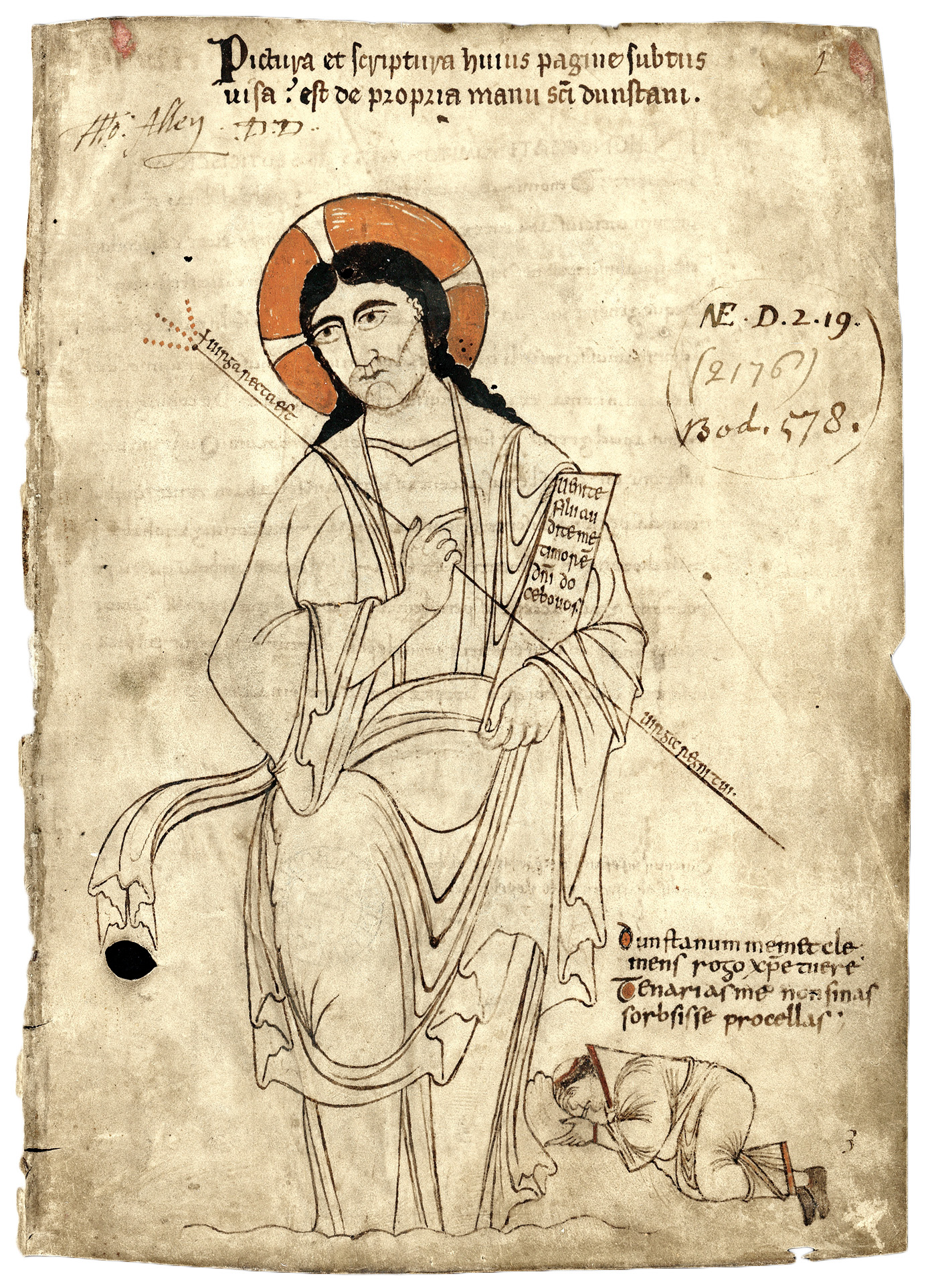
Here’s the final stop on our tour: this icon of Dunstan, Archbishop, Monk, and Saint.  What do you see in this picture?… Do you think it’s like the other icons here, or different? …

Artists have made icons of St. Dunstan that look more like these other icons. But a few years ago when I was looking for one, I found this picture instead.

It’s from something called the Glastonbury Classbook, a book from Dunstan’s time – actually sometimes called the Classbook of St. Dunstan. It contained sermons, prayers, and other religious texts, and a few drawings – including this one, which may be a self-portrait by Dunstan. He might have drawn this picture himself – not this one, but the one that this is a photograph of.

Do you see the tiny words over the monk? They say, in Latin, “I ask, merciful Christ, that you protect me, Dunstan; do not permit great storms to swallow me up.”

The Bodleian Library, who holds the Glastonbury Classbook, makes high-quality images of its pages available, so I had this made for us, to be our image of blessed Dunstan. These other pictures put the saint at the center. But in his picture of himself, Dunstan put Jesus at the center.

God, thank you for Dunstan’s life of faithful and loving service to you and your son Jesus Christ. As we remember your saints, help us to be one too!


Sermon, May 14

Our guest preacher, Hal Edmonson, is a native of Madison and an M.Div. student at Harvard Divinity School. His sermon is entitled, “Seeing and Believing, or, Why Jesus is Like a Moonwalking Bear.”

It was about an hour into the protest when I first saw Jesus. I was standing on the steps of Trinity Episcopal Church in Boston on a January morning. Twenty-thousand or so people crowded into Copley Square, demonstrating against the order banning citizens of six predominantly-Muslim countries, and effectively ending refugee resettlement in this country. The rage was palpable. The signs were witty, maybe, but the knuckles that held them were white hot with fury. And there, held aloft by someone a few feet ahead of me, I never found out who, was Christ. An icon, The Christ of Maryknoll. Jesus is there, on the other side of a barbed-wire fence. His mouth is hidden behind the wires, leaving only his eyes truly visible; His hands rest on the tangle of metal, and though the steel talons have left stigmata of their own, his fingers yet curl their way around them—not a spasm of agony, but an embrace; a sign, almost, of blessing. Providentially, perhaps, in the crowd that left almost no room to breathe, Christ stayed in front of me; when speakers thundered their denunciation, when chants got into some very not-safe-for-church language, and when the crowd tried to make space in the middle of those twenty-thousand for some of the Muslim organizers to pray, there He was, staring at me. Wondering.

He hasn’t stopped. It’s an image I can’t seem to shake. He’s there, floating into my field of vision whenever I’m watching the news, in prayer, in reading, even on my long runs along the Charles River. Which, for me, is really rather strange. I’m in seminary and not art school for a reason: I like words. A lot. I encounter God in the syntax of things, and trust the power of the word to wind its way down in to the dusty corners of the human heart, dwelling there until it is needed most. But I’m not an image guy —I still have nightmares about a particular Art History final in Junior Year of college.

Don’t get me wrong, I find art beautiful. But images don’t stick with me the same way that a line of poetry does. There is always something intolerably ambiguous about images. They lack clarity, for there are always details that I miss. Take this icon, for instance: you can’t see Jesus’ mouth. There’s so much there that could change the whole picture. Or, what do I make of those eyes? Are they convicting? Pitying? Crying out for help? Uttering words of comfort? There is too much uncertainty, defying my desire to pick apart the motivation until I decode it all. That, I think, is why this particular image has been haunting me: I want certainty. And it won’t give it to me.

Our readings for today, and the Gospel in particular, are among the most often quoted in the New Testament—and if we can be real for a moment, also probably among the ones that make we Episcopalians most uncomfortable—because these passages, too, seem to be all about certainty. “I am the Way, the Truth, and the Life,” Jesus says. “None come to the Father but by me.” These are the words that launched a thousand missionary ships, used as the proof that salvation is beyond the hands of those who don’t see their place in the universe quite the same way. And what, for good or for ill, has come to define faith for many, many Christians—including, in the past or right now, probably a good number of us in this room: Belief, pure certainty, to the point that—like Stephen—we’d able to suffer and endure death on the strength of our conviction alone.

But the image of Christ in that icon has me wondering what it is that Jesus is really asking the disciples for, here. Remember that there weren’t really “Christians” yet. What we now consider to be truths, the distillation of them that we recite in the Nicene Creed, nobody had bothered to put together. Notice that Jesus doesn’t say what to believe in, as far as intellectual concepts. He’s a lot more cryptic. He says, “Believe in ME.” He doesn’t tell them the way, he says “I am the way.” I. Me. Myself. Jesus isn’t talking about all the theology and creeds that would eventually come to represent those things, or the scriptures that would tell about him. ’I’ doesn’t mean just what I do, or what I say, or what is accomplished on a cross, or in a tomb. It’s an all-of-the-above-and-then-some sort of situation. When Jesus says ‘I’, he means, well, that. He resists a reduction to some essence that is easier to digest. All of it, all of it, together, matters. Being the Incarnate Word of God is to defy simplification. Just as each of us have a core to our being that defies our worst moments, our most thoughtless words, and our greatest accomplishments, Jesus isn’t going to let himself be easily defined. Incarnation is to take on all the complexity, ambiguity, and irreducible beauty of humanity. To take any of that away is to take away the gift of incarnation itself. He is the way, accomplishing by the mere fact of his being a relationship between humanity and God that is inseparable. Following instructions isn’t quite enough. People are complicated, you see, even if you are, quite literally, God.

Which is a bummer, for the disciples, because they really want simple instructions. Thomas is hung up on this whole ‘way’ thing, and a number of commentators on the Greek point out that he’s confused by Jesus’ words—he’s picturing an actual road, going to a physical place, and probably thinking that if he’d had Google Maps, he could have skipped the whole following-Jesus-around-a-desert-thing. Phillip, meanwhile, wants Jesus to show him the Father, like, now, and that would satisfy him.

But instead, Jesus says you already have these things, in me—together in my words, in my works, and in the work of death and resurrection that is yet to come. None of them make sense without the others. They’ve missed the desert for the sand. What Jesus wants from them, in the end, isn’t their obedience, or their intellectual assent (though there are times when Jesus might have taken those too!). It’s their sight. It’s their willingness to see, look at the image right in front of them—the only image that can convey the fullness of Incarnation, to see what God’s mercy has wrought upon the earth, and the vision of the Kingdom that is coming, and is already here. Seeing, at least this time, is believing.

The trouble is, believing isn’t always seeing. There are these psychology test videos, maybe you’ve seen them, where there are two teams of people passing a ball back and forth, and you’re asked to count how many passes are completed. After about thirty seconds, the video freezes, and the narrator asks you how many passes were made, and then shows the correct answer. Then, she asks whether you noticed the moonwalking bear. And then you go back, and watch it slowly, and sure enough, there’s someone in a bear suit grooving their way across the floor. Our brains can only take in so much information, so we prioritize what to look for; we get the information we think we need, and filter out the rest. We’ve “succeeded” in the task before us, maybe, but if we failed to notice a moonwalking bear, what did we really see? It’s kind of the same with trying to believe in Jesus now. The world, same as it ever was, is overflowing with injustice. The demands on us to feed, to shelter, and to console are great. And it’s oh-so-easy to pray for just the things we think we need to do them, or to read the parts of scripture that seem to touch on them perfectly, that assure us we’re right, and doing our part, and so on. We’re much like the disciples, in that respect: we want the most efficient route possible. We want to know that we’ve done all we could, and followed our instructions.

But we miss things. We always do. We miss how easily, for instance, Christ-like compassion can slide into only showing compassion to those who are most Christ- like. We can miss the moments of weakness, and pain, and grief. We can get so caught up in the work of the world that it starts to become an idol in its own right. We can forget that we are called to a Christian life not on account of our own righteousness, but because we, too, are entangled with sin, and dependent upon God’s mercy.

That’s what happened to me, standing in that crowd in Copley Square, seething with anger and grief at the thought of families days away from being able to leave refugee camps only to be thrust back into limbo. I wanted to hold people accountable, to defeat them, to humiliate them with caustic poster-board signs. And there was this face of Christ staring back at me—not egging me on, just watching. Vanquish all your enemies, His eyes said; there will be new ones. Right all the wrongs; they won’t stay that way. Fortify your convictions as much as you want; God has a way of eluding your logic. I am the Way. I am the truth. I am the life.

It’s much easier to hate error than it is to love that truth. (I paraphrase here one of my favorite quotes from Michael Oakshotte, from his essay “Introduction to Leviathan”.)  Error is a lot more comprehensible, at least. But it matters that we keep this vision of our truth, of the whole person of Christ before us. Icons, obviously, are something I’ve gained a little appreciation for over the past couple of months, and I recommend you try praying with one if you never have. There are things to be learned from crucifixes, out of fashion though they are these days, or from paintings, or books that have been written imagining the bodies that Christ might have called His own. Precisely how one does this matters a lot less than that we keep looking, keep one eye on the image whenever we get caught up in words. It’s a discipline, you see. It takes practice. But one, I believe, that keeps us grounded. There will always be more work, more injustice, more pain. And in the moments of inevitable discouragement, when the certainty of prevailing is long gone, maybe what sustains isn’t inspiring words of scripture, or prayer, or self-care, but simply the image of the Word: the human form of Christ— limited, and frail, and broken, and because it is all these things, the reminder that God has already entered, irrevocably and fully, into our lives, is with us still, and that our salvation will not be on our own terms. Precisely the thing that frustrates me about images is their power: they keep teaching, keep drawing you out of yourself, inviting you to notice things that you never did before. Remember, in the work ahead, that in Christ, flesh is word, and word is flesh. Remember that image, even when it is unclear. Keep looking. You never know what you might have missed.

Sermon, May 7

Who’s heard of Napoleon? The French general? What if I told you that Napoleon was actually… taller than average? This week I read a thought-provoking cartoon written by artist Matthew Inman, for his site The Oatmeal. Matthew uses goofy images to share some of what cognitive scientists have learned about how people respond to new information. It turns out that the response depends on the information – specifically, whether the information challenges an existing idea that’s important to us, that feels central to our worldview. He offers some examples like the one about Napoleon that are pretty easy to take on board. We just think, “Huh. Okay.”

And then he offers a few examples that he suspects some of his readers will find more challenging or unsettling. Like, Jesus Christ was not born on December 25th. The Pledge of Allegiance was written by a socialist. Neither of those gave me much pause, but your mileage may vary. Or take a piece I read recently that revealed that Margaret Atwood, the author of the famous feminist dystopian novel The Handmaid’s Tale, once spoke up to support a fellow writer who’d been fired from his university job for harassing female students. There’s more friction, more discomfort, in taking in facts like these.

We are not equally open to new ideas. Some are just interesting new information that maybe changes our thinking or outlook a little, but is easy to integrate. Some new ideas stretch us, make us re-examine our assumptions. It might take some inner heavy lifting to take them on board. And some new ideas are so challenging that we shut down entirely. We lock up our minds. We build a wall. It doesn’t matter how persuasive the evidence is – whether that’s evidence in the form of data and facts, or the evidence of someone else’s life experience that casts a new light on our world and our thinking. In fact when something really challenges our deep-seated beliefs, more evidence may actually make us shut down even MORE, in a phenomenon called the backfire effect.

When we encounter a new idea that really shakes up our fundamental understandings, our brains respond the same way we would respond to a physical threat. Which is not by getting more flexible or thoughtful, but by flooding our systems with adrenaline, in preparation to FIGHT off the threat – or run away! In those moments, people get confused. Conflicted. Angry. Kind of like the Pharisees in the 9th and 10th chapters of the gospel of John.

Today’s Gospel is one of the times when we really need to know what came before it. If you start at chapter 10, verse 1, it’s easy to take this as just a theological speech, with no particular context or audience. But in fact the context and the audience are really important – and you know about them, if you were here on March 26. Because we had the 9th chapter of John, that Sunday, and we acted it out, just to make sure you’d remember it! There was a young man who was born blind – his eyes didn’t work. And then Jesus came along, and healed him! And that’s when the trouble began.

The leaders in his church, his synagogue, were confused and upset. This kind of healing is so unusual that it’s clearly a miracle. But does that mean that Jesus is using God’s power? Or is he using the Devil’s power instead, or dark magic? And if he is using God’s power – what does that mean? Because we have heard about this guy Jesus, and a lot of what he teaches is different from the way we understand the faith of our God and our ancestors! And if Jesus DOES have some uniquely close relationship with God, then what does that mean for the monotheism that is the non-negotiable heart of Judaism – there is only, always, ever, ONE God!…

The fact of Jesus’ healing of this young man is new information that is way at the fight or flight end of the spectrum for these Pharisees. Matthew Inman says, There’s no magic trick to get around these moment. All you can do is understand how it works, and when you notice it happening inside yourself, ride out that stress reaction and THEN give the new information a serious look and assess whether and how it should change your thinking. He concludes, “I’m not here to… tell you what to believe. I’m just here to tell you that it’s okay to stop. To listen. To change.” And that is exactly where today’s gospel starts: with Jesus trying to talk the Pharisees down a little bit. To get them to listen. Reflect. Wonder. Change.

We get this Gospel lesson today because at some point the Church named the fourth Sunday of Easter as Good Shepherd Sunday. Every year we have one of the passages where Jesus uses this image of himself as the Shepherd (or in this case, the Gate). And preachers usually preach on the image, the metaphor, and probably I will too, next time around. But once I realized that this is the end of that other story, I got more interested in the context and purpose of the conversation than its content.

This passage, Jesus’ extended metaphor of himself as the Good Shepherd, is the moment in the story of the healing of the blind man when Jesus and the Pharisees finally talk to each other. Before that, there was a lot of talking ABOUT Jesus, who he was and what to do about him. Some of them were saying, This man is not from God, for he performed this act of healing on the Sabbath, when God’s people are commanded to rest. Others were saying, How can a sinner perform such miracles? The Pharisees, this group of local religious leaders and scholars, were divided among themselves – and likely conflicted within themselves. And as the story moves along, their anxiety ratchets up, until they become pretty shrill and angry and panicky. (I have been in that mental space, 100%. Anybody else?) They cast out the Man Born Blind – and Jesus comes back around to affirm that young man in his stubborn faith in the One who gave him sight. And he offers one of his paradoxical pronouncements: “I came into this world to bring sight to those who do not see, and blindness to those who do see.” Some of the Pharisees are hanging around – and they say, “Wait. We’re not blind…?” They’re curious about Jesus, interested enough that they care what he thinks and what he has to say, even though he also upsets and challenges them.

Jesus says, “If you were really blind” – remember, folks, we’re talking about *figuratively* blind – “If you were really blind, nobody could blame you for your failures. But since you think you can see, you are culpable.” And then he starts talking about sheep. And gates. And bandits. And stuff. Reading this passage in light of chapter 9, and noticing the cues about the interaction between Jesus and the Pharisees, has really changed how I imagine the tone of this speech. A lot of sources assume that the “thieves and bandits” are an allusion to the Pharisees themselves, and that Jesus is attacking their leadership here, slamming them. But I think he’s actually trying to reassure them.

Here’s what I think he’s saying: “You have been fierce and valiant defenders of our faith. There have been thieves and bandits, over the centuries, who have tried to change or distort or destroy the faith of our God and our ancestors. There have been false prophets and false messiahs – so many. But I’m not one of them. I am the real thing. And you can know that by the evidence of your own eyes: because you saw how I tended one of my sheep, that young man whose eyes didn’t work, and how he responded to me, following my voice like a sheep who knows its shepherd. Those false prophets did what they did for their own gain, or to sow destruction and death. But God the Gatekeeper sent me here to give life to the sheep – abundant life.”

I think Jesus is trying to win them over, or at least to help them understand. And they don’t react like people who feel attacked. They react like people who are still trying to make sense of a big, hard, challenging new idea. That verse isn’t in today’s lesson but here’s how the scene ends: “Again they were divided because of these words. Many were saying, ‘He has a demon and is out of his mind!’ But others were saying, ‘These are not the words of one who has a demon….’”

Divided. Conflicted. Challenged, but fascinated. Struggling to make sense of an unfamiliar truth. I feel for them. I have absolutely been there. It’s a difficult space, that space between the old and the new ways of thinking. A hard space – but also a holy one. This is why Turning is one of the practices of discipleship that we name and affirm here at St. Dunstan’s: We follow the teaching of Jesus Christ by being open to repentance, transformation, and call. This is why “Seek opportunities to learn, turn, and amend” is on the personal Rule of Life I read to myself every morning. Because one of the most important things that makes the Church not just an especially peculiar and anachronistic social club is our conviction that God isn’t done with us yet. That we don’t have it all figured out on our own. That in the words of one of our hymns, the Lord has yet more light and truth to break forth from his Word. That there is deeper and farther to go into the mysteries of God and of our fellow human beings. Knowing that Turning is part of the life of faith is our way of telling ourselves and each other that it’s okay to stop. To listen. To change. Sometimes a new idea or perspective or truth will confuse us and unsettle us, even make us angry; but bit by bit, if we are faithful to the work, listening and wondering and attending to what God is showing us, will transform us into the image of Christ, in whom there is no falsity, and no fear.

In a moment we’ll perform the sacrament of baptism, one of our holiest rites, one of my greatest privileges. In this sacrament we are baptized into certainty: into belonging to a faithful God, marked as Christ’s own forever; into having a loving family of faith that will always welcome and support, no questions asked. But friends, we are also baptized into uncertainty. Into curiosity. Into growth, into change. Into seeking, wondering, repenting, turning. Baptized into life in God who is not done with us yet.

Matthew Inman’s comic may be read here. Language warning! 

Rev. Miranda Reflects on a Week Away

IMG_4646May 4, 2017
Dear friends,
I’m writing, first and foremost, to thank you for being so supportive of my post-Easter trip. It was great to feel that you were encouraging me in this opportunity to spend a little time away, and that there were many able and willing folks who would keep church running smoothly in my absence.
Thanks to a small grant from our diocese (and to my parents’ kindness in staying with our kids!), Phil and I spent a week at Penland School of Crafts, in the mountains of western North Carolina. Phil took a class on paper-cutting, and I took a pottery class. It was wonderful – demanding, refreshing, fun. Spending a week making messy, colorful art in a warm, friendly environment was probably more renewing than any clergy retreat could be!
Penland is just as wonderful as I always imagined it would be. Check out its website to learn more about the place and what happens there.  As we drove (sadly) down the mountain the final day, I found that I had some observations and thoughts to carry home. I think I noticed these things about Penland because they reminded me a little of St. Dunstan’s… but experiencing them at Penland made me think about them in a new way, and wonder whether we could live into them more fully. I’m sharing these thoughts with you (along with a few photos) as a sort of “What I Did On Vacation” report!
 IMG_4415
1. Hospitality in a porous community. 

I was a little bit worried about being a first-timer at Penland, and a relative beginner at my craft. In fact, it was very easy to be there, to learn, connect, find what we needed, and have fun. Penland’s hospitality isn’t the structured kind, of the sign-the-book-and-we’ll-show-you-around variety – perhaps because that kind of hospitality works best when there’s a fairly defined outsider/insider line, and that line doesn’t seem to be in Penland’s mindset. Instead there was a general culture or ethos of expecting newcomers. People – teachers, students, and staff, though there too the lines are fine and flexible – might be there for years, or months, or days, but everyone is there for love of the craft and the place, and it seemed like everyone loved to share about what they do. The big chalkboard in the dining hall outlining each day’s opportunities helped, and so did the maps, but what helped most was just the sense of a community that understands itself to be porous, to have fuzzy edges, and a general readiness to smile at someone and say, “Hey, we’re about to unload the wood-fired kiln, want to come watch?”

I wonder what that could look like in a church?

2. Collaboration and cross-fertilization.
Classes at Penland are taught by visiting artists who may be there for 18 months, 8 weeks, or just a week or so. The artists teaching and assisting during our session did slideshows during the week about their work, and I noticed that they consistently talked about their influences – artists or artistic traditions that had inspired them and shaped their work. And I also noticed experiments in collaboration among the artists at Penland – two potters decorating a mug together; someone in the print studio creating a poster for an event in the metal shop. There was no sense of “turf” or trespass, but rather a wonderful sense of curiosity and possibility. What someone else is doing – even in a totally different area or medium – could connect with what you’re doing to make something remarkable, or give you an idea that could take your work in a new direction.

I wonder what that could look like in a church?

IMG_48053. Place, community practice, and inner life as a united whole. 

While we were at Penland, my mother posted this quotation on Facebook:

“… I found myself thinking in new ways about monastic life as a whole, about how spiritual thought and practice are shaped by landscape and how the experience and perception of living in a place can be deepened through spiritual practice… the ancient Christian contemplative idea of weaving the inner and outer worlds into an integrated vision of the whole had the potential to offer something important to us in the contemporary moment.” – Douglas Christie, The Blue Sapphire of the Mind

Penland seems to have achieved a high degree of integration of sense of place and landscape, of community practice, and of inner life. The inner life is your focus on creativity and craft, your own engagement with matters of skill, beauty, and meaning; the community life is the rhythms of work, mealtime, and fellowship; and then there’s the loveliness of a green valley on a Blue Ridge mountainside. All work together to form a whole that is encompassing, effective, and gracious.

I wonder what that could look like in a church?

Thank you again, friends! And if any of my musings have sparked thoughts for you and you’d like to chat… let me know!

In gratitude and with affection,

Miranda+

Sermon, April 23

The Rev. Thomas McAlpine preached on Sunday, April 23. The lessons are here. 

Alleluia. Christ is risen. The Lord is risen indeed. Alleluia.

Today’s Gospel sets before us a rich feast; here we’ll only be able to sample a little of it.

The first thing we might notice is that the Evangelist describes a scene that’s heavy with fear. The doors are locked “for fear of the Jews.” Fear permeated all of what we call Holy Week: the Jewish leadership fearful of things getting out of hand, Pilate fearful of how it will look if he lets Jesus go, the disciples fleeing in fear at Jesus’ arrest…

And this lethal stew of fears is one of our obvious connections with the text. Today there is plenty to be afraid of, and plenty more that various voices are trying to make us afraid of. But in contrast to the emcee in Cabaret, the Church’s invitation is not to leave the troubles and fears outside, but to bring them in—and see what Jesus might do with them.

And in the Gospel Jesus appears. Not a ghost or a resuscitated carcass, his body is…unique. He eats, invites his friends to touch him, goes through locked doors, and often isn’t recognized at first glance. N. T. Wright makes the intriguing suggestion that this body isn’t less physical but more. Jesus walks through locked doors with the same naturalness that we walk through the mists.

There are hints in this first encounter of a new creation: he breathed on them and said to them, “Receive the Holy Spirit…” As in creation God breathed into our nostrils the breath of life, so here Jesus breaths the beginning of a new creation.

New creation: In the world that Scripture portrays there are two Big Bangs. The first at the beginning of creation: “Let there be light.” The second: that Easter morning.

But it doesn’t stop with new creation. Here’s where it’s important to let each Gospel writer tell their own story. Our Church Year follows Luke’s chronology: the Holy Spirit’s given on Pentecost, 50 days after Easter, & at that point the disciples engage in mission. In John’s chronology, it’s Easter that morning and Pentecost that evening. This Jesus wastes no time: “As the Father has sent me, so I send you.”

By the end of that encounter it looks like Jesus has done pretty much all he needs to do, and there’s no reason to think that he’ll show up again. And this creates a problem, because Thomas, one of the Twelve, was absent, and unwilling to accept the others’ testimony: “Unless I see the mark of the nails in his hands, and put my finger in the mark of the nails and my hand in his side, I will not believe.”

So there’s a whole week in which the other disciples are all “Alleluia” and Thomas is holding out for some evidence. And no one has reason to think that this difference is going to be resolved anytime soon.

So it looks to me as though there are two sorts of miracles in today’s Gospel: Jesus’ appearances and the Twelve still being together at the end of that week. It would have been so easy for Thomas to have been excluded. In the midst of that lethal stew of fears it would have been even easier. And everyone would have been the poorer: Thomas, not encountering the risen Jesus, the others not learning from Thomas’ striking confession “My Lord and my God!”

So here’s our other obvious connection with the text, for pretty much in every age there are issues that threaten to divide Christians. We all—in Paul’s language—“see through a glass, darkly,” and nevertheless find it quite easy to communicate—usually nonverbally—if you think or feel that you don’t belong here. The fears in our environment make that even easier.

Well—it’s hard to think of an issue more basic than whether Jesus is alive or still in the tomb. Yet there Thomas is with the other disciples at the end of the week.

I wish the Evangelist had spelled out how that happened. But I think the Evangelist has given us some clues. Here are three; you may see others.

·         Just a few days ago Jesus had washed the disciples’ feet and said “So if I, your Lord and Teacher, have washed your feet, you also ought to wash one another’s feet.” My sister’s or brother’s feet matter more than my dignity, my perceptions. So perhaps that had something to do with the disciples’ being together at the end of the week.

·         Later Jesus had said “Just as I have loved you, you also should love one another.” Love is easy and natural when we’re in agreement on the important stuff… So perhaps the disciples actually heard some of what Jesus was saying and so stayed together.

·         And later Jesus had said “You did not choose me but I chose you.” The disciples aren’t together because they chose to be together but because what they have in common is that Jesus chose them. (What if that’s true today? Take a look around the sanctuary. What if we’re together because the fundamental thing we have in common is that Jesus chose us?) So, perhaps they’re still together at the end of the week because it’s sunk in that being together is not a matter of their choice.

Whatever the combination of reasons, a week later they’re together, and Jesus again appears. Jesus gives Thomas what he needs; Thomas’ confession is a gift to that and subsequent generations.

One of the questions these stories of Jesus’ post-resurrection appearances deal with is how Jesus may be encountered by the readers, by us. So Luke’s story of the road to Emmaus presents a sort of mini-Eucharist, with Jesus explaining the Word, and then breaking bread at the Table. Word and Table. So John here suggests that encountering the risen Jesus has something to do with staying together—Thomas and all.

One final thing to notice: that last verse in our reading. It uses the plural, and so the KJV: “that ye might believe that Jesus is the Christ, the Son of God; and that believing ye might have life through his name.” And the story we’ve just heard may suggest what believing together might mean in the midst of disagreements: washing each other’s feet, loving each other, recognizing that we are together because what we finally have in common is that Jesus has called us.

Palm Sunday homily

The Church holds up this story as uniquely important. This death, and what follows, are our core story, The Story. But its power, its uniqueness, comes from who Jesus was, from his first followers’ experience of God present in Jesus in a way unlike any other person in history. That as the author of the letter to the Philippians says, in Jesus, God set aside infinity to join us in mortality.

The death itself – and the events that lead up to it – were far from unique. Indeed, there’s much in this story that’s too familiar. There are no monsters in this story. Only ordinary people, driven by ordinary motives, ordinary fears, ordinary resentments.

Start with the leaders. Leaders bear a special responsibility for what happens on their watch. So surely we can point fingers at the leaders in this story, and say, There. There are the monsters. The chief priests, the scribes, the elders – they are the institutional and moral leadership of first-century Judaism. They are the leaders and teachers of the faith. They knew it was wrong to kill an innocent man; how did they let this happen? Well – Jesus was not actually innocent. I know there’s a lot of talk about Jesus as an innocent victim, but he’d basically done the stuff they said he did. Stirred up the people. Spoken dismissively about Sabbath-keeping and other practices. Busted stuff up in the Temple. And worst of all, blasphemed, by claiming a uniquely close relationship with God – a fundamental challenge to the core of Jewish faith, that there is only one God. They’re genuinely afraid that Jesus is sparking a popular movement that will dilute or even destroy the faith they’ve sustained for so many centuries. And these religious leaders weren’t only responsible for the faith, but also for the wellbeing of the people. They are legitimately afraid that the unrest swirling around Jesus will turn into a rebellion that will inevitably lead to a violent crackdown by the forces of Rome, the great empire occupying and ruling Judea. The high priest Caiaphas says, It’s better for one man to die than to have the whole nation destroyed. He’s not wrong – although that doesn’t make it right.

What about Pilate, the Roman governor of the province? There’s some scholarly speculation that Pilate must have been out of favor in Rome to have been sent to Judea, a miserable, impoverished backwater full of religious zealots. Why would a governor representing the greatest empire in the world, backed with all the superior military force of Rome, bend in the face of a scrappy crowd of Judeans? Because he feared a riot – that his soldiers would have to put down, violently, which might spark other riots, and would definitely mean having to write some awkward letters to Rome. Pilate is a man with great power, true, but he’s also part of a system, and others have power over him. Pilate’s interest is in stability and peace, even if it’s an unjust peace, a cruel peace. Can we call him a monster?

What about the soldiers and officers? There are two different groups in this narrative. First, there’s the armed group that comes to arrest Jesus, probably a mix of Temple guards and some irregulars. Jesus shows a kind of wry compassion for them – they are, after all, his people. It’s the Roman soldiers later, the soldiers of the governor, who are truly cruel, hurting and mocking Jesus. And yet as much as we’d like to find monsters there – there are seventy years of social science research, sparked by the desire to understand the Holocaust, that has shown again and again and again that it is all too easy to get a group of human beings to start thinking of another group of human beings as less than human. We hate each other so easily. To call these Roman soldiers monsters is to deny our innate capacity to dehumanize and destroy.

What about the bystanders, the crowds in the story? One minute they’re so excited to see Jesus, shouting Hosanna! and waving palms; the next minute they’re shouting that he should be crucified! Well – those events were actually several days apart, and they weren’t the same crowd, even though in our liturgy today we treat them as if they were, as we take on their voices. The crowd greeting Jesus at the city gate was full of those who had heard about this man and hoped he would bring about a new era of freedom and prosperity. The crowd before Pilate was probably the kind of crowd that gathers for executions and bloody accidents. But let’s be honest: I’m sure there were many people who were part of both crowds. Because it’s not that hard for us to turn on someone, especially someone who disappoints us. Who turns out not to be the savior we’d hoped for. We see that dynamic most clearly in Judas, whom I can’t help but pity. He wanted change – big, immediate, transformative change. And when Jesus’ agenda turned out to be slower and subtler, he turned against him – and then turned again, and was overcome by deadly remorse.

And then there are the disciples, Jesus’ friends and followers. If it were only up to me, this is the voice I’d have us read together in the story. It’s tradition in many Episcopal churches for the congregation to be the voice of the crowd that shouts out, “Crucify him!” And that’s important to some of you, so I have left that custom be; but if I were to locate contemporary Episcopalians in this story, it would be as the disciples. The disciples, who follow him – but only so far. Who believe in him – but often really don’t understand him. Who love him, truly – but not as much as he needs them to. Who are right there with him, ready for action, while they’re all seated around the table together, with a good meal and a glass of wine inside them, but when it comes to taking to the streets – well, a lot of us have to think twice. We have jobs and families and reputations to protect. This discipleship thing can get to be more than we anticipated, real quick.

There are no monsters in this story. And yet the story reminds us, every year, how quickly and easily resentment and reluctance, complacency and fear, can make us part of something monstrous.

Sermon, April 2

“I am the resurrection and the life. Those who believe in me, even though they die, will live, and everyone who lives and believes in me will never die. Do you believe this?”

Our Sunday readings are walking us towards the cross. In John’s Gospel, the raising of Lazarus from the dead stirs up the people of Bethany and nearby Jerusalem – more and more begin to believe in and follow Jesus, and the religious leaders, who think Jesus is at best a fraud and at worst a tool of the Devil,  and who are legitimately afraid that unrest among the people will bring a violent crackdown from the occupying Roman forces – the religious leaders decide that it would be a good idea if something were to happen to Jesus. The Palm Sunday Gospel, Jesus’ triumphal and confrontational march into the city, follows this story almost immediately.

Our Sunday readings are walking us towards the cross, and beyond that, towards Easter, and resurrection – the Church’s 50-cent word for rising again from the dead. Two weeks from today, we’ll be shouting, Christ is Risen! We’ll be singing about how Jesus trampled down death by death, and bestowed life upon those in the tomb. Death no longer has dominion over us! God wipes away all tears! Love wins!

Except… people still die.

So… what are we talking about?

Part of this Gospel is often chosen for funerals. And last week I realized that I often preach at funerals about what the Church teaches – and trusts – about death. I almost never do so on Sunday morning. But everybody here has someone you love on the other side of that river. We all have somebody we miss. We all have somebody we dread losing. We all wonder.

And yet the Church and her representatives, have the audacity to stand up here in our funny clothes and say it doesn’t matter. That it’s not real. That they’re in a better place now. As if that made it OK.

“I am the resurrection and the life. Those who believe in me, even though they die, will live, and everyone who lives and believes in me will never die. Do you believe this?”

Jesus talked a lot about eternal life – a new life in God beyond our earthly existence.  So it became Christian conviction and teaching, from the very beginning, that physical death is not an absolute end, but leads into another kind of life. The resurrection of Jesus at Easter opens the door to the resurrection of everybody.

But what does Jesus mean, when he talks about eternal life? When he tells his friends and followers that even though they die, they will live? When he promises that his beloved ones will not perish, but have life everlasting?

I think part of the struggle here is that we come to Jesus with a simple, human question: What happens after we die? And frankly Jesus is not very interested in that question. He’s human enough to weep at the death of a friend, in today’s Gospel, but he’s also God enough to know that death is smaller than we think it is. What he really wants us to think about is life, and what it means to be alive – now, and always. But still: we carry the question in our hearts. Where is my grandpa now? Your father? Your sister? Your child? Can they see us? Are they okay? Are they… at all?

The New Testament doesn’t give us a clear or consistent view of what happens to the dead. Jesus tells the thief crucified beside him that they’ll be together in paradise that very day, but other texts assume – as Martha does in today’s Gospel – that the dead will sleep until the Last Day, when they will be awakened to new life forever with God. The images of life beyond the grave are varied, too -from the city thronged with holy crowds in Revelation, to the intimate image of Jesus preparing rooms for his friends in his Father’s house, from the 14th chapter of John’s Gospel. (There is very little to support the popular image of Heaven as a place up in the clouds, where people are issued wings and harps.)

The plain fact is, the early Christians didn’t know what happens after death, and neither do we. There’s a mystery here which only time will resolve. The writer and philosopher Henry David Thoreau, while he was dying, was visited by a friend, who said to him, “You seem so near the brink of the dark river that I almost wonder how the opposite shore may appear to you.” And Thoreau replied simply, “One world at a time.”

But – if we Christians don’t offer freedom from the inevitability and grief of death – if we can’t offer proof that there’s something more, something better, on the other side – then what can the Church offer in the face of death, besides beautiful words?

Well: even though there’s no proof, there is that promise and hope of something more. Jesus seems very sure that death is not the end – though we have no clear picture of what comes after. But we have to be careful with that assurance of eternity – the Church and its people have sometimes used it to shame or shut out people’s real and profound grief. Even if your loved one IS in a better place now, free from pain and struggle, it hurts that they’re gone. If Jesus wept for Lazarus, there is no shame in weeping for our beloved dead.

Another thing the Church offers in the face of death is the consolation of community. I’ve heard from many of you, in conversations over the years, that one of the most substantive gifts of belonging to a church, to this church, has been companionship in the hardest times. Of opening up about something painful –  a broken relationship, a sick child, the death of a parent – and finding that there are three or four people in the room who have walked that road, and are willing to walk it again with you, offering solace, kindness, and help.

Yet another thing the Church offers is the sense of a bigger picture, a longer perspective. In a recent essay on this topic, Peter Wehmer wrote, “There is…, for me at least, consolation in the conviction that we are part of an unfolding drama with a purpose. …I may not have a clue as to what that precise purpose is,

but I believe… that the story has an author, that difficult chapters need not be defining chapters, and that even the broken areas of our lives can be redeemed.” His words remind me of the voice of today’s Psalm, Psalm 130, a voice of resignation, patience, hope: “Out of the depths I cry to you, O God – hear my voice!… I wait for you, O God, my soul waits for you.”

Please understand: I am not claiming, here, that everything happens for a reason, that even tragedy is God’s will for you. I do not believe that, and you’ll never hear me preach it. But I do believe in grace, in God’s patient, persistent work to weave good from evil, to heal, restore, renew. It’s not easy, or fast, or certain; but it’s possible.

What can the Church offer in the face of death, besides beautiful words? Well… actually, beautiful words can be a real gift and comfort. I don’t know if I love beautiful, holy language, prose and poetry, because I’m a lifelong Episcopalian, or if I’m a lifelong Episcopalian because I love beautiful language. But at my grandfather’s funeral two weeks ago, I found myself reflecting on how we address death, as Christians in the Episcopal tradition.

We have sister churches both Catholic and Protestant who handle the mystery of death and what comes after by developing detailed doctrines and theories. We Episcopalians tend instead to let it rest in mystery – but not a mystery we pass over in silence; rather one we dwell with, or perhaps dance with, in poetry and prose, art and song.

And two weeks ago, I found that it was the strength and grace and felt truth of those songs and Scriptures that both freed my tears, and – eventually – dried them. It was the beautiful words we say and sing that opened my heart to trust in the eternal life Jesus promises,  and reaffirmed my hope in a better beyond.

Receive them into the arms of your mercy, into the blessed rest of everlasting peace, and into the glorious company of the saints in light.

All we go down to the dust, yet even at the grave we make our song… 

There’s a gathering of spirits, there’s a festival of friends, and we’ll take up where we left off, when we all meet again. 

And even you, most gentle Death, waiting to hush our final breath – you lead back home the child of God, for Christ our Lord that way hath trod. 

Changed from glory into glory,  till in heaven we take our place, till we cast our crowns before thee, lost in wonder, love and praise.