All posts by Miranda Hassett

Announcements, March 12

THIS WEEKEND… 

Rector’s Discretionary Fund offering, Sunday, March 15: On third Sundays, half the cash in our collection plate, and any designated checks, will go towards the Rector’s Discretionary Fund. This fund is a way to quietly help people with direct financial needs, in the parish and the wider community. Thanks for all your generous support.

Sunday School, Sunday, March 15, 10 am: This week, our 3-6 year old class will continue learning about the Faces of Easter, while our 7-11 year old class will explore Psalm 107.

Members of St. Dunstan’s are welcome to join the Zion City Church congregation in their weekly worship service of thanksgiving and praise on March 15.  The service is from noon to 2:00pm.  Meet at St. Dunstan’s at 11:30am to carpool, or meet at Zion City Church shortly before noon.  They are located at 1317 Applegate Road in Madison.  This is just south of the Beltline, off of Fish Hatchery Road.

Evening Eucharist, Sunday, March 15, 6pm: Join us for a simple service before the week begins. All are welcome.

Explorers, Sunday, March 15, 6:30pm: St. Dunstan’s Explorers will meet for light refreshments and wide-ranging conversation. All are welcome. (I will see if I can get any more definitive information by Thursday)

Young Adult Meet-up at the Vintage, Sunday, March 15, 7pm: The younger adults of St. Dunstan’s are invited to join us for conversation and the beverage of your choice, at the Vintage Brewpub on South Whitney Way. Friends and partners welcome too.

THIS WEEK & BEYOND…

Do you like to feed people? Consider joining our St. Dunstan’s Meals Network, to provide a meal for another household in our congregation. New babies, critically ill family members, surgery, or a death in the family are just a few of the occasions for which people might need extra support and compassion. Sometimes it’s just dropping of food, sometimes it’s also sitting with people and listening to how things are going.  Go to the “Sharing Meals” page under “People” on our main page to join our network or, if you’re already part of it, to pick a date on our current meal calendars.

Vestry Meeting, Wednesday, March 18, 6:45pm: The Vestry is the elected leadership body of our parish. Any members are welcome to attend our meetings, to observe or raise questions or ideas.

The Stations of the Cross, Fridays at noon: Walking and praying the Stations of the Cross is a meaningful practice of prayer for many Christians in the season of Lent. On Fridays you are invited to come and join Rev. Miranda in sharing Scripture, meditations from Christian tradition, and prayer as we walk with Jesus on the journey to the cross.

Outreach Committee Meeting, Saturday, March 21, 8-10:30am: All are welcome to join our conversations about how St. Dunstan’s can best serve the world with our resources and our hands. We begin with an optional potluck breakfast at 8am.

Food Forestry at St. Dunstan’s: Plans for 2015, Saturday, March 21, 1pm: All interested or curious folks are invited to come learn about permaculture, our work adding food plants to our woods and grounds over the past two years, and ideas and plans for this year.

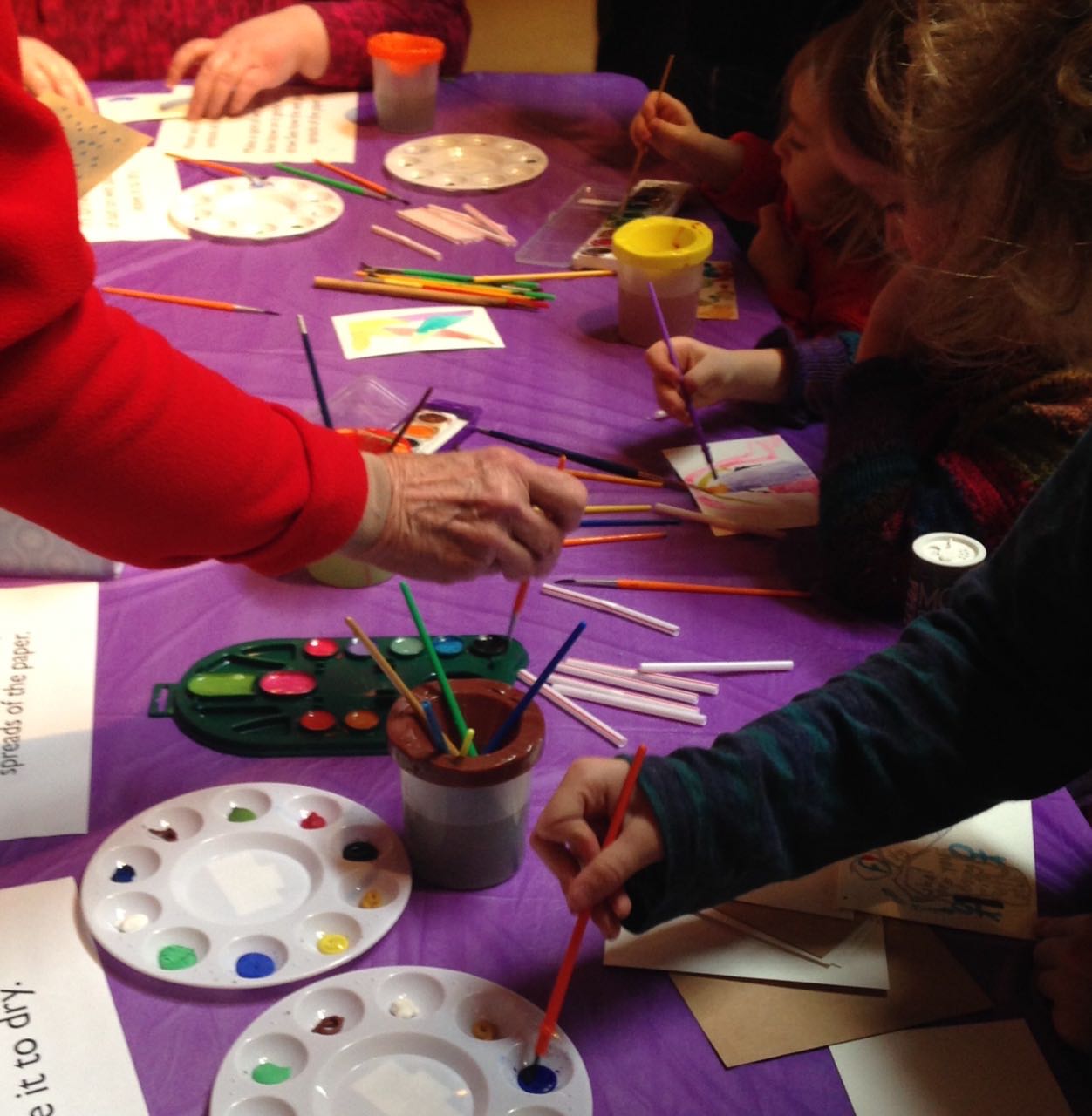
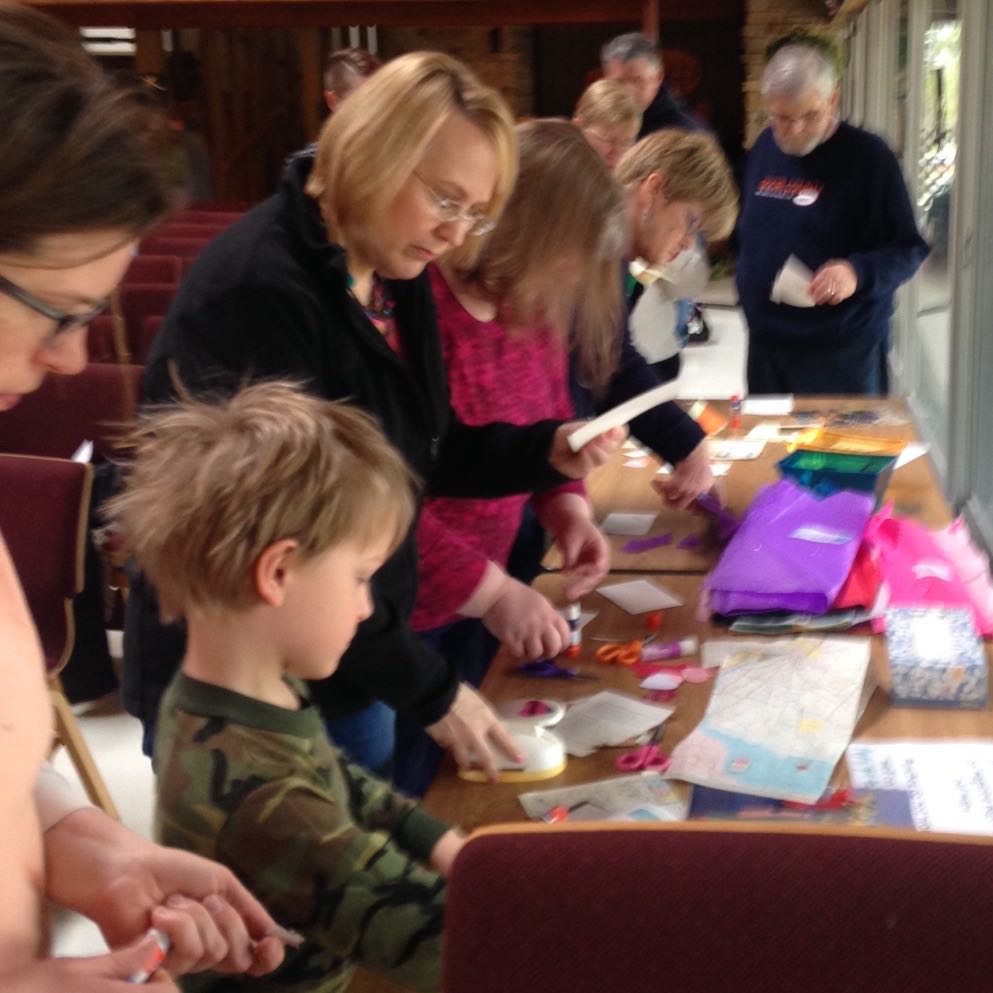
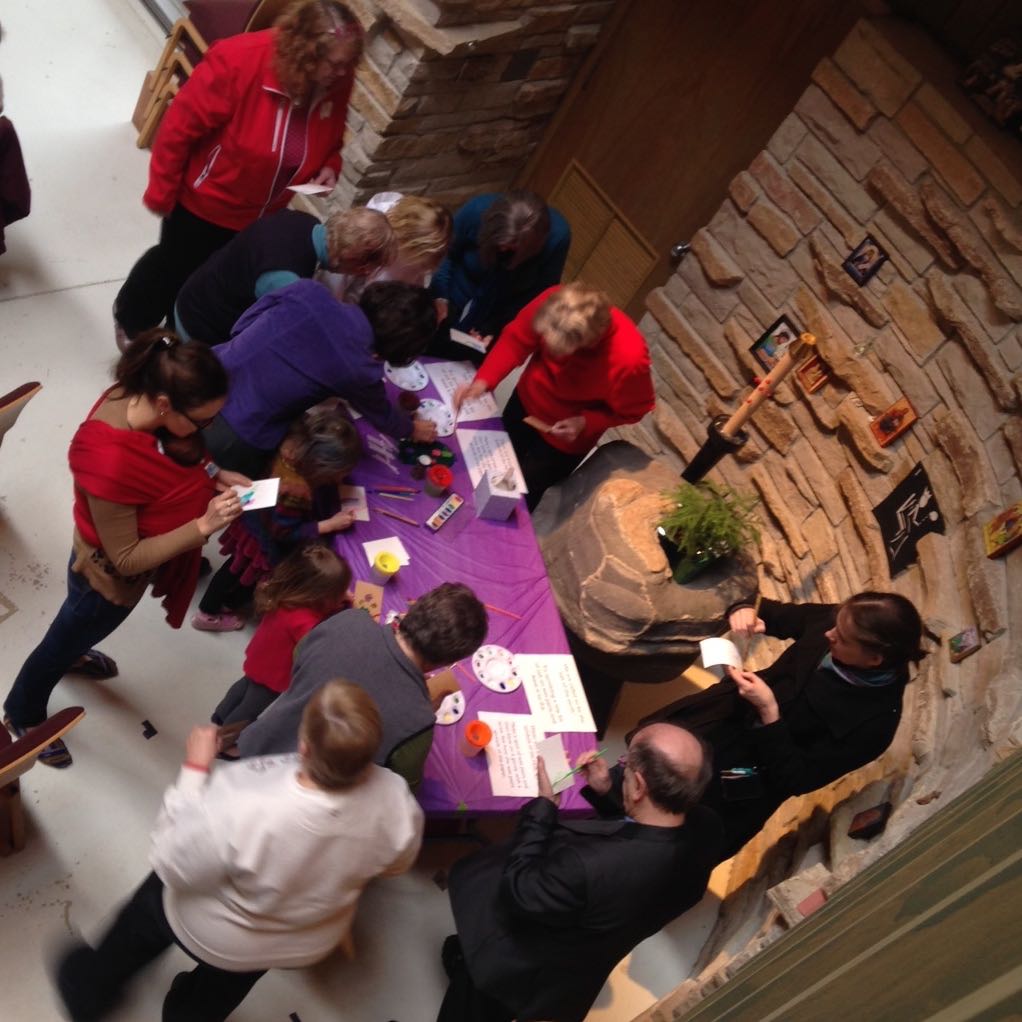
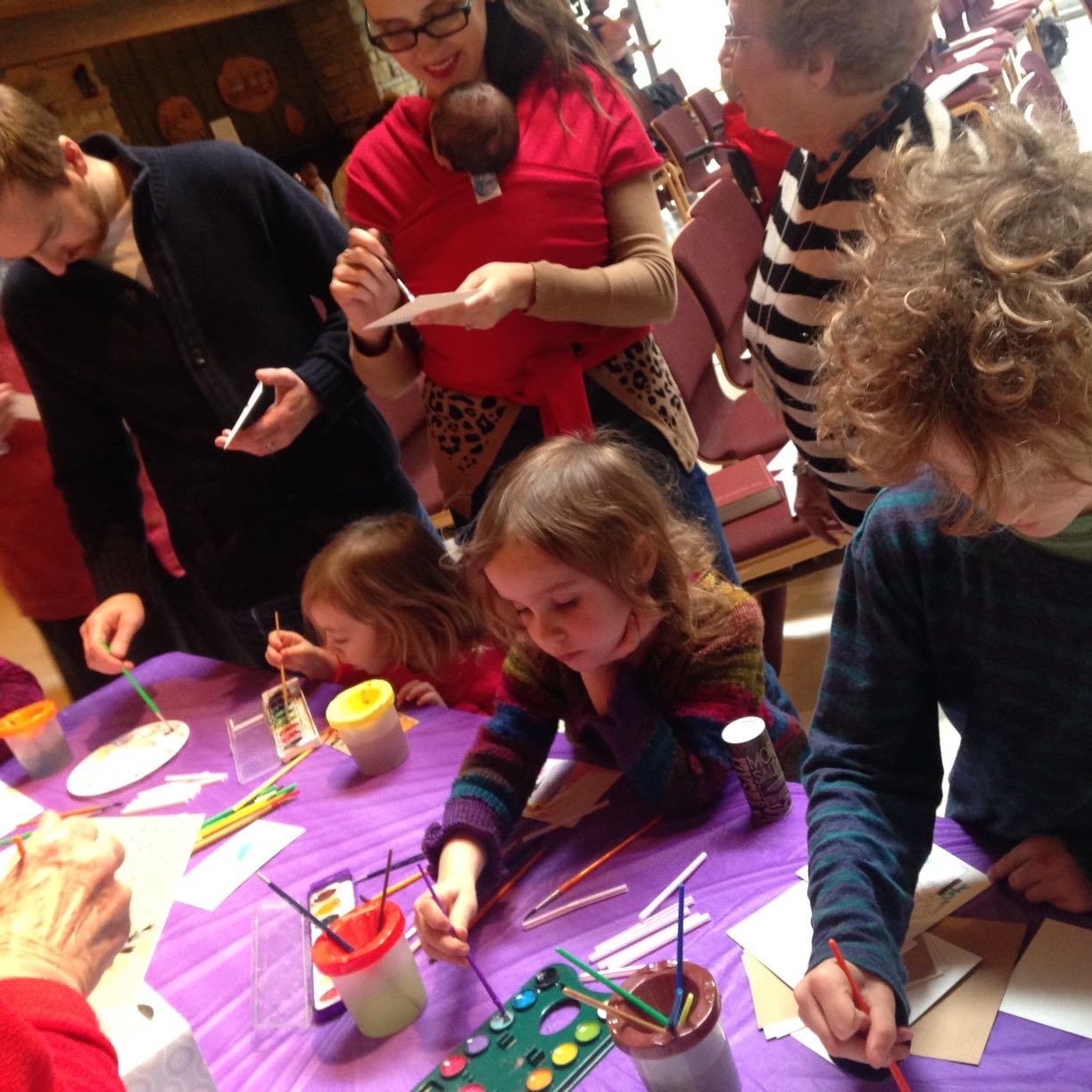
Makers’ Guild, Saturday, March 21, 2 – 4pm: Bring your own current handwork – sewing, knitting, painting, beadwork, whatever! – or help out with preparing sample palm crosses and tucking treats into plastic Easter eggs for our egg hunt on Easter Sunday. All are welcome!

Poetry & Spirituality: John Milton, Sunday, March 22, 9am: Paul Thompson will introduce us to the life and work of the great 17th century English poet, John Milton.

“Last Sunday” Worship, Sunday, March 22, 10am:  Our “Last Sunday” pattern of worship is simplified to help children (and adults new to our way of worship) to participate and understand. This month, our Last Sunday worship will invite us all into the final weeks of Lent as we approach the mystery of Easter. Our 8am worship always follows our usual seasonal order of worship.

Christian Formation Committee Meeting, Sunday, March 22, 11:45am:  Our Christian Formation Committee meets to review and plan programs for Easter, the summer, and beyond. All interested folks are welcome to attend and participate.

 Help Spruce up St. Dunstan’s for Holy Week and Easter! Spring Cleaning inside St. Dunstan’s, Sunday, March 22, 12-2pm:  Please see the list of jobs to complete and sign up to help as you are able.  

Grace Shelter Dinner, Sunday March 22, 7pm: Every fourth Sunday, a loyal group of St. Dunstan’s folk provides dinner for residents at the Grace Church shelter, and breakfast the next morning. See the signup sheet in the gathering area to help out.

The Stations of the Cross in Downtown Madison, Friday, March 27, 12pm & 5pm: Walk the story of Jesus’ journey to the cross on the streets of a modern city.  As we walk the fourteen traditional Stations of the Cross, we will reflect together on how we can trace those events in the geography of Madison today – our issues, stories and struggles. We will start on the sidewalk near the Federal Courthouse, across from the Overture Center, and end in the garden at Grace Church on the square. The total walk will be about 1.2 miles, and it takes about 45 minutes. Come at noon or 5pm, as your schedule permits. All are welcome.

“Palm Saturday”, Saturday, March 28, 10:30am – 12pm: Kids, parents, grandparents and friends are invited to make Easter crafts and communion bread, and to take part in a gentle, age-appropriate and participatory telling of the whole Easter story, presented by the youth and adults of our church. This event is best suited for kids ages 3 to 10. All are welcome!

Spring 2015 Chocolate Making: Our Spring Chocolate Event will be after Easter this year. Mark your calendars for Friday evening and Saturday, April 10 – 11. Signup sheets and order forms will be out by mid-March.

LENTEN OPPORTUNITIES…

Tools for Tanzania Giving Opportunity: St. Dunstan’s seeks to raise $800 for a set of tools to send to our sister diocese, the Diocese of Newala in Southern Tanzania. Rev Miranda visited Newala with our diocesan team in 2013, and Bishop Oscar Mnung’a visited St. Dunstan’s last October. As partners in this “diosisi rafiki” (friend diocese) relationship, we look for ways to support one another, both in prayer and practicality. Newala is one of the poorest parts of Tanzania. It is overwhelmingly rural, and most people are small-scale farmers, working with traditional hand tools. During Bishop Oscar’s visit last fall, we learned about better-engineered, modern hand tools that would help farmers in Newala. If we can send one set of new farm tools to Tanzania, then local artisans can use them as models to adapt the tools they make for local use. Then local farmers may be able to grow more food for their families, which means more resources for their churches & communities! A set of tools, plus transport costs, comes to about $1300. We are trying to raise $800 as our contribution; our sister parish, St. Andrew’s Church in Monroe, WI, will raise additional funds as our partners in this project. To contribute, put a check in the offering plate with “TZ Tools” on the memo line. Thanks for your generosity!

Sermon, March 1

I was sick for a good portion of last week, and while lazing around, I read a book. For fun. It’s called Redshirts, by John Scalzi. And if you spent any portion of your younger life watching Star Trek, especially the first series, I recommend it. Redshirts is the story of a small group of people who become junior crew members on a starship called the Intrepid,  the flagship of an interplanetary exploration force. During their early weeks on the Intrepid, they notice several things. There are five senior officers on the ship, including the captain, who nearly always go on away missions, beaming onto damaged ships or plague-ridden planets. That seems… strange. And while the senior crew always mysteriously survive any encounter or adventure, one, two, or more of the junior officers who accompany them on these missions always end up dead… killed by things like sand worms, crazed cleaning robots, and ice sharks. The title of the book, Redshirts, comes from the fact that many of the junior crew members who suffered similar fates on Star Trek in the 1960s wore red uniform shirts on their ill-fated journeys.

The main characters in the novel also notice that sometimes they seem to be living their own lives, and thinking their own thoughts. But at other times, especially moments of excitement, on a mission or facing an enemy, they get caught up in something bigger. Their words and actions are no longer their own, but follow the demands of the narrative, driven by the drama. Almost as if there was a script, and they were just characters in the hands of a merciless writer. Eventually they discover that they are somehow living as extras in an early-2000s era TV series, a B-grade Star Trek knock-off. When the writer decides to kill someone as a dramatic moment before a commercial break, a real person on their real starship … dies. At one point in their investigations, a more experienced member of the crew warns them: Stay away from the Narrative. Stay away from the Narrative.

Why the book report? Well, you may have noticed that it’s Lent. Lent is the season in which Christians prepare for the mystery and joy of Easter. By ancient tradition, it is a season of penitence, a season to examine our lives, repent of our sins, and try to live more fully as God’s people. It’s the season in our church’s year when the word and notion of Sin stands most in the center of our life and liturgy. So I’ve taken it as part of my work as a preacher and teacher to preach at least one sermon, every Lent, about what we’re talking about when we talk about sin. To offer some fresh way to come to grips with this difficult, important, dangerous, powerful word. So welcome to this year’s Sin sermon.

In Lent we begin our worship with a litany of confession. I appreciate our Lenten litanies, the Great Litany and this lesser Litany, from the Ash Wednesday liturgy, that we use weekly. It feels good for my soul to lay out, line by line, all the small and large ways that I fall short of my intentions for my own life. Anger at my own frustration: check. Intemperate love of worldly goods and comforts: check. Waste and pollution of Creation: Check. I am sorry, God. So very sorry. I believe in the power of the Litany as a spiritual exercise. And, at the same time,I acknowledge its limits.

Marcus Borg, the great Scripture scholar and theologian who passed away a few weeks ago, wrote in his book Speaking Christian that in the church, we have tended to overfocus on sins, and underfocus on Sin. That’s Sin, singular, with a capital S. Sins are the ways that we as individuals fall short of the call of Christ on our lives and hearts. Things done which we ought not to have done, things undone which we ought to have done. What Francis Spufford wonderfully renames as “The Human Propensity to Mess Things Up.” Abbreviated HPtFtU. I have found Spufford’s terminology helpful; some folks who find the word “sin” strange, artificial, or loaded, can readily recognize their own propensity to mess things up, and offer it to God for healing.

Talking about sins, the reality of that propensity in all our lives, is part of the work of the church, and of this season. But do we talk enough about Sin? Singular, capital-S Sin? The great big word for what ails us. For the Human Condition. For what makes the world and our lives imperfect, painful, broken. Do we talk enough about Sin, the flawed and harmful status quo that is simply daily life, the way things are?

Borg suggests that the church’s overfocus on sins has kept us from taking a hard look at Sin. Is this what we tell each other, what we tell ourselves? – “If I can just fix my life, live up to my own standards, and everybody else’s, and God’s, and be a good person, things will be OK.” That’s an impossible illusion. You can’t do it, and even if you could, it wouldn’t save you from pain, from struggle, from life.

What if our calling as people of God is not primarily to help our members correct their sins, but to be a community that bravely names and grapples with Sin, and its grip on all of us?…

Walter Brueggeman – another great Scripture scholar of our time – gave a speech in 2005 about the scripts that run our lives. He writes that our lives and our communities are organized by and around particular scripts. We are taught the scripts of our family, culture, and society, in explicit ways but also, overwhelmingly, in implicit ways, simply by growing up and being formed by images, assumptions, expectations, labels. There are, of course, many scripts in our complex society. A political debate, for example, is a clash of conflicting scripts about what’s wrong with a state or a nation, and how to fix it. But Brueggeman steps back and says, We all, left and right, live under the umbrella of an overarching 21st-century American script. He calls it “therapeutic, technological, consumerist militarism.”

Our dominant script is therapeutic because of the near-universal assumption that the goal of human life is happiness and freedom from pain, and that there is a product or treatment to counteract every pain, discomfort, or trouble that life brings us. That seems so natural, doesn’t it? But hold it up against Jesus’ words in today’s Gospel, his call to his followers to hold their own lives lightly and walk willingly into risk and suffering, when such suffering may serve God or benefit a neighbor. This assumption we have, that pain is a problem to be solved – that pain is a problem that CAN be solved – it is not the assumption of every human culture. It is not the assumption of Scripture. And it is, in fact, not true.

Our dominant script is technological because of the near-universal assumption  that, in Brueggeman’s words,“everything can be fixed and made right through human ingenuity… There is nothing so complex or so remote that it cannot be solved.” But of course! These are the days of miracle and wonder! Look at all that we’ve achieved; surely anything is possible. And yet, this is not the assumption of every human culture; nor of Scripture; and it is, in fact, not true.

Our dominant script is consumerist, because we live in a culture that teaches us that the world and its resources are infinitely available to us; that if you want it, you need it; that we are defined by our possessions; that she who dies with the most toys, wins; that our deepest yearnings and aspirations can be satisfied with a little help from a credit card. I have a healthy suspicion of the consumerist mentality, and yet this stuff still drives me; it’s deep, it’s powerful. And again: the idea that wholeness, happiness, satisfaction are available for purchase – this is not the mindset of every human culture. It is emphatically not the mindset of Scripture – as Jesus reminds us today, you could gain the whole world, and still lose your life, your soul. The script of consumerism, too, is not true.

And finally, our dominant script is militaristic – grounded in the assumption that our way of life is under threat and in need of protection. That if we let too many of Them in, We might not have it so good anymore. That if we question the Powers that Be, we must not love America or appreciate how good we have it. Our fundamental cultural militarism is based on a mindset of scarcity and fear. And while some of that thinking may indeed be present in every human culture -Scripture tells us that God has called us away from it, again and again and again. Look at Jesus and Peter, arguing, in today’s Gospel: Peter is looking for victory in terms of human power. He says, You’re the One, Jesus! You will ride into Jerusalem in triumph, call down your angelic army to kick out the Romans, restore Israel to greatness, and rule as our holy King!  And Jesus says, Nope. That’s not the story we’re living, Peter. Because that story, too, is false. Has always been false. We can’t protect or fight our way into justice, peace, or true human flourishing.

This script, the therapeutic, technological, consumerist, militarist script of early 21st century America, this script promises to keep us safe and make us happy. This isn’t about Republicans or Democrats; all our parties are invested in versions of this narrative. It’s the air we breathe, the water we swim in. It directs how we organize our lives, set our goals, solve our problems, spend our time. And it’s a lie.

Brueggeman writes, “That script has failed… We are not safe, and we are not happy.  [That] script is guaranteed to produce new depths of insecurity, and new waves of unhappiness… [Our] health depends, for society and for its members, on disengaging from… that failed script.” In a very real sense, we are all redshirts in a narrative that was not written to benefit us. There’s a moment in the book, Redshirts, when one character asks another, I know you’re a man of faith; but how can you still believe in God, when God keeps putting us in these terrible situations? And the second character says, That’s not God. God is not the writer of the narratives that are killing us. These are human scripts.

Many aspects of the scripts that drive our lives – the narratives that suck us in and write our stories for us – they were composed without our best interests at heart. They were written to protect power and privilege. To maintain a social and economic status quo. To continue concentrating wealth in the hands of a few. To keep most of us too distracted or busy or superficially satiated to ask hard questions. Stay away from the Narrative, indeed!…

Marcus Borg, talking about the churches’ language of Sin, points out that Scripture contains several dominant images of what ails us, as human beings. One of those images is bondage. The archetypal story, though not the only one, is of Israel’s time of slavery in Egypt. Their time, their work, their lives not their own.  The Book of Exodus doesn’t tell us  that the Israelites were in bondage because they had sinned. Their enslavement wasn’t a punishment. It was just a thing that happened. A thing that humans do to each other. And the solution to their situation of bondage wasn’t forgiveness: it was liberation.

That story and that image come up again and again, in the Bible and in Christian history: the human condition as bondage, enslavement, subjugation to some Pharaoh or another; God’s grace coming to us as freedom, the parting of a sea, the breaking of chains, the bursting open of a prison door; the call into openness and light and the uncertainty and hope of new paths.

Borg writes, too, about what bondage can look like when we take it into ourselves, internalize it: he names it as sloth. Sloth. One of the seven great sins named by the early church. Sloth isn’t laziness, exactly; it’s deeper and darker. Sloth is apathy, passivity. Dejection. Despair. Nihilism. It can even manifest as a crippling restlessness – the kind that makes you hit Refresh on Facebook again, instead of doing something worth doing, like writing a poem or washing the dishes.

Borg describes Sloth as “leaving it to the snake.”  He explains, “The reference is to Adam and Eve in the Garden of Eden [complacently] letting the serpent tell them what to do…. You are ‘going along’ with what you have heard, with how things are.” Sloth is what bondage looks like when you wear it on your soul.

So… what do we do? If we are even a tiny bit persuaded by the idea that we are maybe possibly in bondage to a dominant script that promises us safety and happiness but actually delivers fear, inequality, alienation and struggle?

Here’s what happens in the novel. The characters start to notice.They notice when the narrative takes over, and tries to suck them in, feed them words and ideas that aren’t their own and that put them at risk. They talk about it. Together, they become able to name the Narrative and its destructive impact. Together, they find some ways to evade the Narrative; but they decide that their own escape isn’t enough, because it leaves others still subject to the lethal script. They decide challenge the Narrative itself, to try to change the very script of their reality.

In the book, they use a tidy bit of black-hole time travel to go back to 21st century Earth and convince the TV show’s writer to stop killing them. In the real world,

our driving narratives are pretty entrenched. We can’t change them by convincing one writer. But we can change ourselves.  We can choose to ground our lives in other narratives. In Brueggeman’s words, “[we can abandon that dominant] script in favor of a new one, a process that we call conversion.”

What if our calling as people of God is not primarily to help our members correct their sins – but to be a community that bravely names and grapples with Sin, and its grip on our lives?… With that which holds us in bondage, which I am naming today as a Script, a Narrative, the therapeutic, technological, consumerist, militarist logic of our nation and our century? What if our calling as people of God is, in part, to notice and share and muster the courage, together, to name that Narrative and its costs and victims, instead of leaving it to the snake, sunk in weariness and apathy?

Brueggeman sees no “What if” about it. He writes,  “It is the task of the church and its ministry to detach us from that powerful script, … through the steady, patient, intentional articulation of an alternative script that we testify will indeed make us safe and joyous… “The claim of that alternative script,” he continues, “is that there is at work among us a Truth that makes us safe, that makes us free, that makes us joyous in a way that the comfort and ease of the consumer economy cannot even imagine…. The slow, steady work [of the church is to make us able,] personally and communally, … to renounce old scripts of death and enter new scripts of life.” Or as Paul puts it in the Letter to the Romans: “Be not conformed to this world, but be transformed by the renewing of your mind.”

It is hard and uncertain and strange to step out of the dominant script, to wade against the powerful currents of our culture and way of life. The alternative script isn’t straightforward or tidy. In many respects it’s much messier than the Narrative that drives our world. But that uncertain, ambivalent, wondering space is exactly the kind of space where the Holy spirit can find us, and work with us and in us.

Maybe this is what a church that engages with Sin, singular, big-S, human-condition Sin, looks like:  A plucky band of redshirts talking together about what we see, in our daily lives and the world around us, of the ways that the dominant narrative closes minds, damages lives, limits possibilities, holds us in bondage. Finding courage in our community, and wisdom in our Scriptures, and power in the Spirit of God, to begin to live by another script, the messy, sprawling, lifegiving story being written and rewritten, day by day, century by century,  by the One whom we name as the Author of our salvation.

Announcements, Feb. 26

Episcopal 101, Sunday, March 1, 9am: An ongoing exploration of the Episcopal Church for new and long-time members. This month (POSTPONED from February), a whirlwind tour of Anglican history. All are welcome!

 Birthdays & Anniversaries will be honored this Sunday, March 1, as is our custom on the first Sunday of every month. Come forward after the Announcements to receive a blessing and the Community’s prayers.

 Healing Prayer, Sunday, March 1: This Sunday, one of our ministers will offer healing prayers for those who wish to receive prayers for themselves or on behalf of others.

 MOM Special Offering, Sunday, March 1: Half the cash in our offering plate and any designated checks will be given to Middleton Outreach Ministry’s food pantry.  Groceries are welcome gifts, too. Here is a list of the top ten items needed at this time: cereal, sugar, canned chicken/turkey, cooking oil, toothpaste/toothbrushes, diapers (sizes 4, 5 and 6), paper towels, and facial tissue. MOM is always in need of quality bedding items such as comforters, sheets, blankets and towels. Thank you for all your support!

Deacon Sybil Performs, Sunday, March 1, Coffee Hour: Did you know that our beloved deacon Sybil Robinson, who still faithfully proclaims the Gospel for us at the age of ninety, is a retired professor of theater and an actress? She will share two prepared pieces, one serious and one comic, for us over Coffee Hour.

Backpack Snack Pack Prep, Sunday, March 1, 11:45am: The kids and families of St. Dunstan’s are invited to join our Madison Vineyard Church neighbors in preparing “Backpack Snack Packs,” to help local school children from low-income households to have nutritious snacks available over the weekend. We’ll work in the Meeting Room at St. Dunstan’s following the 10am service.

Let’s Get Uncomfortable! Conversations about Racism and Racial Justice: Whether you’ve got lots of questions or whether you think you’ve got it all figured out, come explore more deeply with others who share your faith, in this Lenten series. This week we meet at 1pm on Sunday, March 1, and on Wednesday, March 4 at 7:15pm. Talk with Rev. Miranda with questions or for the complete schedule.

 Evening Eucharist, Sunday, March 1, 6pm: Join us for a simple service before the week begins. All are welcome.

Guest Preacher, Sunday, March 8: The Rev. John Rasmus, one of our treasured resident retired clergy, will preach about the faith and influence of John and Charles Wesley (feast day, March 3). Thanks to Father John for sharing his voice!

Bible Study, “Dwelling in the Word”, Sunday, March 8, 9am: Every second Sunday, adults and youth are invited to gather in the Meeting Room for an opportunity to engage some of the holy stories of Scripture with our minds, hearts and imagination.

Sunday School, Sunday, March 8, 10am: This week, our 3-6 year old class will begin exploring the Faces of Easter, while our 7-11 year old class will reflect on Psalm 19.

Spirituality of Parenting Lunch, Sunday, March 8, 12 noon: All who seek meaning in the journey of parenthood (at any age or stage) are welcome to come for food and conversation. Child care and a simple meal provided.

Support our Sunday School! Here are a couple of ways you may be able to help out with our growing and energetic Sunday school classes for kids ages 3-6 and 7 – 11.

1. Assist in a classroom. The teachers for our younger class are looking for helpers to help manage the room and watch over play and crafts. This is a lovely bunch of kids; wouldn’t you like to get to know them? Sign up for as little as one date for the months ahead, on the yellow sheet in the Gathering Area below the big calendar.

2. Give us your Lego. Do you have a stash of Lego gathering dust in a closet or basement? There are some great new approaches to doing Sunday school with Lego, and our older class would LOVE to try it out. If you have some Lego to contribute, please bring it in! Only actual Lego, please, but Lego in any amount and of any age is welcome.

Members of St. Dunstan’s are welcome to join the Zion City Church congregation in their weekly worship service of thanksgiving and praise on March 15.  The service is from noon to 2:00pm.  Meet at St. Dunstan’s at 11:30am to carpool, or meet at Zion City Church shortly before noon.  They are located at 1317 Applegate Road in Madison.  This is just south of the Beltline, off of Fish Hatchery Road.  Five of us attended their service in January, and came away inspired and blest!

The Stations of the Cross in Downtown Madison, Friday, March 27, 12pm & 5pm: Walk the story of Jesus’ journey to the cross on the streets of a modern city.  As we walk the fourteen traditional Stations of the Cross, we will reflect together on how we can trace those events in the geography of Madison today – our issues, stories and struggles. We will start on the sidewalk near the Federal Courthouse, across from the Overture Center, and end in the garden at Grace Church on the square. The total walk will be about 1.2 miles, and it takes about 45 minutes. Come at noon or 5pm, as your schedule permits. All are welcome.

Spring 2015 Chocolate Making: Our Spring Chocolate Event will be after Easter this year. Mark your calendars for Friday evening and Saturday, April 10 – 11. Signup sheets and order forms will be out by mid-March.

Tools for Tanzania Giving Opportunity: St. Dunstan’s seeks to raise $800 for a set of tools to send to our sister diocese, the Diocese of Newala in Southern Tanzania. Rev Miranda visited Newala with our diocesan team in 2013, and Bishop Oscar Mnung’a visited St. Dunstan’s last October. As partners in this “diosisi rafiki” (friend diocese) relationship, we look for ways to support one another, both in prayer and practicality. Newala is one of the poorest parts of Tanzania. It is overwhelmingly rural, and most people are small-scale farmers, working with traditional hand tools. During Bishop Oscar’s visit last fall, we learned about better-engineered, modern hand tools that would help farmers in Newala. If we can send one set of new farm tools to Tanzania, then local artisans can use them as models to adapt the tools they make for local use. Then local farmers may be able to grow more food for their families, which means more resources for their churches & communities! A set of tools, plus transport costs, comes to about $1300. We are trying to raise $800 as our contribution; our sister parish, St. Andrew’s Church in Monroe, WI, will raise additional funds as our partners in this project. To contribute, put a check in the offering plate with “TZ Tools” on the memo line. Thanks for your generosity!

Lent Letters:  It’s an ancient custom of the church for members to confess their sins to a priest and receive God’s forgiveness. Sometimes we carry old hurts or regrets that need to be told, but are hard to tell someone we see regularly. “Lent Letters” is a new approach, inspired by the tradition of sacramental confession and reconciliation in Lent.  You write a note about something you want to lay down, and sent it to another priest to be blessed and offered up. See the “Lent Letters” station in the Gathering Area, from Ash Wednesday onwards, to learn more. Rev. Miranda is also very willing to meet with you for the Rite of Reconciliation (BCP p. 447) during Lent or at any time.


Sermon, Feb. 15

The Rev. Miranda K. Hassett, St. Dunstan’s Church, Madison, WI

Today we come to the end of the church’s season of Epiphany, as we receive the Gospel of the Transfiguration. Epiphany always begins with two holy stories from the Gospels, the books that tell the life of Jesus. First, the three Wise Men, those patient seekers, who saw a remarkable future for a seemingly-ordinary child, and honored him with royal gifts. And second, the baptism of Jesus, now an adult – that moment when those gathered beside the Jordan saw the Spirit descend like a dove upon the stranger in the water, and heard a voice from heaven proclaim, This is my beloved son!

And we conclude the season with one more story of revelation, of seeing truth beyond what’s readily visible – Jesus’ closest friends follow him off to a nearby hillside, probably expecting to spend some time in quiet prayer. Instead they see their friend and teacher transfigured before them, dazzling white, shining bright; and then obscured by a dark cloud of holy mystery.

All of these keystone stories of Epiphany are stories of people having their eyes opened to see the holiness in what’s right in front of them – the scruffy radical from Nazareth. It is an experience that can be joyful, strange, and/or terrifying.

We use another text of revelation, of transfiguration, in the season of Epiphany – Canticle 11, the Third Song of Isaiah. We use it as our Song of Praise in this season. Here is the text:

Arise, shine, for your light has come, and the glory of the Lord has dawned upon you. For behold, darkness covers the land; deep gloom enshrouds the people. But over you the Lord will rise, and his glory will appear upon you. Nations will stream to your light, and kings to the brightness of your dawning. Your gates will always be open; by day or by night they will never be shut. They will call you, The City of the Lord, the Zion of the Holy One of Israel. Violence will no more be heard in your land, ruin or destruction within your borders. You will call your walls, Salvation, and all your portals, Praise.  The sun will no more be your light by day; by night you will not need the brightness of the moon. The Lord will be your everlasting light, and your God will be your glory.

This text comes from near the end of the book of Isaiah. It is part of a long prophetic hymn about the restoration of Israel after decades of conquest, destruction, and exile. It holds out the promise and hope of a new season of peace, prosperity, and righteousness. The chapters that follow offer beautiful verses like this: “You shall be a crown of beauty in the hand of the Lord… You shall no more be termed Forsaken, and your land shall no more be termed Desolate; but you shall be called My Delight Is in Her…. You shall be called, ‘Sought Out, A City Not Forsaken.’”

All these rich and lovely images of restoration and peace focus on Jerusalem, the great City of the people Israel. Jerusalem was both the religious and political capital, the site of the great Temple, the heart of the people.  Jerusalem stands symbolically for the whole nation – rebuilding Jerusalem is rebuilding the people Israel; peace and prosperity for Jerusalem mean peace and prosperity for the whole land and its inhabitants.

In casting this beautiful image of a restored Jerusalem, the prophet, inspired by the spirit of God, isn’t just seeing beyond the ruins left by conquest; he is seeing beyond the squalor and poverty of normal life in a great city, even at the best of times. Big cities, always and everywhere, have some things in common. They’re always places of great cultural mixing, folks from all over rubbing shoulders – resulting in terrific food, art and music; and also intergroup hatreds and gang violence. Cities are always places of extreme population density, meaning crowdedness and discomfort and lack of privacy; meaning also the rapid spread of whatever diseases the human race is dealing with at the time: bubonic plague, HIV, measles. Cities are always places of extreme poverty – because if you’re poor in the country, at least you can build a shack and grow a little food; but if you’re poor in the city, you can literally have nothing. Nothing but your own labor or your own body with which to try to earn enough to stay alive. And of course population density and poverty mean that cities have also always been places of crime and danger.

What I’m saying is, even before Jerusalem was conquered by her enemies  in the 6th century, the great city was no vision of loveliness, justice and peace. She was a city. Messy and risky and smelly. Like any great city today.

Canticle 11 offers us a vision of a city transformed – you might even say transfigured. Its violence and its poverty swept away; shining with the light of God, a beacon to all those dwelling in darkness, near and far.

Who here knows the name Brandon Stanton?  …  Okay, who here has heard of Humans of New York? …

Humans of New York, or HONY, is a photoblog, posted on Facebook and Instagram. It’s the work of a photographer named Brandon Stanton. He approaches people on the streets of New York City – notorious as one of the world’s most unfriendly places – and asks if he can take their photo.  And if they say yes, he uses the process of taking the photograph as a doorway into conversation. He asks them things like, Tell me about a person you admire. Or, What’s your biggest struggle right now? Or, What’s your biggest regret in life? Your biggest hope?

And he publishes a photo, or two, of each subject, and a few evocative sentences from whatever that person shared in conversation. A bright-eyed child says he wants to be an architect when he grows up. A white-haired lady holding an umbrella printed with kittens talks about her husband’s dying advice. An elderly couple remembers a night of dancing, a half-century ago. A young woman – the photo only shows her hands – talks about bathing her dying sister. An unshaven man perched in a doorway, with garbage bags of his possessions at his feet, shares memories of his father.

The photos and the words are remarkable. And so is the response. If you read things on the Internet with any regularity, you know the cardinal rule: Don’t read the comments. The comments on any story are often where the hate and irrationality and nastiness spill out, regardless of the substance of the story. But the comments on the Humans of New York posts are amazing. Partly because Brandon has established policies and norms about nasty or unkind posts; but more because the way Brandon presents his subjects invites the viewer to see and respond to their humanity. To affirm the hopes of a child, the beauty of an uncertain young woman, the value of a scarred and weary man. Unlike almost anywhere else on the Internet, the comments on HONY are uplifting. People offering affirmation, praise, hope, prayers, words of encouragement, offers of help.

Think about what it’s like to be on the sidewalk of a big, big city – remember or imagine; we’ve all seen those movies. Crushed among strangers, avoiding eye contact. Trying not to see, not to be seen, just keep moving and get on with your business. HONY, Brandon, breaks that open. Strips away the strangeness of the stranger. Reveals our shared humanity, and calls forth our compassionate response.

And amazing things can happen when we see each other. On January 19, Brandon took a picture of a young man,  an African-American middle school student named Vidal. Vidal goes to school in a high-crime part of Brooklyn – as Brandon says, “not the best place to be a kid.” Brandon asked Vidal to tell him about a person he admires. Vidal told Brandon about the principal at his school, Mrs. Lopez, and her compassionate response when kids get in trouble. Vidal said, “One time she made every student stand up, and she told each one of us that we matter.”

Brandon got interested and visited the school, and ended up profiling the principal and teachers, and their hard, passionate work to create hopeful futures for kids from poor and under-served neighborhoods. Turns out Mrs. Lopez had a dream for her students. She wanted to take every incoming 6th grade class to tour Harvard University. Many of the kids have never left New York, and she wanted them to know what it feels like to stand on the campus of one of the world’s great universities. To imagine that they could belong there.  But of course, that trip is expensive – a stretch for the budget of a small school and its families. Brandon wondered whether he could use the popularity of HONY to get them some help with that project. He created an online fundraising campaign for the school. His goal was to raise $100,000, enough to fund the program for three years. The campaign hit $100,000 within an hour, and raised $700,000 in the first four days, from 25,000 donors all over the country and the world.

The total on the campaign – which is still going – now stands at $1.3 million dollars. Incredible wealth for a high-poverty middle school in Brooklyn, which will enable them to open a lot of doors for their kids. You might have seen that just last week, Brandon, Vidal, and Mrs. Lopez took a trip to Washington, D.C., to visit President Obama.

Amazing things become possible when we see each other.

Through Brandon’s lens, New York is a city transfigured. A city Not Forsaken; a city with walls of salvation, and gates of praise; a city ablaze with the Presence of God. No longer reduced to its dirt and crowdedness, poverty and crime. A place where human hopes dwell, a place where people love and dream and remember. A place where people can, sometimes, take the risk of seeing each other, and responding to each other, to the beauty of our shared humanity.

In the Gospel of the Transfiguration, Peter, James, and John, and we with them,  witness the dazzling fulness of divine grace present in their friend Jesus, who usually just looks like an ordinary guy. And what about the rest of us ordinary folk? If a city can be transfigured into a haven of plenty and peace – if a man can be transfigured into a icon of God’s glory – can you or I be transfigured too? Do we, might we, shine with divine light, once in a while?

Paul thinks so. In today’s Epistle, in language so beautiful that it’s been woven into our Eucharistic preface for Epiphany, he writes, ‘For it is the God who said, “Let light shine out of darkness,” who has shone in our hearts to give the light of the knowledge of the glory of God in the face of Jesus Christ.’

God shines in our hearts; and makes us shine with the light that comes from encountering the fulness of divine love made known to us in Christ Jesus. Elsewhere, in the letter to the Romans, Paul writes,  “Do not be conformed to this world, but be transformed by the renewing of your mind.” (Romans 12:2) Our translators here have gone for the rhyme, conformed/transformed. But that word, transformed? It’s the same Greek verb as “transfigured,” in today’s Gospel. Be transfigured by the renewing of your mind.  

When our guest iconographer was with us last month, he talked about holy images in Eastern Christianity and traditions about how the faces are painted. They’re not painted as if there were a light over here, casting highlights and shadows. Instead, they shine gently with their own light. In the understanding of the iconographic tradition, holy people glow from within. Holy people glow from the inside. God shines in our hearts.

But it can be hard to see that light, to notice that glow, in each other, and maybe especially in ourselves. We need a mountaintop moment when the veil of ordinary sight is ripped away and we see clearly, for a moment, the staggering beauty of something so familiar, so humble. We need poets like the voice of Canticle 11 to cast a vision of what could be, if we scrubbed the streets and threw open the gates and lived into our wildest hopes. We need a new way of seeing, a fresh lens, like Brandon’s work with HONY, to help us notice that that stranger on a park bench, or a doorway, or the next office over has a story, and a heart, and a beauty all his own.

I think one of the holiest things we can do, as a church, as a community of faith, is to look at each other with those eyes. Witness to the light that shines from your neighbor’s face, and life; and name it, speak it. Because we often can’t see our own light.  Be the Humans of New York comments section for each other: offering affirmation and praise, hope and prayers, words of encouragement, offers of help.

And I think another of the holiest things we can do as a church, as a gathering of God’s people in this time and place, is to look at the world with those eyes. With eyes that see beauty and hope and possibility in the mess and struggle and ugliness around us. With eyes that see even in stranger the truth of our common humanity, the light of divine grace stirring in each soul. With eyes that are eager to see, that search passionately and persistently, for glints and sparks and divine twinkles that show us God’s transfiguring and transforming grace always already at work, waiting for us to notice, and catch up, and join in.

Announcements, Feb. 19

 Last Sunday All-Ages Worship, Sunday, February 22, 10am: We will begin the season of Lent with the Great Litany procession, the gospel of Jesus’ temptation in the wilderness, and an all-ages sermon on fasting. Our 8am service will follow our usual Lenten order of worship.

Spirituality and Poetry, Sunday, February 22, 9am: Come for an exploration of the themes of Lent in poetry.  We meet in the Chapel Meeting Room between services.

 Grace Shelter Dinner, Sunday, February 22, 7pm:   Every fourth Sunday, a loyal group of St. Dunstan’s folk provides dinner for residents at the Grace Church shelter, and breakfast the next morning. See the signup sheet in the Gathering Area to help out.

Lets Get Uncomfortable! Conversations about Racism and Racial Justice: Whether you’ve got lots of questions or whether you think you’ve got it all figured out, come explore more deeply with others who share your faith, in this Lenten series. We will offer the same material at two different times, for your convenience – Sunday afternoons at 1pm, starting Feb. 22, and Wednesday evenings at 7:15pm, starting Feb. 25.

Coffee Hour hosts needed for most of March!  Please consider being a coffee host. Sign-up sheets for upcoming months can be found in the Gathering Space. Thanks for lending a hand.

Episcopal 101, Sunday, March 1, 9am: An ongoing exploration of the Episcopal Church for new and long-time members.  This month (POSTPONED from February), a whirlwind tour of Anglican history.  All are welcome!

 Birthdays & Anniversaries will be honored next Sunday, March 1, as is our custom on the first Sunday of every month.  Come forward after the Announcements to receive a blessing and the Community’s prayers.

 Healing Prayer, Sunday, March 1: Next Sunday, one of our ministers will offer healing prayers for those who wish to receive prayers for themselves or on behalf of others.

 MOM Special Offering, Sunday, March 1: Next Sunday, half the cash in our offering plate and any designated checks will be given to Middleton Outreach Ministry’s food pantry.  Groceries are welcome gifts, too. Here is a list of the top ten items needed at this time: cereal, canned fruit (no peaches/pears), sugar, canned chicken/turkey, cooking oil, toothpaste/toothbrushes, fruit juice, diapers (sizes 4, 5 and 6), paper towels, and facial tissue. MOM is always in need of quality bedding items such as comforters, sheets, blankets and towels. Thank you for all your support!

Deacon Sybil Performs, Sunday, March 1, Coffee Hour: Did you know that our beloved deacon Sybil Robinson, who still faithfully proclaims the Gospel for us at the age of ninety, is a retired professor of theater and an actress? She will share two prepared pieces, one serious and one comic, for us over Coffee Hour.

Backpack Snack Pack Prep, Sunday, March 1, 11:45am: The kids and families of St. Dunstan’s are invited to join our Madison Vineyard Church neighbors in preparing“Backpack Snack Packs,” to help local school children from low-income households to have nutritious snacks available over the weekend. We’ll work in the Meeting Room at St. Dunstan’s following the 10am service.

Help feed the students! St Francis House Dinner, Sunday, March 1: St. Dunstan’s will provide dinner for the St. Francis House community in a few weeks. We are asked to provide food for up to 15 people, and we are invited to attend worship with the students at 5pm.  Vegan and gluten-free options are welcome (that’s easier than you think: a veggie stew over rice, bean chili …). Please sign up in the Gathering Area if you can help with the meal, or contact Rev. Miranda at 238-2781.

Evening Eucharist, Sunday, March 1, 6pm:  Join us for a simple service before the week begins.  All are welcome.

Support our Sunday School! Here are a couple of ways you may be able to help out with our growing and energetic Sunday school classes for kids ages 3-6 and 7 – 11.

1.  Assist in a classroom. The teachers for our younger class are looking for helpers to help manage the room and watch over play and crafts. This is a lovely bunch of kids; wouldn’t you like to get to know them? Sign up for as little as one date for the months ahead, on the yellow sheet in the Gathering Area below the big calendar.

2. Give us your Lego. Do you have a stash of Lego gathering dust in a closet or basement? There are some great new approaches to doing Sunday school with Lego, and our older class would LOVE to try it out. If you have some Lego to contribute, please bring it in! Only actual Lego, please, but Lego in any amount and of any age is welcome.

Members of St. Dunstan’s are welcome to join the Zion City Church congregation in their weekly worship service of thanksgiving and praise on March 15.  The service is from noon to 2:00.  Meet at St. Dunstan’s at 11:30 to carpool, or meet at Zion City Church shortly before noon.  They are located at 1317 Applegate Road in Madison.  This is just south of the Beltline, off of Fish Hatchery Road.  Five of us attended their service in January, and came away inspired and blest!

Mishpack Summer Youth Mission Trip Registration: Mishpack this year will be July 17 to August 2.  If you are currently a high school student, you are eligible to go on Mishpack. Contact Fr. John or JonMichael Rasmus for details, or talk with Rev. Miranda.  Interested students will need to register by the end of March.

Lent Letters:  It’s an ancient custom of the church for members to confess their sins to a priest and receive God’s forgiveness. Sometimes we carry old hurts or regrets that need to be told, but are hard to tell someone we see regularly. “Lent Letters” is a new approach, inspired by the tradition of sacramental confession and reconciliation in Lent.  You write a note about something you want to lay down, and sent it to another priest to be blessed and offered up. See the “Lent Letters” station in the Gathering Area, from Ash Wednesday onwards, to learn more. Rev. Miranda is also very willing to meet with you for the Rite of Reconciliation (BCP p. 447) during Lent or at any time.

Announcements, Feb. 12

Family Field Trip to MOM, Saturday, February 14, 12:30pm: The kids and families of St. Dunstan’s are invited to visit the MOM (Middleton Outreach Ministry) food pantry, to learn more about how they – and we – can serve our neighbors in need. We’ll tour the pantry and sort food donations from our parish food drive. Dress warmly as it can be cool in the building.

 Sunday School, Sunday, February 15, 10am: Our class for 3 – 6 year olds will receive the Parable of the Sower, and our older class (7 – 10 years) will explore the Gospel of the Transfiguration of Jesus. All kids & parents welcome!

Rectors Discretionary Fund offering, Sunday, February 15: Half the cash in our collection plate, and any designated checks, will go towards the Rector’s Discretionary Fund this day and on every third Sunday.  This fund is a way to quietly help people with direct financial needs, in the parish and the wider community.  

Christian Formation Committee Meeting, Sunday, February 15, 11:45am:  All are welcome to join us as we plan programs for learning and spiritual growth for all ages, for Lent, Easter, and beyond.

Evening Eucharist, Sunday, February 15, 6pm: A simple service before the week begins. All are welcome.

Explorers Meeting, Sunday, Feb. 15, 6:30pm: The Explorers meet to bounce around big ideas. This month we’ll talk about the Task Force to Reimagine the Episcopal Church and their ideas. All are welcome!

Young Adult Meet-up at the Vintage, Sunday, February 15, 7pm: The younger adults of St. Dunstan’s are invited to join us for conversation and the beverage of your choice, at the Vintage Brewpub on South Whitney Way.   Friends and partners welcome too.

A new presence in our sanctuary: The Virgin of Guadalupe is a depiction of Mary, the mother of God, based on an appearance of Mary to a Native American peasant in Mexico in the 16th century. This manifestation of Mary is very important to Latino Christians, Catholic and Protestant alike, and she is a powerful symbol of God’s grace coming to the poor and marginalized. We welcome the Virgin to join our collection of holy images near the baptismal font at St. Dunstan’s, as a sign of hospitality to Latino visitors and members.

Shrove Tuesday Pancake Supper, Tuesday, February 17, 5:30 – 6:30pm: Great food and fellowship! Join us and bring a friend for a tasty meal. Suggested donation of $5 per adult, $10 per household, kids eat free. If you’d like to help or contribute, signup in the Gathering Area!

Ash Wednesday services will be at noon, 4pm, and 7pm on Wednesday, February 18. The 4pm service is especially intended for kids and families.

 Ashes To Go, Wednesday, February 18, 8 – 9am and 2 – 3pm: Our drop-in “Ashes To Go” station will be at Old Middleton Road & St Dunstan Drive, besides our signboard and Little Free Library. Pull over on St. Dunstan Drive or park across the street on Stonefield Rd. Imposition of ashes, prayer, and warm beverages will be available.

Last Sunday All-Ages Worship, Sunday, February 22, 10am: We will begin the season of Lent with the Great Litany procession, the gospel of Jesus’ temptation in the wilderness, and an all-ages sermon on fasting. Our 8am service will follow our usual Lenten order of worship.

Spirituality and Poetry, Sunday, February 22, 9am: Come for an exploration of the themes of Lent in poetry.  We meet in the Chapel Meeting Room between services.

 Grace Shelter Dinner, Sunday, February 22, 7pm:   Every fourth Sunday, a loyal group of St. Dunstan’s folk provides dinner for residents at the Grace Church shelter, and breakfast the next morning. See the signup sheet in the Gathering Area to help out. To learn more, talk with Rose Mueller at 608-836-1028.

LENTEN OPPORTUNITIES

Lent Letters:  It’s an ancient custom of the church for members to confess their sins to a priest and receive God’s forgiveness. Sometimes we carry old hurts or regrets that need to be told, but are hard to tell someone we see regularly. “Lent Letters” is a new approach, inspired by the tradition of sacramental confession and reconciliation in Lent.  You write a note about something you want to lay down, and sent it to another priest to be blessed and offered up. See the “Lent Letters” station in the Gathering Area, from Ash Wednesday onwards, to learn more. Rev. Miranda is also very willing to meet with you for the Rite of Reconciliation (BCP p. 447) during Lent or at any time.

Lets Get Uncomfortable! Conversations about Racism and Racial Justice: Whether you’ve got lots of questions or whether you think you’ve got it all figured out, come explore more deeply with others who share your faith, in this Lenten series. We will offer the same material at two different times, for your convenience – Sunday afternoons at 1pm, starting Feb. 22, and Wednesday evenings at 7:15pm, starting Feb. 25.

Lenten Virtual Book Group – CRAZY BUSY: A [mercifully] short book about a [really] big problem, by Kevin DeYoung. Rev. Miranda invites members and friends to a “virtual book group” this Lent, beginning the last week in February. We’ll read along together during Lent and share reactions and reflections on a Facebook group. (If you’re not a Facebook user, you would have to join Facebook to participate.) A $10 donation to defray the cost of the books is welcome, but not required. You can also check the libraries for the book or buy it for your e-reader.  Look for “Lenten Reading Group – Crazy Busy” on Facebook and ask to join up!

Have you been baptized? The Prayer Book tells us, “Holy Baptism is full initiation by water and the Holy Spirit into Christ’s Body the Church.” From the earliest years of Christianity, the season of Lent (which begins March 5) was when new Christians studied the faith and prepared for baptism at Easter. If you have never been baptized, or aren’t sure, and would like to learn more about this rite, please contact Rev. Miranda at  238-2781.


Sermon, Feb. 8, 2015

I am no one’s slave, but I have made myself a slave to all, so that I might win more of them to the way of Christ. To the Jews I became as a Jew, in order to win Jews. To those under the law I became as one under the law, so that I might win those under the law. To those outside the law I became as one outside the law, so that I might win those outside the law. To the weak I became weak, so that I might win the weak. I have become all things to all people, that I might by all means save some.  – 1 Cor 9:19-22

In these chapters of the first letter to the church in Corinth, the early Christian leader and church planter Paul is defending himself against questions regarding his authority and motives as an apostle as Christ. And in the course of this rather cranky passage, he offers this clear and powerful statement of what Anglicans, many, many centuries later, will name as the vernacular principal.

Vernacular is a good fifty-cent word. It means the language spoken by ordinary people, in the course of their ordinary lives. The language in which you function normally and comfortably, not a second language or an unfamiliar jargon that leaves you floundering, uncertain of meanings, how to understand or make yourself understood.

The Vernacular Principal is one of the great pillars of the Protestant Reformation: That worship should be in the language of the people. This principal is stated very plainly in the 39 Articles, the historic statement of the doctrines of the newly-formed Church of England, the mother church of the Anglican way of Christianity, to which we belong as Episcopalian Christians. The 39 Articles define a space for Anglicanism between the extremes of continental Protestantism and Roman Catholicism. Article Twenty-Four is titled,  “Of speaking in the Congregation in such a Tongue as the people understandeth.” And the Article states, in wonderfully emphatic 16th-century English: “It is a thing plainly repugnant to the Word of God, and the custom of the Primitive Church, to have public Prayer in the Church, or to minister the Sacraments, in a tongue not understanded of the people!”

The theological warrant for this core principal goes back much earlier than the English Reformation, to the Incarnation, to Jesus himself: God become human, not as some universal everyman, but as a human living in a particular setting, speaking the language and wearing the clothing of his time and place and people. Jesus himself was an act of translation, a vernacular moment within the life of God. And Paul takes up that theological theme in his deep commitment to meeting people where they are, speaking to them in terms they can understand, framing the good news of love and transformation that he carried with such conviction in terms of their language, their concerns, their convictions.

Now, the central issue in the 39 Articles was the use of Latin as the language of worship, in a country where the common people spoke English. But the vernacular principal is about much more than simply translating our prayers or theological terms into local languages, Maori or Kikonde or Korean. There are many, many linguistic communities within a language like American English. We all know this: we have different ways of speaking depending on who we’re with and where we’re from, our jobs and professional vocabularies,  the formality or informality of the setting, and more. And then there are all the non-linguistic languages we use: Musical and symbolic and ritual vocabularies. Social patterns, norms, and beliefs about the world.

This kind of translation has happened throughout Christian history. It’s not unique to Anglicanism, but our tradition names it clearly as part of our way of being. We Anglicans are a people who expect, when we gather to worship God together, to be able to understand, respond and participate. And so over five hundred years and in countries and cultures all over the world, Anglicans and Episcopalians have adapted our core practices and teachings into local customs and idioms, opening the door into new ways of being Anglican. That work of adaptation to local contexts is so central for us that a recent book on the Episcopal Church states,  “If it’s not translated, it’s not yet Anglican.”

If it’s not translated, it’s not yet fully Anglican.

Now, I’ve just preached for three pages on the centrality of translation for the Anglican Christian way, our living-out, as a global and local church, of Paul’s commitment to being all things to all people. And some of you are undoubtedly thinking, Okay, but. So why do we worship in this odd and distinctive building, instead of just meeting in the coffeeshop up the road? Why are you wearing that white robe and the thing around your neck, which you call a stole, though you did not steal it, and a funny piece of white plastic around your neck under that, instead of the normal uniform of an educated forty-something mom in Madison, Wisconsin? Why do we use funny words like “Eucharist,”  instead of, I don’t know, “holy snack of Jesus”?

The vernacular principal doesn’t stand alone. It exists in dynamic tension with our identity as a church grounded in Scripture, sacrament, and tradition. As a church entrusted with ancient, holy, and powerful treasure to carry into new cultures and futures.  The proud forty or so of you who made it here last week in the snowstorm will remember the catchy definition of Anglicanism that I shared: the embrace of apostolic catholicity within vernacular moments. Let me try to capture the sense of that statement in a language understanded of the people: Anglicanism is the embrace of ancient traditions, practices and symbols, carried forward into the present and adapted to local and current contexts.

We’re not a church that just throws out the old stuff in favor of the new. We don’t have a worship leader in jeans, giving friendly faith chat followed by praise songs that sound like pop music. That works for some people, some churches. It’s not our gig. We are most fully Anglican when we hold what is modern, ordinary, daily, familiar, concrete, and what is ancient, lovely, mysterious, otherwordly, and odd, and bring them into conversation. Allow them to speak to each other. The ancient in the present, and vice versa. The holy in the ordinary, and vice versa.

For Paul, being all things to all people didn’t mean that his preaching sounded like every other voice in the culture around him. He had a core message that he carried wherever he travelled, and wove into all his letters. Things like his conviction that what matters most is not who or what you are when God comes to you, but what you become afterwards. Like his conviction that how people treat each other within a Christian community is one of the most important ways we can witness to God’s love. Paul has core messages that he’s always proclaiming. But he’s also always looking for the best, most effective way to speak those truths to the people among whom he finds himself. Translating the good news into the local language and worldview, so it can be “understanded of the people.” Paul was a good Anglican in so many ways!…

As I talk about these two core elements of the Anglican way, tradition and translation, the word “balance” keeps wanting to come out of my mouth, and I keep resisting it. Balance implies something settled, equal, resolved. But we are talking instead about a living, productive tension between receiving from the past and renewing for the present. That tension IS the life of our churches, the heart of our Way.

And it’s never resolved, never finished. It’s never been finished in two thousand years of Christian history, in five hundred years of Anglican history. The 1979 Book of Common Prayer, the foundation of our worship, was a pretty radical work of translation and adaptation when it was new; today, many things about it feel dated. Even when we work out a way of being, a way of worshipping or gathering or structuring our life together, that works really well for us,  it’s not the way things will be for always and everyone. Because we are Anglicans, and that’s just not how we roll.

So if the word “balance” comes into it at all, let your mental image be not a set of scales settling out to equilibrium, but a tightrope walker with a pole – Tradition, Translation – making minute adjustments with every step, every breath, in order to stay on her feet and keep moving forward.

Dwight Zscheile, a priest and professor at Luther Seminary, and the leader of the Missional Leadership Cohort program that I’m doing right now, states in his book “People of the Way,” “The Church must ask itself, ‘Are we worshipping in the language of the people, or are we asking them to worship in a foreign tongue?’ This doesn’t apply only to [those] whose first language is not English. It also applies to younger generations, and newcomers to church, who need expressions of Episcopal worship and life that resonate with their native ways of speaking and being together.”

As Anglican Christians we are fundamentally committed to the ongoing, puzzling, paradoxical work of discerning, with the power of reason and the wisdom of tradition and the guidance of the Spirit, the sweet spot between translation and tradition for us, in our time and place. For the people who are coming to our doors now and for the people beyond our doors to whom we wish to speak good news.

Last Saturday I attended an event here in town featuring Nadia Bolz-Weber, the famously-sarcastic Lutheran pastor, writer, and speaker. She shared about her theology and ministry, and the liturgy and public presence of her parish in Denver, the House for All Sinners & Saints. I had been back in Wisconsin for exactly 36 hours after my trip to Texas for my Missional Leadership Cohort retreat, where we were grappling deeply with these questions of translation and renewal, so I noticed immediately how much Nadia was talking about the same issues, the same work. Though she uses a different metaphor: instead of translation, over and over again, she spoke about sewing things together. She said, “To be a church today is to take scripture and tradition and people’s lives, and sew them together, and make things jive.” Being church is about faithfully stitching together Scripture and world and self; faith, practice, current events and daily life.  And she shared with us many wonderful examples of how the House of All Sinners and Saints, over their years together, have lived this out, through many mistakes and failures and things tried once, revised, and tried again. Until they have developed some robust and lively, holy and powerful and delightful ways of quilting together tradition, word, symbol, and world.

On Good Friday, their liturgy includes laying flowers at the foot of a cross. The first year they wondered afterwards, What do we do with the flowers? So they took them to the scene of a recent street shooting, said a prayer together, and left them there. Now they do that every year; there’s always a recent act of violence to remind us that every day is Good Friday.

Shrove Tuesday is coming up in a couple of weeks. Episcopal churches generally celebrate with pancakes, a custom based in the old practice of getting rid of all the fat and sugar and meat in your kitchen before entering the great fasting season of Lent, which begins the following day.  Nadia’s church, the House of All Sinners and Saints, celebrates Shrove Tuesday by going to a bar and giving out donuts, for free. All evening. Box after box of donuts, with a sheet of simple suggestions for practicing Lent. That’s how they’ve translated the customs of Shrove Tuesday, into the language of twenty-first century indulgence.

There were lots of other examples in Nadia’s talk. One or two that we might try adapting here; and many more that simply stand as examples of bold experimentation with translating tradition into the language of a fresh context; with stitching together Scripture, faith, and life, into an eclectic patchwork that is creative, intentional, and sacred.

Sometimes the Holy Spirit is not subtle. The vernacular principal has been coming at me from a lot of directions, the past couple of weeks: conferences and talks and books I’m reading and even today’s Epistle. I think the Holy Spirit has something she wants me, and us, to hear. And I think that word is a word of encouragement.

I hear all of this as an endorsement of a path that we are already on. St Dunstan’s is a church that is already pretty thoughtful, and pretty engaged, and pretty creative about seeking new intersections of faith and life. We have tried quite a few experiments in translation, and many of them have even worked pretty well, and are worth repeating or improving upon. (And we learn from the ones that don’t work, too!…)

Just last week, we celebrated the feast of Candlemas. In medieval churches, candles would be blessed and taken home to burn in times of sickness, storm, or crisis. I invited the congregation to come up with some ideas for how to translate that custom into our modern world. And one of our members suggested that, next year, we invite folks to bring in their emergency flashlights, to be blessed alongside the candles, connecting the spirit of this traditional rite with something real and meaningful in our lives.

So when I hear some of the best and brightest voices in our churches talking with urgency and hope about this kind of work – the work of honoring tradition by helping it speak into the present – I hear it as an encouraging and joyful reminder of how necessary and holy this work is. I hear it as grounding this work in Scripture and theology and the Anglican way, and in the very nature of God incarnate.

I hear it as encouragement for us to continue on the path boldly, being willing to try things, to be playful, to risk a little, to make mistakes, to fail; to reflect, listen, learn, wonder, and explore. And I hope you hear it in that spirit too, as I pass all this on to you. I am proud that St Dunstan’s is a vibrantly Anglican congregation, actively engaged with the work of translation, of sewing together past and present, church and world, holy story and daily news, into the brightly-colored, strong, and beautiful quilt that is our life of faith together at St. Dunstan’s.

Sermon, Jan. 18, 2015

It’s the custom in the Episcopal Church, on Annual Meeting Sunday, for the Rector to present a little speech on where the church has been in the past year, and where she thinks it’s going. And it’s our custom at St. Dunstan’s, as at many churches, for that speech to be my sermon, so that you don’t have to listen to me give TWO fifteen-minute talks in one morning.

I could probably spend 15 minutes just talking about everything we’ve changed in 2014.  2014 was a year of a lot of transitions and new approaches. We hired our office coordinator Pamela in March, and she’s already become essential. We got new accounting and member database software, and then a new office computer that can run it all better. Anyone who’s been through software transitions can guess how many hours that’s taken! We upgraded our Internet service here at the church – a long-overdue transition. I spend a lot less time waiting for pages to load than I used to, and we can actually stream video, and show some of the infinite world of content – some of which is actually useful and relevant – on our awesome new TV & Roku setup in the Meeting Room. We found a new home for our elderly commercial dishwasher – you can visit it over at Sector 67 Makerspace, if you miss it – and we bought a new dishwasher which is used several times a week. We changed over most of the light bulbs in this building to LED technology, to reduce our energy use and, we hope, give us longer bulb life!

And then there’s all the new stuff we did in 2014. Our growth, numerical and spiritual, called for new spaces and opportunities to grow more and go deeper. We began to offer some kind of teaching or sharing time every Sunday at 9am. Our growing Sunday School now meets twice a month. We added a summer Vacation Bible School, which was wildly successful. And our Sandbox Worship began in the fall of 2013 but became a weekly gathering in March of 2014.

Many of you may not be aware of a lot of these changes. New lightbulbs, or the fact that your giving statement is generated by Quickbooks instead of ACS… who knew? But believe me when I tell you that all of these changes have taken a lot of time and energy, for your church staff and many volunteers, too. I’m looking forward to a year in which all these changes can settle out and become our new normal. But as much energy as they took, and as crazy as we maybe were to pack so many into one year, they were all necessary, for various reasons. We replaced things and models and arrangements that weren’t serving us well anymore – too old, too big, too expensive, too slow, too limited. We’re moving forward with greater flexibility, focus, and efficiency, better able to become whatever God has in mind for St. Dunstan’s in the 21st century.

I wish I could tell you that we’re done. That we’ve changed what we needed to change and upgraded what we needed to upgrade and begun what we needed to begin, and we’re good to go. But I can’t tell you that. We are living in a time of great change, for the world, for the church.  This is the decade in which the Episcopal Church, as a body, finally has to face and respond to the epochal changes in culture, faith, and economy that have transformed the face of American society and religion over the past half-century. That’s the urgency behind the work of the Task Force for Re-Imagining the Episcopal Church, or TREC. TREC was called into being by our last national church gathering, the General Convention in 2012. They recently released their final report, in preparation for this summer’s General Convention, at which I will serve as a deputy from our diocese.

The simplest way to explain their work is to quote a little from the report itself. (You can download the full report here.) 

“The members of the Task Force for Reimagining The Episcopal Church believe that the Holy Spirit is calling our Church to participate in God’s mission in a faithful and life-giving way in a changing world…. 

[We must learn how to form Christian community and practice Christian witness in environments where the culture no longer supports Christian identity, practice, and belonging as it once did.]

The Task Force spent two years in discussions with thousands of Episcopalians about their hopes, dreams, ideas, and concerns for the Church and about our collective mission to serve Christ. We also reviewed broad research on the identity and mission of The Episcopal Church in which thousands more participated. We studied how other churches and even non-religious organizations have innovated to pursue their missions in a changing world. We conferred, we listened and read, and we prayed. 

In this final report, we present our recommendations for changes in the Church’s structures, governance, and administration, to serve God’s mission in the world.” 

TREC urgently calls the attention of all Episcopalians to the fact that big, big changes have gone on outside the church, and that big, big changes are needed inside the church, for us to adapt and flourish in this new reality. We’re not talking about moving a service time from 7:30 to 8am, or rearranging the chairs, or updating the website, though all of those things may be good changes to make. We’re talking about rethinking what it means to be church. What it means to belong. What it means to follow. What it means to serve.

I find it both terrifying and comforting to be reminded that the changes we’re dealing with at St. Dunstan’s – different patterns of belonging and giving and participating, different things people are seeking in a faith community – that’s not just us. It’s the whole Episcopal Church – and more: it’s the Protestants and the Catholics and even the Evangelicals, friends. Everybody in the church as it has been is striving to get a handle on the church as it is becoming.

Which brings me back to the TREC report. Because a lot of what it contains are recommendations for General Convention to deal with: resolutions about how we elect bishops, for example. But early on in the report, they lay out a call to the Church as a whole, and to all its member parishes and people. A set of simple yet transformational practices that they believe were the heart of the Christian way since the days of Jesus, and that still have the power to renew us today:

Follow Jesus together into the neighborhood, and travel lightly. 

The TREC report uses a portion of Luke 10 as its keystone Scripture, and I’d love to study that Scripture with all of you sometime; your Vestry read and reflected on it together this week. But it’s not one of our readings today, and in the interests of having this be at least 30% sermon, I do want to pull in today’s Scriptures. Fortunately, they connect pretty well with the TREC practices. Follow Jesus together into the neighborhood, and travel lightly. Let’s take a look, piece by piece.

Follow Jesus together.

The TREC report says, Christianity is an embodied way of life, not just an institution or set of ideas. The Episcopal Church has a distinct and rich heritage of interpreting and expressing the Way of Jesus, [how to live as Christians in the world.] The renewal of our Church will come only through discerning the shape of that Way and practicing it together in the power of the Spirit.”

Today’s Gospel from John brings us, quite simply, a story of following Jesus together. Jesus calls Philip. Philip knows Andrew and Peter, who have already begun to follow Jesus. Philip goes and calls his friend Nathanael, shares what he’s heard and seen from this new rabbi, and urges him to follow Jesus too. All of these young men are taking a risk – doing something new and strange and daring, leaving home, following this rabbi, questioning the status quo, risking trouble with both religious and political authorities.

But they’re doing it TOGETHER. With friends. When you’re starting something new, or hard, or new and hard, having friends beside you makes all the difference in the world, doesn’t it?

Follow Jesus together. What might that look like for us here at St. Dunstan’s? I think it looks like deepening our bonds of friendship and mutual care. Spending time together. Having real conversations. Bearing one another’s burdens. Sharing in both weeping and laughter. Listening and responding to one another, in the language of our parish mission statement. Building up the “together”. And building up, too, our shared sense of what it means to follow Jesus. Exploring Christianity as an way of life. Talking and wondering and sharing and praying – together – about what lived faith looks like and feels like for us. When are we conscious of bringing our faith into our daily life? – or of needing our faith? I anticipate with hope some holy conversations in the months and years ahead, as we explore what living faith means for us, individually and together.

Follow Jesus together, into the neighborhood. 

The TREC report says, “Jesus sends us together into the places where ordinary life unfolds. We are sent to [share the good news of God’s Kingdom and share in God’s work] of peacemaking and healing…. For many churches now disconnected from neighbors, this will mean attempting small experiments in [listening and in] sharing God’s peace [with our neighbors].”

The word “neighbors” here is used with a literalism that challenges us: the people who live near your church. Most churches are fairly disengaged from their immediate neighbors and the issues and concerns of their neighborhoods. TREC challenges us to re-engage, to look, listen, and learn. To seek out where God may have work for us to do, or may already be at work among our neighbors, and to join in that work.

Looking outside our church walls can be overwhelming. There are SO many issues, and SO many needs. SO many voices telling us that we live in terrible times. Watching the news can make us feel that we, like Samuel, are living in a time when the word of the Lord is rare, and hopeful visions are few and far between. But don’t let the news mislead or overwhelm you. There are good things happening in the world, in the big picture and over the long term. There are many ways in which human life has substantively improved in the past century. Maybe the realization that God is still at work in the world can turn our despair to hope, our discouragement to courage.

Yes, there are many voices that clamor in our ears, about the needs and struggles of our neighbors, near and far. What young Samuel discovered is that sometimes the voice that wakes and calls and stirs you turns out to be the voice of God. In the months and years ahead, let’s ask God’s Holy Spirit to help us listen with discerning ears to the voices around us, to discover together where God is calling us into new or deeper engagement with the world around us.

Follow Jesus together, into the neighborhood, and travel lightly. 

Travel lightly. 

Jesus, in sending out his disciples to preach and heal, told them to carry no bag or purse, not even an extra pair of shoes. The TREC report says, “Jesus sends us out empty-handed so that we might rely upon God’s abundance, which sometimes comes to us through the hospitality of our neighbors. We must hold [our inherited institutions and practices] loosely as we make space for alternative patterns of organizing our life together. We must discern what of our traditions is life-giving and what unduly weighs us down. Traveling lightly means going in vulnerability, risking being changed by God and our neighbors.”

Traveling lightly is very much what Paul is talking about in this portion of the first letter to the church in Corinth. Paul is writing this letter in a time when he expects Jesus’ return, and the end of the world as we know it, pretty much any day now.

A few verses earlier he used the phrase, “In view of the impending crisis…” In Paul’s later letters he begins to shift gears, to offer teachings on how to live as followers of Christ for the long haul. But there’s a theme here that carries on in Paul’s letters and in Christian thought over the millennia – what the Buddhists call non-attachment. “Let those who buy be as though they had no possessions, and let those who deal with the world as though they had no dealings with it. For the present form of this world is passing away.” Paul says, if you’re invested in the way things are, you’re less ready for the way things are becoming, less open to the unknown future that is even now taking shape in the present.

I don’t think “traveling light” for us, in the here and now, means ignoring our spouses or burying our emotions. But the Episcopal Church as a whole is undertaking the needful work of discerning how to “travel lightly” into the 21st century, changing or laying to rest practices and structures and patterns that weigh us down or hold us back. And we can ask those same questions in our parishes. No sacred cows; everything on the table. If there’s anything we do just because we’ve always done it, anything we have just because we have it, it’s worth taking a thoughtful and prayerful look at it together, and asking ourselves:

Is this blessing us, or our neighbors? Is it life-giving, energizing, joyful?  Could it be? Can we make it so? Can we name why it matters to us, and are those Gospel reasons or human reasons? Does concern with protecting or preserving it

make us fearful, or reluctant to follow a new call? Is it something that attracts and engages new members, or creates stumbling blocks and closes doors? Is there anything that needs to die, that we are called to name, and grieve, and lay to rest? Is there anything that wants to be born, that we are called to draw forth, and baptize, and nurture? If we spend a year or eighteen months asking those questions about everything, I absolutely believe we’d have a lot less baggage to carry forward and a lot more energy and enthusiasm for the journey.

Follow Jesus together, into the neighborhood, and travel lightly. 

The TREC report says, “We believe that, rather than an anxious focus on how to preserve our institution, a joyful focus on these basic practices [of Christianity as a] movement will hold the real key for moving us into God’s future.”

We are in a good place, St. Dunstan’s. We have such a concentration of good, loving, committed, smart, brave, curious, generous, interesting, amazing people here. I am so blessed to be your priest; I am so excited by what God is doing among us and with us.  We have our feet on solid ground financially, for the moment; we have the blessing of young and old  caring for each other and living our faith together; we have strong and joyful worship at the heart of our common life. This is a wonderful year to say, Where do we go from here? What do we become? To say, with Samuel, Speak, Lord, for your servant is listening! To hear, with Nathanael, the words of Jesus: You will see greater things than these! 

Seeking the way of Jesus, together – hearing God’s call in the many voices around us, and following it into deeper engagement with our neighbors – holding lightly the way things have been, in confidence that there is hope in the way things are becoming … let us follow Jesus together, into the neighborhood, and travel lightly.

Let us pray.

Lord Jesus, stay with us, as we walk in new paths; be our companion in the way, kindle our hearts, and awaken hope, that we may know you as you are revealed in Scripture and the breaking of bread. Grant this for the sake of your love. Amen.


The Holy Innocents, 1/4/15

This is a difficult Gospel {Matthew 2:1-23}.  And I asked for it. Our Episcopal lectionary, our calendar of Sunday readings, tries hard to give us the Wise Men while avoiding the Holy Innocents – the name given by the church to the babies murdered by Herod’s soldiers. We have three options for Gospel readings today: the FIRST part of the Wise Men story, up to their arrival & the presentation of the gifts; the story of Joseph’s flight into Egypt with his wife and child, skipping what happens to all the other young boys in Bethlehem; and a passage from Luke about something else entirely.

Because I am committed to Biblical narrative, to taking these texts as they come to us, honoring the skill and inspiration of their writers by not chopping the text into bits, and wrestling with them even when they make us uncomfortable -because of all that, I said, Let’s take this whole chunk, the whole Wise Men/Herod/Egypt story, as our Gospel today, and let’s see what we can make of it.

Why the heck would I do that? Why would I give myself this story? When there is a big news story about something terrible happening to a child, because of racist systems or an unsecured gun or a parent’s unloving judgments, I am the kind of person who hides the story from my Facebook timeline, and avoids clicking on the headlines, because I just can’t. Those stories tear me up; they eat up the emotional energy I need for my family and my parish. I believe it’s important for me, as a citizen, a voter, a parent, and a leader, to be familiar with the ways our society tends to commit violence, and allow violence, against children. But I do not, will not, cannot wallow in the details; it would wreck me, and reduce my capacity to respond to events and tragedies within my own community.

So why hand myself Herod and the Holy Innocents, and why lay it on you? Well: because it probably didn’t really happen. This King Herod – there were several – was a really bad, crazy, paranoid guy. He was said to have even had some of his own sons killed because he believed they were plotting against him. So it’s not that he wouldn’t have done something like this; he would. But the historians who record his other awful deeds don’t mention anything like this event, soldiers killing all the male babies of Bethlehem. Some people say, Well, Bethlehem was a small town; maybe the massacre that happened there just didn’t make the Jerusalem Times, and enter the historical record. That’s possible. But the general scholarly consensus seems to be that this particular atrocity attributed to Herod was probably invented by the gospel writer we know as Matthew.

I find that persuasive because it fits what I know, what we know, about Matthew as a Gospel writer. One of the most distinctive things about Matthew’s Gospel is its emphasis on Jesus’ life as a fulfillment of the Old Testament or Hebrew Bible. Again and again, Matthew makes reference to Old Testament prophecies, often putting a spin on events in Jesus’ life that makes them fit those Old Testament patterns. Writing his account of Jesus’ life for a primarily Jewish audience whom he hopes to convince to accept Jesus as God’s Messiah, one thing Matthew does is deliberately cast Jesus as a second Moses. A new leader called by God to lead God’s people out of bondage. And one of the places we see that very clearly is right here. We just had the Moses stories at the end of the summer; who remembers another story about a cruel leader having baby boys killed? Does that ring any bells?… It’s exactly what Pharaoh did in the first chapters of Exodus, trying to reduce the numbers and break the spirits of the enslaved Israelites. Jesus, like Moses, is the one special baby boy, protected by God, who escapes an evil king’s cruelty and grows up to save his people. And in case anybody missed it, Matthew hits the point home by sending the Holy Family to Egypt. That would have been quite a trip… another country, another language… why flee so far, even if Joseph did get word that his family was at risk? I tend to take the Egypt expedition, like the massacre itself, with a grain of salt – or as a narrative that tells a different kind of truth than historical truth. As I’ve said before: stories carry their truths in different ways.

What is Matthew trying to tell us, here? If there never was a massacre of baby boys in Bethlehem, Matthew’s Jewish audience in the late first century would have known that perfectly well. They would have understood that the truth Matthew is trying to tell isn’t the literal truth of historical narrative. Matthew is telling us here about the kind of leader,  the kind of savior, Jesus was called to be; and the kind of world Jesus was born into, a society in which the powerful could do what they liked without accountability or consequence.

Remember, Jerusalem and Judea at this time were under Roman colonial rule. The Romans were the great power of the world at this time; their armies and their emperor claimed territory from Britain to North Africa, from Spain to Syria. Where possible, the Romans liked to use indirect rule: putting in place a local leader  who would serve their interests and follow their orders. That’s what Herod was: a puppet king, subjugated to the Romans just as surely as his people, dependent on their power and their goodwill. Hated by his own subjects for cooperating with their conquerors.

Notice what Matthew says here: When King Herod heard the wise men from afar speak of a newborn king of the Jews, he was frightened, and all Jerusalem with him. Herod the King is FRIGHTENED. Because his leadership, his position,  is tenuous at best. His people hate him; the Romans only care about him as long as he’s useful; none of his power or authority are truly his own. A rumor of a holy child, a new king called by God as in the time of Samuel, could threaten him in any number of ways; it’s entirely credible that he would have responded with repressive and ruthless violence.

But it’s not just Herod who is frightened. Jerusalem, the City and her people, are frightened. Their peace is just as uncertain as Herod’s power. A new popular leader could lead to civic unrest, which could lead – would lead – to Roman military violence, to crush any resistance and re-establish the Pax Romana, the Roman Peace. It had happened before; it would happen again, with the destruction of Jerusalem in 70 AD, four decades after Jesus’ crucifixion, and perhaps a decade before Matthew composed his Gospel.

Herod probably didn’t send soldiers to kill the babies of Bethlehem; but Matthew wants us to know that he could have, and the mothers and fathers of Bethlehem would have had no recourse. The Romans wouldn’t have cared unless it made trouble for them. The religious leaders of the great Temple had no power or will to oppose Herod. There was no earthly authority to hold Herod’s cruelty in check. The truth this story carries, what Matthew wants us to understand, is that Jesus, who was God, was born poor and ordinary and vulnerable, was born into a world of fear and violence, a world of powerlessness and bitter injustice. Everything else he tells us, about the love and anger and courage of Christ, about his preaching and teaching, his healing and arguing, his life and his death, flows out of this initial piece of scene-setting: Matthew’s description of the ruthless and hopeless times into which God chose to be born.

In the fifth century, this story began to be celebrated in the church as the Feast of the Holy Innocents. It was honored in many ways and many places, over the centuries. Today, in the western churches, it has largely fallen out of practice. Too ugly a story to celebrate. Too bloody, too strange, too archaic, too upsetting.

But there may be something here worthy of reclaiming. There is still much that is fearful in our world, much that is violent and ruthless, and many who are vulnerable. A friend of mine,  a priest in an urban setting in New Jersey, celebrated the Feast of the Holy Innocents this year by having a simple weekday service for the children of his community – largely children of color – and members of the local police department. The children anointed the policemen

and prayed for their work and their safety, and the policemen prayed for the children – for them to be safe and learn and grow into adults who make their world a better place.

That service reworked one of the ancient traditions of the Feast of the Holy Innocents: praying for the children of the congregation or village. Moved and inspired by that tradition and by this example in calling it into the present, I’m inviting us to pray together today for the protection and flourishing of our children, here at St. Dunstan’s. Those who are here with us today; those who are still traveling, or home sick, or tucked in for their morning naps – and by extension, for all the children of Madison and Middleton and beyond.

To the children who are here today: I invite you to come into the center of our church. Parents with babes in arms, if you’re comfortable doing so, please join us here too. And I ask the congregation to raise your hands and join me in praying over our kids, using words adapted from St Patrick of Ireland.

We pray over you not because we think you are in danger, dear ones – there is no Herod lurking here – but because we love you, and your wellbeing and safety and nurture are one of the very most important things entrusted to us as your family of faith. So, as we begin this new year, as we welcome the light of the Incarnation shining into the darkness of our world, let us pray for these young people.

I call today upon our God, the Holy and Undivided Trinity,

in unity of love,

to bless our children among us.

I call upon God’s power to guide you,

God’s might to uphold you,

God’s Wisdom to teach you,

God’s Eye to watch over you,

God’s Ear to hear you,

God’s Hand to guide you,

God’s Shield to shelter you,

God’s Way to lie before you.

Christ be with you, Christ within you,

Christ behind you, Christ before you,

Christ beneath you, Christ above you,

Christ in hearts of all that love you.

Dear ones, may you grow in wisdom as in stature,

and in divine and human favor.

And the blessing of God the Holy and Undivided Trinity be upon you,

body, mind, and spirit,

this day and forever more.

And let the people say AMEN.


Prayer for the Feast of the Holy Innocents 

We remember today, O God, the slaughter of the holy innocents of Bethlehem by King Herod. Receive, we pray, into the arms of your mercy all innocent victims; and by your great might frustrate the designs of evil tyrants and establish your rule of justice, love, and peace; through Jesus Christ our Lord, who lives and reigns with you, in the unity of the Holy Spirit, one God, for ever and ever. Amen.

(1979 Book of Common Prayer, p. 238)

Sermon, Advent III

On the second and third Sundays in Advent, our lectionary, or cycle of Bible readings, always gives us a good dose of John the Baptist. John appears in all four of our Gospels, proclaiming Jesus’ mission and baptizing Jesus at the beginning of his years of ministry and teaching, as told in those books. Matthew and Luke both begin their gospels with stories about Jesus’ parents and birth; Mark and John both begin with John the Baptist, the voice of one crying in the wilderness, Prepare the way of the Lord.

It’s interesting to pause and reflect why our Advent lessons give us so much of John the Baptist.Two Sundays out of four, every Advent! I, personally, always resist it a little. I’d rather be in those first chapters of Matthew and Luke, working our way towards the stable, the star, the holy birth. I think the lectionary brings us John and his words because of the traditional understanding of Advent as a penitential season – a season to prepare our hearts and lives for God’s coming. The collect for the second Sunday of Advent says in part, “Merciful God, who sent your messengers the prophets to preach repentance and prepare the way for our salvation: Give us grace to heed their warnings and forsake our sins, that we may greet with joy the coming of Jesus Christ our Redeemer.” John stands in that lineage of Old Testament prophets, and with his predecessors, calls us across the ages to renewal of life.

I think, too, that we get so much John in the lectionary to help us avoid the temptation

of a sentimental over-focus on the sweet baby in the manger. The beauty and wonder of the Nativity story draws our eyes and our hearts. John the Baptist says to us, ‘Yes, yes, cute baby, great story; but do you realize who that child is going to grow up to be? The strange, beautiful, challenging truths he’s going to speak? Are you ready to face his violent death; are you ready to see him rise from the grave; are you ready to follow where he may lead you? The baby is only the beginning.’

But John has his own birth story, in the Gospel of Luke. You can read it here; it’s a wonderful story! 

Luke, perhaps the most literary of the four Gospel writers, knows the Old Testament very well. His story of John’s conception and birth – recorded only in his gospel – may be based on stories and memories that were passed on to him, and became part of his “orderly account.”  Luke’s story of John’s birth is quite *clearly* based, in part, on stories of wondrous births from the Hebrew Scriptures: Abraham and Sarah bearing a son in old age; Manoah questioning the angel; Hannah’s prayers and her triumphant song. Luke skillfully weaves together the themes and poetry of those older holy stories, and creates something new, and delightful.

In looking at the story of John this year, in its fulness – from Zechariah in the sanctuary

to his death in Herod’s prison – something dawned on me that I’d never considered before. John… is a PK. A PK – a preacher’s kid, or priest’s kid.

I don’t know how widespread the PK stereotypes are, but I certainly grew up with them.

Here’s the basic gist: PKs tend to be overly serious, and precociously churchy, as children. They’re at church all the time, because their mom or dad is at church all the time. And as kids they actually like it: acolyting, reading, helping out in the sacristy, all that stuff. As teens and young adults, they either stick with that, become youth group leaders, go to seminary right out of college, that sort of thing. OR they go the other direction, throw off their straightlaced youth and get as far away from church as possible; and undertake any number of lifestyle experiments, sometimes reckless, even self-destructive.

I love realizing that John the Baptist was a PK because it fits. It fits so well. Imagine little John shadowing his daddy Zechariah as he performed his duties as a priest. Helping with the incense, the oil, the bread, learning the prayers and gestures, memorizing the Scriptures and the songs. Maybe he even snuck into the sanctuary, the holy of holies, once or twice; surely, surely he peeped in, driven by a child’s curiosity and a PK’s piety. I bet he was one of those kids who played “temple” at home,with sticks and stones and simple clay figures. He grew up steeped in the language and symbols, the formalized holiness, of the Great Temple, the heart of first-century Judaism. John could have become a priest himself. He came from a priestly family. I’m sure he had the skills, and he clearly had a heart that was open to God.

But… John swung the other way. He rejected the Temple, the symbol and center of his parents’ and his people’s faith. Perhaps, as Jesus did, he saw that the faith of the Temple wasn’t moving hearts from despair to hope, wasn’t moving the world from oppression to justice.

And John didn’t just, you know, quit going to church and become a carpenter or an accountant or something.  He set himself up as a prophet of a different kind of faith. He drew upon the Hebrew Scriptures, which he no doubt knew backwards and forwards, and he cast himself as a latter-day prophet. Living in the wilderness, wearing rags and animal hides, eating whatever he could find, thoroughly rejecting his parents’ middle-class respectability and establishment piety. John preached faith without a temple,

without costly offerings of livestock or a priest to pronounce purity. He said: Change your heart. Change your life. Be fair and just and kind. That’s harder than it sounds, but DO IT.  Let your life bear witness that your heart has been transformed. Then you’ll be ready for what God is about to do. You don’t need a huge ornate building; you don’t need priests in fancy clothes; you don’t need particular prayers or songs or gestures. You just need to look unflinchingly at your own daily life, hold it up against God’s call to live with justice and compassion, and do what you need to do.

All of that, I think, makes John an interesting icon for the Episcopal Church in the 21st century. We are a church of formal worship, not entirely unlike the great Temple. We have our songs and prayers, incense and holy vessels and priests in fancy robes, and oh, do we have our traditions. We have been steeped in the rituals of holiness; we have experienced the ancient grace of those patterns and ways of worship. I hope we won’t walk away from them; I believe they have power and purpose.

And yet: the wilderness of our times, the yearnings and struggles of our society, call us, I think, to be like John: grounded in those traditions, but ready, eager, hungry for something new, for the breaking-in of holiness in our time and place.

Can we find inspiration in John the Baptist, the Wild Man, the Prophet? Are we willing to leave the temple to walk the wilderness, sustaining ourselves however we can, while we seek God’s word and God’s call?  Are we open to a faith that goes deeper than words and gestures, that sinks into hearts, touches lives, and fuels the transformation of the world?

Come, Lord Jesus!