Category Archives: Kid-friendly

Honoring the Holy Innocents

IMG_9425The Feast of the Holy Innocents has largely been dropped from observance in the Episcopal Church. It’s a sad and grisly story, and rubs up uncomfortably against the obligatory joyfulness of Christmas and the impulse to take it easy for a while, in every possible sense, right after Christmas. I don’t know quite what led me to take a second look at this story, this year, and to decide to tell it after all – and to the children of the parish, no less. For one thing, I have a contrarian aversion to the practice of just ignoring the parts of Scripture that we find difficult or unpleasant. So while I feel the tension in holding up this story of murdered children as the coda to the Nativity, I also think there’s a deep truth and wisdom in its placement there that we may be missing. I’ve vaguely felt that way for several years. Then sometime before Christmas this year, I ran across the custom of blessing the children of the church (and, more, commending the practice of asking God’s blessing for our children and loved ones, to all our members) on the Feast of the Holy Innocents. I found that a beautiful and worthwhile custom, and it needs the story as explanation. So I drafted this. And then on Sunday morning between services, I pulled together some items to construct a simple prayer station to go with the story. After the Post-Communion  Prayer, I invited the kids – about eight of them, ages 3 to 10 – to meet me at the chancel steps and talk about this story. 

It all went fine. Nobody burst into tears. I talked with a few parents afterwards and they voiced some of the same convictions I hold, as both a parent and a person charged with the faith formation of other people’s kids: If we act like all the stories of faith are happy stories where good things happen to good people, then the faith we teach has little to do with the actual world in which we live. Kids, even quite young kids, know that bad things happen, that children get hurt or killed, that sometimes kings are evil. Let’s be brave enough to let Scripture speak in our churches with at least as much drama and danger as a Disney movie. 

I have a story for you guys.  The bad news is that it’s a scary, sad story; the good news is that it’s just a story.  To understand it we have to go ALL the way back to Moses.  Remember Moses? Remember baby Moses in the basket in the river?… Why was he in the basket?…  [We talked over that story a little bit.]

Matthew, who wrote one of our Gospels,  knew that story about Moses. And Matthew wanted the people who read his Gospel to see that Jesus is like another Moses – a great leader who calls his people into a new way of living with God.  So there are lots of little things that Matthew put into his Gospel, his story of the life of Jesus,  to make you think about Moses, and how Jesus is like Moses. And one of those things is a story about a bad, cruel king, King Herod, and how he was just like Pharaoh.  Matthew tells us that King Herod heard  that a baby had been born in Bethlehem who would become a king.  He didn’t know that Jesus was going to be a different kind of king; he thought Jesus might try to take his throne, someday. So he sent his soldiers to Bethlehem  to kill all the baby boys there.  But Joseph was warned in a dream,  so he took Mary and baby Jesus  and they ran away into Egypt to hide, and were safe.

It’s a scary story, isn’t it? But like I said: it’s probably just a story. King Herod was a bad, cruel king, and he did some pretty bad things, that ancient historians wrote about. But only Matthew tells this story, the story of the Holy Innocents, and people who study the Bible think that Matthew probably made up this story to make us think of Moses and of how he was saved, in Egypt, when all the other baby boys were being killed.  So baby Jesus escaping with his family is like baby Moses in his basket on the river Nile.

But stories are powerful even when they aren’t history. And of course there really are bad, cruel leaders in the world, and there really are children who live with danger, every day. So let’s create an altar to pray for those children. First, a red cloth – this is actually a chasuble. We use this color in church when we are remembering somebody who died for God. Next, a crown for King Herod and Pharaoh and all the kings of the earth. Next, a sword, for all the violence in our world. (NB: I asked a three-year-old girl to place the sword on the altar, guessing – rightly – that she would resist the temptation to start swinging it around.) Now, some of the sheep from our Nativity set. Lambs are a sign of children and innocence. Next, a cross, as a sign of life coming out of death. And finally, a candle in a dove-shaped holder, as a sign of hope and peace.

Now let’s pray for all those children in danger in the world.

Loving God, we remember before you the children whom Herod slew in his jealous rage, and all children of the world who face fear and danger. We ask that your love will enfold, protect, and comfort them, and we call on you to strengthen the hands of those who work for to ensure that all God’s children have safety, kindness, and hope. Amen.

One of the ways Christians have handled this hard story, over the centuries, is to use it as a time to bless their children.  Not just to have them blessed in church by the priest – that’s me –  but to learn the habit of blessing them at home –  at bedtime, before school, whatever. And remember kids need blessing not just by moms and dads, but by grandmas and grandpas, aunts and uncles, godparents and teachers and close grownup friends.  I’m going to teach you a simple blessing now.  You can use it for any of your loved ones. May God bless you,  and be the guardian of your body, mind, and heart.  Turn to your friend and trace a cross on his forehead and say,  May God bless you,  and be the guardian of your body, mind, and heart.

And I say it now to all of you: May God bless you and be the guardian of your body, mind, and heart! Amen.

Craft-In 2015 – Reflections

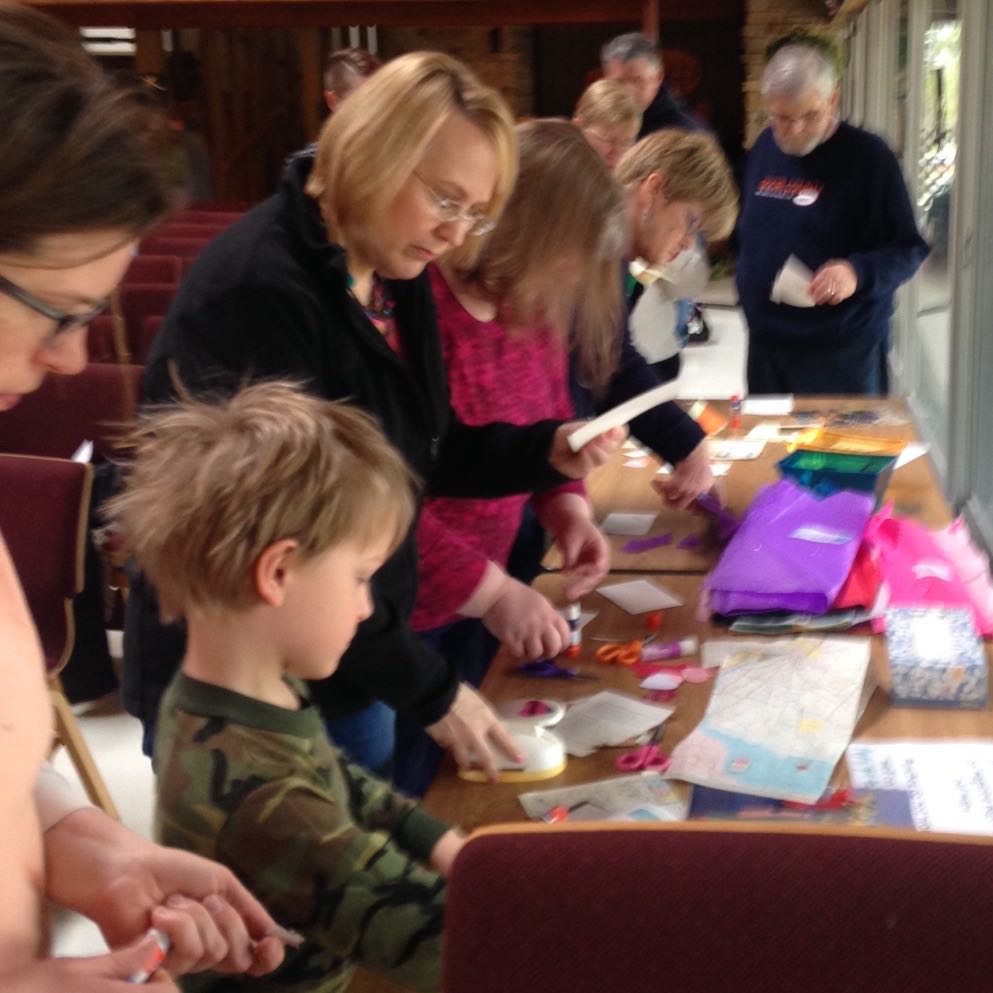
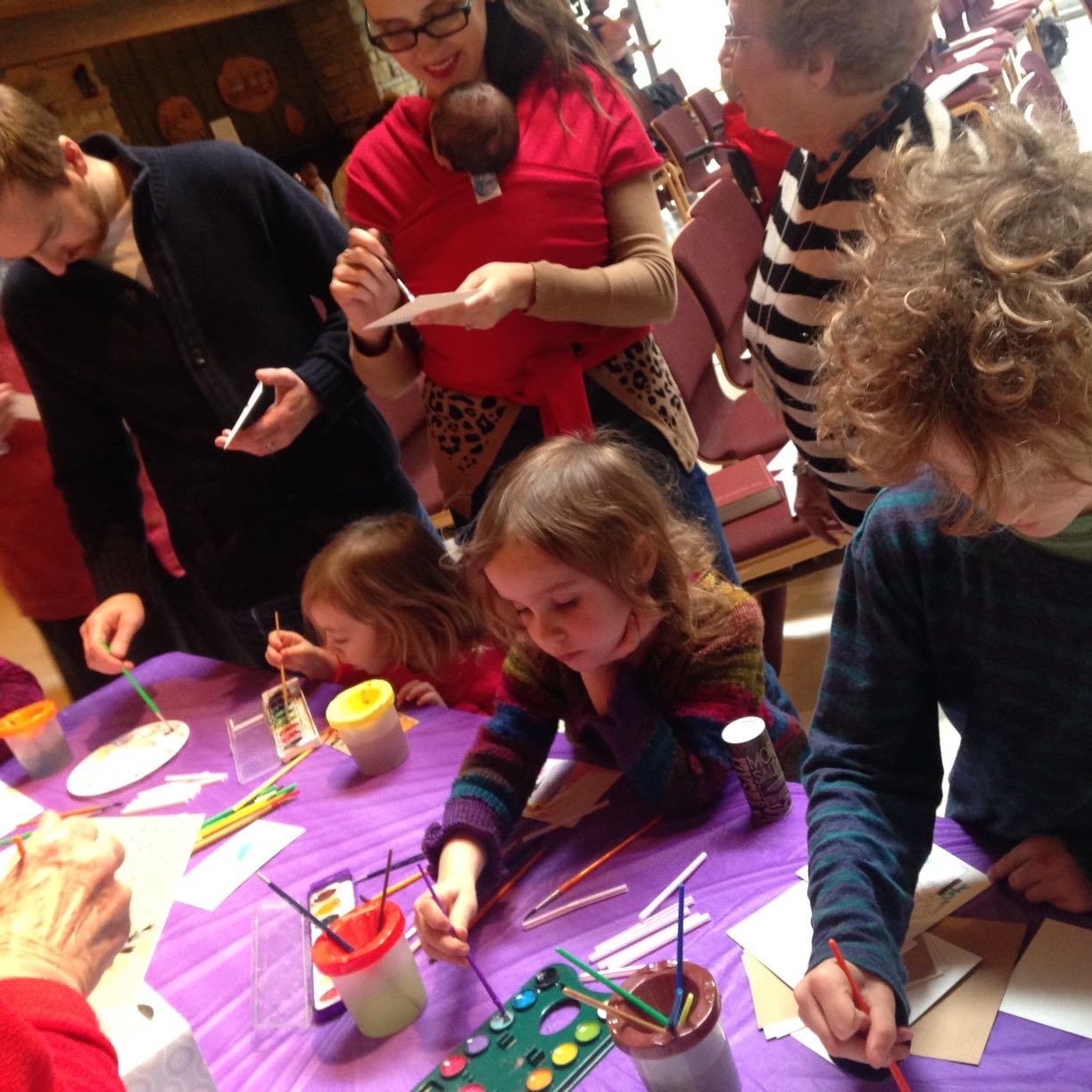
IMG_7881On Friday, November 27, St Dunstan’s held our second annual Black Friday Craft-In. From 1 – 4pm, we were open to the public, with our Gathering Area and Meeting Room full of tables covered with crafting materials. Crafts included decorative ornaments, flower headbands, stamped notebooks and cards, cardboard shields, tiny clay pot nativity scenes, knitting demonstrations, magnets, and more. Over the course of three hours, about sixty people came – and stayed. They stayed to make crafts together, to chat, to share cookies and cocoa, to take a break and have a little fun together on a busy holiday weekend.

IMG_7879Aside from our terrific team of volunteers, almost no members of St Dunstan’s attended. Our guests were folks from the neighborhood, other area churches, and the wider community. They came because it sounded like a fun way to get out of the house for a few hours. Grandparents, parents, and aunts and uncles brought kids of all ages, and kids and adults enthusiastically engaged with our craft stations. Strangers helped each other – my six-year-old daughter made fast friends with two sweet eighth-grade girls. Susan, one of our hospitality volunteers, remarked on how much people seems to be enjoying the time together: “Last night as I thought about the greatest reward of the arts and crafting, I felt like it was the friends, parents and grandparents involved with each other in a way that created a very memorable holiday experience; everyone seemed to be extremely grateful to be there.”

IMG_7873I was really touched that we had at least two households who had come last year, for our first Craft-In, and have been looking forward to coming again, ever since – even spreading the word and bringing friends. What a wonderful affirmation!

Last year, our Craft-In was something new, and we got a little press about it, which helped with our pre-event publicity. Planning for this year, I wondered if we’d get much turn-out without the media boost. But in fact, turnout was substantially higher, we were better organized, and the event was amazing. We ate all the cookies and used up most of the craft supplies, and people had a wonderful time. IMG_7877This is an event people like enough to talk about and plan ahead to attend. That’s really exciting! I hope next year’s Craft-In will be even bigger and better – and we’ll buy a few more cookies.

– Rev. Miranda+


The creative impulse originates in the heart of God. God is present, the divine energies are present, in every creative impulse. The human being, made in the image and likeness of God, shares in God’s creative energies.

-Br. Mark Brown, Society of Saint John the Evangelist

Sermon, Sept. 27

The Jewish people, who share our God and our Old Testament, tell the story of Esther every year, at a festival called Purim. It’s an important story for them because they have lived through many times of being persecuted and hated by those in power,  and this is a story about facing a situation like that, and surviving – surviving because both people and God are faithful and loving.

Who here likes stories? …  Do you remember something better if somebody just says it, or if it’s in a story? …  Stories are powerful.Our minds and hearts are wired for story.  All around the world, all throughout time, human beings have talked about what’s important through stories. We tell stories to make each other laugh, or cry. We tell stories about things that everybody experiences, and about exceptional, strange, crazy things that only happen once. We tell stories that are true, and we tell stories that are lies, and stories that are absolutely made-up, but somehow true anyway. We love stories. It’s one of the most important things we do – make and tell and remember and share stories. So when our cycle of Bible readings in church brings us a little snippet of a good story, I like to make sure we hear the whole story!

Why spend time with stories from the Bible? Well, because they’re great. This one has a beautiful brave princess, a King, a good old-fashioned villain who you don’t have to like, and noisemakers! It’s a lot of fun! But we don’t share these stories just because they’re great stories. Stories from the Bible tell us that God is part of our human stories. God is working in the world and in the lives of human beings – extraordinary people and ordinary people too.

But God’s story isn’t just in the Bible; it’s still happening in the world. Does anybody remember this book from our Godly Play classroom? … It’s from a lesson called “The part that hasn’t been written yet.” You spend the year learning some of the great stories of God’s people, and then we remind each other that those stories keep happening, and we are in some of them.

So when we’re hearing a Bible story, one question we can ask ourselves is, How might this story be my story? Am I in this story somewhere? In our Godly Play classroom, one of the questions at the end of each story is, I wonder which part of the story is most about you? That’s a good question to think about – for grownups too!  Here’s a more grownup way to say the same thing, from missional church scholar Alan Roxburgh:  “Where does the biblical imagination give us language to talk about what we are experiencing?” Holy stories can help us make sense of our experiences, and know them as part of God’s unfolding story.

Here’s a little example. There’s a story Jesus tells about a young man who leaves home. He takes his share of his father’s money and he goes off to have a good time. He makes some really bad choices, spends all his money and ends up in trouble. Finally he’s desperate enough to go home to his father, even though he thinks his father will be really angry, might even refuse to call him his son anymore. But when he’s walking up the road to his home, his father sees him and RUNS to meet him. He hugs him – and he’s so glad to have his son back safely that he throws a party! Do you know that story? It’s usually called the Prodigal Son story.

I was talking with a friend recently whose grownup son has been going through some tough times. Things weren’t going well for him. And my friend said, I just need to be the Prodigal Father. I just need to welcome my son back, and celebrate that he is safe, without giving him a hard time about his choices or his failures. That story from the Bible, that story Jesus told, helped my friend know how to be, in this real-life situation. That story gave him guidance and comfort. And it told him that God knows how he feels. God has been there.

I wonder which part of this story is most about you? I hope you’ll think about that question sometimes, and I look forward to hearing your answers.

Kids’ sermon, August 30

We just heard a beautiful poem, full of wonderful images, like lilies and doves and flowers and apple trees. It is called the Song of Solomon because it talks about King Solomon, David’s son. People who study the Bible think it was written much later, and just used King Solomon as a character in the poem.

This is a poem about love.But not just any kind of love.This is a romantic poem. It’s the words of two people very much in love, in the spring, getting ready for their wedding. Two people who want to be as close to each other as possible. (I know; gross, right?)

In English, the language we use,there is just one word for love. That’s it: love. I saw a cartoon once where a lady got madbecause her husband said “I love lobster” and then he said, “I love you.” You could say, I love my mom, and I love gummi bears. But do you feel the same way about your mom and gummi bears? Not really!

In the language called Greek, which some of the Bible was written in, they had different words for different kinds of love .Eros is like boyfriend/girlfriend love, romantic love. Storge is like the love in a family. Philio is like the love we feel for our friends. Agape is like the love we have in a community or a team or a group of people that know each other and take care of each other. The kind of love where you share happy times and hard times, and where you try to help somebody even when it’s hard. This is the kind of love that Jesus tells us to have for each other. I don’t know what word the Greeks would use for how people feel about lobster or gummi bears! …

Okay, so coming back to this love poem we just heard. Why are we reading a love poem in church? Well, because it’s in the Bible. So why is a love poem in the Bible? A lot of people have asked that question, over the years. Some people have felt like it just doesn’t really belong here.It’s about romance… and some of it is pretty kissy-kissy… reading it might make people think about things other than God… so let’s just skip that part of the Bible. And certainly don’t read it to the children!

Other people have said, What is wrong with you? This isn’t a poem about romance at all. It’s a poem about the love between God and God’s people. The sweet, tender adoration that God has for us. And if you see something kissy-kissy there, that’s your issue.

I wonder if we can say that it’s kind of both? It’s kind of about the romantic love of two people, and also about the tender love God feels for us? I wonder if all kinds of love -Eros and Storge and Philia and Agape – I wonder if all those kinds of love, deep down, are really the same love?

At least, I wonder if all the good kinds of love we feel are really the same love, deep down. Because sometimes we get attached to things that aren’t really good for us, but it might feel like love. One word we use for that is addiction.That’s when you want something all the time, and it feels really important to you, like you need it to be yourself, and it feels like you love it; but the thing you’re attached to is unhealthy for you. Or at least it’s not truly adding anything to your life, it’s just taking your time and energy without building you up. The best example for kids might be computer or video games. Maybe you’ve felt a little bit addicted yourself, or you have a friend who’s kind of addicted. For grownups it might be cigarettes or alcohol or online shopping, or even a person who’s really exciting but who does hurtful things. People can get addicted to lots of things.

So not everything that feels like love, is good for us. Real love does good things in our hearts and minds and lives. And that’s true whether it’s the love of a friend, or a parent, or a pet, or a teacher, or a girlfriend/boyfriend someday. Real love doesn’t always feel good every minute. Sometimes we hurt each other, or we feel sad when someone we love leaves or gets sick. And sometimes we have to tell people we love something that they don’t want to hear. Like, come do your homework! …

But even if it doesn’t feel good all the time, real love is good, and we need it. Let me tell you a story about King Solomon, because it is also a story about love. Remember, King Solomon was King David’s son, and he was famous for being very, very wise. This is one of the stories that people told about how wise he was.

There were two women, sisters, who both had new babies. And one of the babies died. Very sad! So now there was only one baby, but both mothers said that that baby was theirs. The babies looked alike so nobody could tell for sure, and both women said, This is my baby. So they argued and argued, and finally they took the baby to King Solomon the Wise. They said, How can we solve this?

And King Solomon thought about it, and then he said, All right, I know what to do. We have to cut the baby in half. Each of you can have half of the baby. Was that a good solution?…

It doesn’t sound like a good solution, does it? But let me tell you what happened. One of the mothers said, All right, fine, that seems fair. But the other mother said, NO! Don’t hurt the child! She can have him. Just – let him live.

And King Solomon said, Let the baby go to this woman. She is the baby’s mother. He saw that she truly loved her baby. The other woman was so broken by her sadness and jealousy that she didn’t care what happened. But this woman loved the baby with such big, deep, strong love that she would rather let the baby go with somebody else than be hurt. (Now do you think King Solomon was wise?)

So that’s real love! And all that kind of love comes from God. That’s what we mean when we say that God is love. Have you heard people say that? God is love? The woman who draws the Sunday Papers is named Gretchen. And the way she draws God – it’s hard to draw God, nobody knows what God looks like! – so the way Gretchen draws God is as a heart with hands. Love that reaches out to us and touches the world, and our lives.

What do you think about that idea? That the love in your family, the love of your pet, the love you share with your closest friends, the love you feel for a special place like a lake or woods, the love you feel for doing something you’re really good at, all of that real, good love is holy? Comes from God? That it’s one of the ways God is in our lives, every day?

I’m going to give you all some hearts. I want to notice love in your life today, okay?Notice where there is love in your life. Put a heart on it if it’s a thing, or if it’s a person you could give them a heart. And say in your heart, Thank you, God! Thank for all the love in my life!

Community Art Micro-Retreat, 4/22

FullSizeRenderToday is the fifth Sunday in Lent. Next Sunday we begin our walk through the Great Story…. In our Sunday school classes, we describe Lent as the season when God’s people get ready for the mystery of Easter. So: are you ready? How have your preparations been going?Have your Lenten practices and prayers opened some space in your heart to receive the power and grief and strangeness and joy of this story, all over again? IMG_1081

… I come to this Sunday, the last “normal” Sunday in Lent, wishing I’d been able to create a little more space for that getting-ready work. So here’s what we’re doing today: we’re taking a little space. I’m giving you a gift that most of us rarely give ourselves: fifteen minutes of silence, with some art supplies and the presence of God in our own hearts, as the prophet Jeremiah reminds us in today’s Old Testament lesson.

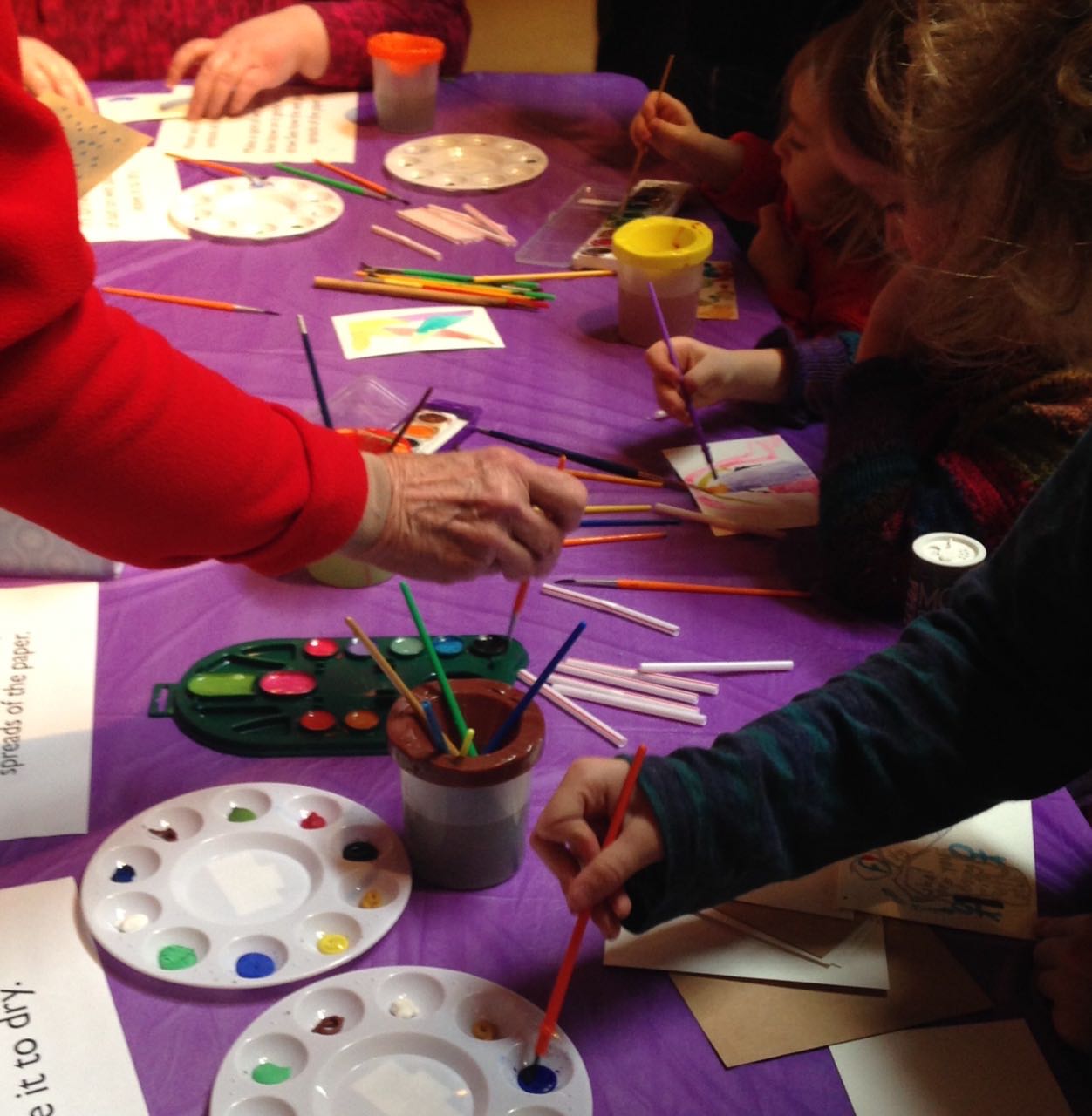
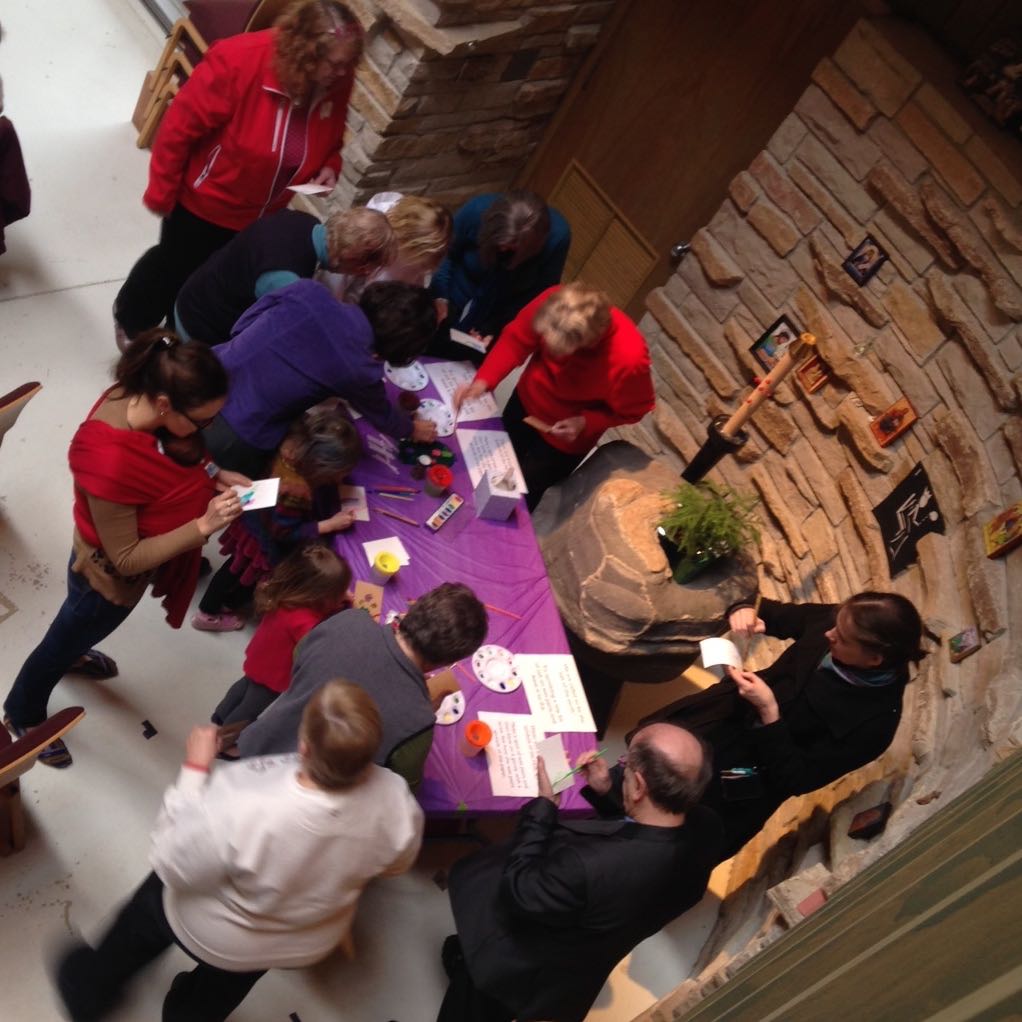
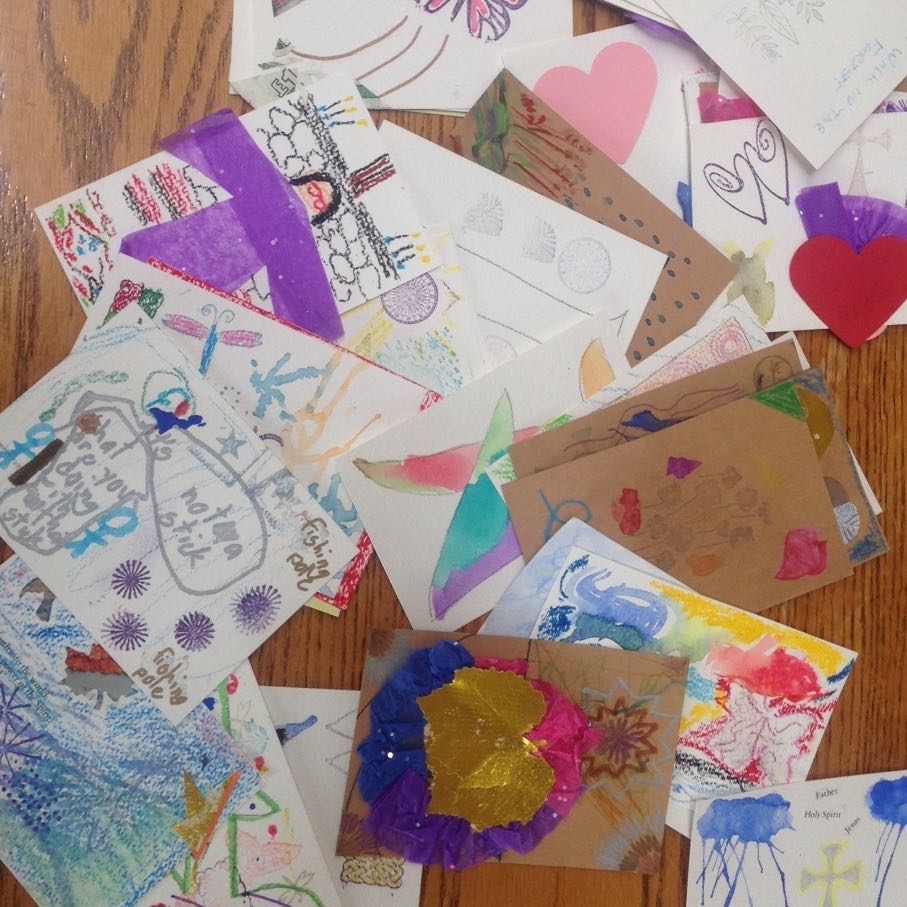
IMG_1084All around the room are different art stations. At any station you can pick up a card to decorate. You’ll work with just one card, and carry it around with you. You can draw a picture if you want, but the goal is to fill the card with color and texture. It doesn’t have to be a picture, it can just be shapes or squiggles or patterns or colors or whatever. Just keep going, keep adding, and see what happens.

IMG_1092Of course as we move around this room, which is not really all that big, we’ll interact with each other a little, standing close, passing things to each other. That’s fine. But don’t talk. Respect the quiet. Mostly stay with yourself and with what you’re doing. Let your art come out of your soul without telling yourself, This is ugly, or I can’t do this. Just be playful and enjoy it.  When the time comes to an end – I’ll let you know –  just leave your card at the table where you are and come back to your seat. Our art cards will become something beautiful together, just like us.

IMG_1101You are also welcome, if it’s what you really need, to just use this time to sit in silence, and listen to your own heart, and maybe to God. That’s fine too.

Announcements, March 12

THIS WEEKEND… 

Rector’s Discretionary Fund offering, Sunday, March 15: On third Sundays, half the cash in our collection plate, and any designated checks, will go towards the Rector’s Discretionary Fund. This fund is a way to quietly help people with direct financial needs, in the parish and the wider community. Thanks for all your generous support.

Sunday School, Sunday, March 15, 10 am: This week, our 3-6 year old class will continue learning about the Faces of Easter, while our 7-11 year old class will explore Psalm 107.

Members of St. Dunstan’s are welcome to join the Zion City Church congregation in their weekly worship service of thanksgiving and praise on March 15.  The service is from noon to 2:00pm.  Meet at St. Dunstan’s at 11:30am to carpool, or meet at Zion City Church shortly before noon.  They are located at 1317 Applegate Road in Madison.  This is just south of the Beltline, off of Fish Hatchery Road.

Evening Eucharist, Sunday, March 15, 6pm: Join us for a simple service before the week begins. All are welcome.

Explorers, Sunday, March 15, 6:30pm: St. Dunstan’s Explorers will meet for light refreshments and wide-ranging conversation. All are welcome. (I will see if I can get any more definitive information by Thursday)

Young Adult Meet-up at the Vintage, Sunday, March 15, 7pm: The younger adults of St. Dunstan’s are invited to join us for conversation and the beverage of your choice, at the Vintage Brewpub on South Whitney Way. Friends and partners welcome too.

THIS WEEK & BEYOND…

Do you like to feed people? Consider joining our St. Dunstan’s Meals Network, to provide a meal for another household in our congregation. New babies, critically ill family members, surgery, or a death in the family are just a few of the occasions for which people might need extra support and compassion. Sometimes it’s just dropping of food, sometimes it’s also sitting with people and listening to how things are going.  Go to the “Sharing Meals” page under “People” on our main page to join our network or, if you’re already part of it, to pick a date on our current meal calendars.

Vestry Meeting, Wednesday, March 18, 6:45pm: The Vestry is the elected leadership body of our parish. Any members are welcome to attend our meetings, to observe or raise questions or ideas.

The Stations of the Cross, Fridays at noon: Walking and praying the Stations of the Cross is a meaningful practice of prayer for many Christians in the season of Lent. On Fridays you are invited to come and join Rev. Miranda in sharing Scripture, meditations from Christian tradition, and prayer as we walk with Jesus on the journey to the cross.

Outreach Committee Meeting, Saturday, March 21, 8-10:30am: All are welcome to join our conversations about how St. Dunstan’s can best serve the world with our resources and our hands. We begin with an optional potluck breakfast at 8am.

Food Forestry at St. Dunstan’s: Plans for 2015, Saturday, March 21, 1pm: All interested or curious folks are invited to come learn about permaculture, our work adding food plants to our woods and grounds over the past two years, and ideas and plans for this year.

Makers’ Guild, Saturday, March 21, 2 – 4pm: Bring your own current handwork – sewing, knitting, painting, beadwork, whatever! – or help out with preparing sample palm crosses and tucking treats into plastic Easter eggs for our egg hunt on Easter Sunday. All are welcome!

Poetry & Spirituality: John Milton, Sunday, March 22, 9am: Paul Thompson will introduce us to the life and work of the great 17th century English poet, John Milton.

“Last Sunday” Worship, Sunday, March 22, 10am:  Our “Last Sunday” pattern of worship is simplified to help children (and adults new to our way of worship) to participate and understand. This month, our Last Sunday worship will invite us all into the final weeks of Lent as we approach the mystery of Easter. Our 8am worship always follows our usual seasonal order of worship.

Christian Formation Committee Meeting, Sunday, March 22, 11:45am:  Our Christian Formation Committee meets to review and plan programs for Easter, the summer, and beyond. All interested folks are welcome to attend and participate.

 Help Spruce up St. Dunstan’s for Holy Week and Easter! Spring Cleaning inside St. Dunstan’s, Sunday, March 22, 12-2pm:  Please see the list of jobs to complete and sign up to help as you are able.  

Grace Shelter Dinner, Sunday March 22, 7pm: Every fourth Sunday, a loyal group of St. Dunstan’s folk provides dinner for residents at the Grace Church shelter, and breakfast the next morning. See the signup sheet in the gathering area to help out.

The Stations of the Cross in Downtown Madison, Friday, March 27, 12pm & 5pm: Walk the story of Jesus’ journey to the cross on the streets of a modern city.  As we walk the fourteen traditional Stations of the Cross, we will reflect together on how we can trace those events in the geography of Madison today – our issues, stories and struggles. We will start on the sidewalk near the Federal Courthouse, across from the Overture Center, and end in the garden at Grace Church on the square. The total walk will be about 1.2 miles, and it takes about 45 minutes. Come at noon or 5pm, as your schedule permits. All are welcome.

“Palm Saturday”, Saturday, March 28, 10:30am – 12pm: Kids, parents, grandparents and friends are invited to make Easter crafts and communion bread, and to take part in a gentle, age-appropriate and participatory telling of the whole Easter story, presented by the youth and adults of our church. This event is best suited for kids ages 3 to 10. All are welcome!

Spring 2015 Chocolate Making: Our Spring Chocolate Event will be after Easter this year. Mark your calendars for Friday evening and Saturday, April 10 – 11. Signup sheets and order forms will be out by mid-March.

LENTEN OPPORTUNITIES…

Tools for Tanzania Giving Opportunity: St. Dunstan’s seeks to raise $800 for a set of tools to send to our sister diocese, the Diocese of Newala in Southern Tanzania. Rev Miranda visited Newala with our diocesan team in 2013, and Bishop Oscar Mnung’a visited St. Dunstan’s last October. As partners in this “diosisi rafiki” (friend diocese) relationship, we look for ways to support one another, both in prayer and practicality. Newala is one of the poorest parts of Tanzania. It is overwhelmingly rural, and most people are small-scale farmers, working with traditional hand tools. During Bishop Oscar’s visit last fall, we learned about better-engineered, modern hand tools that would help farmers in Newala. If we can send one set of new farm tools to Tanzania, then local artisans can use them as models to adapt the tools they make for local use. Then local farmers may be able to grow more food for their families, which means more resources for their churches & communities! A set of tools, plus transport costs, comes to about $1300. We are trying to raise $800 as our contribution; our sister parish, St. Andrew’s Church in Monroe, WI, will raise additional funds as our partners in this project. To contribute, put a check in the offering plate with “TZ Tools” on the memo line. Thanks for your generosity!

The Holy Innocents, 1/4/15

This is a difficult Gospel {Matthew 2:1-23}.  And I asked for it. Our Episcopal lectionary, our calendar of Sunday readings, tries hard to give us the Wise Men while avoiding the Holy Innocents – the name given by the church to the babies murdered by Herod’s soldiers. We have three options for Gospel readings today: the FIRST part of the Wise Men story, up to their arrival & the presentation of the gifts; the story of Joseph’s flight into Egypt with his wife and child, skipping what happens to all the other young boys in Bethlehem; and a passage from Luke about something else entirely.

Because I am committed to Biblical narrative, to taking these texts as they come to us, honoring the skill and inspiration of their writers by not chopping the text into bits, and wrestling with them even when they make us uncomfortable -because of all that, I said, Let’s take this whole chunk, the whole Wise Men/Herod/Egypt story, as our Gospel today, and let’s see what we can make of it.

Why the heck would I do that? Why would I give myself this story? When there is a big news story about something terrible happening to a child, because of racist systems or an unsecured gun or a parent’s unloving judgments, I am the kind of person who hides the story from my Facebook timeline, and avoids clicking on the headlines, because I just can’t. Those stories tear me up; they eat up the emotional energy I need for my family and my parish. I believe it’s important for me, as a citizen, a voter, a parent, and a leader, to be familiar with the ways our society tends to commit violence, and allow violence, against children. But I do not, will not, cannot wallow in the details; it would wreck me, and reduce my capacity to respond to events and tragedies within my own community.

So why hand myself Herod and the Holy Innocents, and why lay it on you? Well: because it probably didn’t really happen. This King Herod – there were several – was a really bad, crazy, paranoid guy. He was said to have even had some of his own sons killed because he believed they were plotting against him. So it’s not that he wouldn’t have done something like this; he would. But the historians who record his other awful deeds don’t mention anything like this event, soldiers killing all the male babies of Bethlehem. Some people say, Well, Bethlehem was a small town; maybe the massacre that happened there just didn’t make the Jerusalem Times, and enter the historical record. That’s possible. But the general scholarly consensus seems to be that this particular atrocity attributed to Herod was probably invented by the gospel writer we know as Matthew.

I find that persuasive because it fits what I know, what we know, about Matthew as a Gospel writer. One of the most distinctive things about Matthew’s Gospel is its emphasis on Jesus’ life as a fulfillment of the Old Testament or Hebrew Bible. Again and again, Matthew makes reference to Old Testament prophecies, often putting a spin on events in Jesus’ life that makes them fit those Old Testament patterns. Writing his account of Jesus’ life for a primarily Jewish audience whom he hopes to convince to accept Jesus as God’s Messiah, one thing Matthew does is deliberately cast Jesus as a second Moses. A new leader called by God to lead God’s people out of bondage. And one of the places we see that very clearly is right here. We just had the Moses stories at the end of the summer; who remembers another story about a cruel leader having baby boys killed? Does that ring any bells?… It’s exactly what Pharaoh did in the first chapters of Exodus, trying to reduce the numbers and break the spirits of the enslaved Israelites. Jesus, like Moses, is the one special baby boy, protected by God, who escapes an evil king’s cruelty and grows up to save his people. And in case anybody missed it, Matthew hits the point home by sending the Holy Family to Egypt. That would have been quite a trip… another country, another language… why flee so far, even if Joseph did get word that his family was at risk? I tend to take the Egypt expedition, like the massacre itself, with a grain of salt – or as a narrative that tells a different kind of truth than historical truth. As I’ve said before: stories carry their truths in different ways.

What is Matthew trying to tell us, here? If there never was a massacre of baby boys in Bethlehem, Matthew’s Jewish audience in the late first century would have known that perfectly well. They would have understood that the truth Matthew is trying to tell isn’t the literal truth of historical narrative. Matthew is telling us here about the kind of leader,  the kind of savior, Jesus was called to be; and the kind of world Jesus was born into, a society in which the powerful could do what they liked without accountability or consequence.

Remember, Jerusalem and Judea at this time were under Roman colonial rule. The Romans were the great power of the world at this time; their armies and their emperor claimed territory from Britain to North Africa, from Spain to Syria. Where possible, the Romans liked to use indirect rule: putting in place a local leader  who would serve their interests and follow their orders. That’s what Herod was: a puppet king, subjugated to the Romans just as surely as his people, dependent on their power and their goodwill. Hated by his own subjects for cooperating with their conquerors.

Notice what Matthew says here: When King Herod heard the wise men from afar speak of a newborn king of the Jews, he was frightened, and all Jerusalem with him. Herod the King is FRIGHTENED. Because his leadership, his position,  is tenuous at best. His people hate him; the Romans only care about him as long as he’s useful; none of his power or authority are truly his own. A rumor of a holy child, a new king called by God as in the time of Samuel, could threaten him in any number of ways; it’s entirely credible that he would have responded with repressive and ruthless violence.

But it’s not just Herod who is frightened. Jerusalem, the City and her people, are frightened. Their peace is just as uncertain as Herod’s power. A new popular leader could lead to civic unrest, which could lead – would lead – to Roman military violence, to crush any resistance and re-establish the Pax Romana, the Roman Peace. It had happened before; it would happen again, with the destruction of Jerusalem in 70 AD, four decades after Jesus’ crucifixion, and perhaps a decade before Matthew composed his Gospel.

Herod probably didn’t send soldiers to kill the babies of Bethlehem; but Matthew wants us to know that he could have, and the mothers and fathers of Bethlehem would have had no recourse. The Romans wouldn’t have cared unless it made trouble for them. The religious leaders of the great Temple had no power or will to oppose Herod. There was no earthly authority to hold Herod’s cruelty in check. The truth this story carries, what Matthew wants us to understand, is that Jesus, who was God, was born poor and ordinary and vulnerable, was born into a world of fear and violence, a world of powerlessness and bitter injustice. Everything else he tells us, about the love and anger and courage of Christ, about his preaching and teaching, his healing and arguing, his life and his death, flows out of this initial piece of scene-setting: Matthew’s description of the ruthless and hopeless times into which God chose to be born.

In the fifth century, this story began to be celebrated in the church as the Feast of the Holy Innocents. It was honored in many ways and many places, over the centuries. Today, in the western churches, it has largely fallen out of practice. Too ugly a story to celebrate. Too bloody, too strange, too archaic, too upsetting.

But there may be something here worthy of reclaiming. There is still much that is fearful in our world, much that is violent and ruthless, and many who are vulnerable. A friend of mine,  a priest in an urban setting in New Jersey, celebrated the Feast of the Holy Innocents this year by having a simple weekday service for the children of his community – largely children of color – and members of the local police department. The children anointed the policemen

and prayed for their work and their safety, and the policemen prayed for the children – for them to be safe and learn and grow into adults who make their world a better place.

That service reworked one of the ancient traditions of the Feast of the Holy Innocents: praying for the children of the congregation or village. Moved and inspired by that tradition and by this example in calling it into the present, I’m inviting us to pray together today for the protection and flourishing of our children, here at St. Dunstan’s. Those who are here with us today; those who are still traveling, or home sick, or tucked in for their morning naps – and by extension, for all the children of Madison and Middleton and beyond.

To the children who are here today: I invite you to come into the center of our church. Parents with babes in arms, if you’re comfortable doing so, please join us here too. And I ask the congregation to raise your hands and join me in praying over our kids, using words adapted from St Patrick of Ireland.

We pray over you not because we think you are in danger, dear ones – there is no Herod lurking here – but because we love you, and your wellbeing and safety and nurture are one of the very most important things entrusted to us as your family of faith. So, as we begin this new year, as we welcome the light of the Incarnation shining into the darkness of our world, let us pray for these young people.

I call today upon our God, the Holy and Undivided Trinity,

in unity of love,

to bless our children among us.

I call upon God’s power to guide you,

God’s might to uphold you,

God’s Wisdom to teach you,

God’s Eye to watch over you,

God’s Ear to hear you,

God’s Hand to guide you,

God’s Shield to shelter you,

God’s Way to lie before you.

Christ be with you, Christ within you,

Christ behind you, Christ before you,

Christ beneath you, Christ above you,

Christ in hearts of all that love you.

Dear ones, may you grow in wisdom as in stature,

and in divine and human favor.

And the blessing of God the Holy and Undivided Trinity be upon you,

body, mind, and spirit,

this day and forever more.

And let the people say AMEN.


Prayer for the Feast of the Holy Innocents 

We remember today, O God, the slaughter of the holy innocents of Bethlehem by King Herod. Receive, we pray, into the arms of your mercy all innocent victims; and by your great might frustrate the designs of evil tyrants and establish your rule of justice, love, and peace; through Jesus Christ our Lord, who lives and reigns with you, in the unity of the Holy Spirit, one God, for ever and ever. Amen.

(1979 Book of Common Prayer, p. 238)

Watch Night: New Year’s Eve

bellsAll are invited to an evening of celebration, song, and prayers. From 6:30 to 8-ish, enjoy desserts and board games, and try out our “Photo Booth”!  At 8:15 we’ll begin a simple participatory New Year’s Eve vigil service, exploring the themes of longing for justice, the mystery of time’s passing, and new beginnings. At 9pm we’ll loudly & joyfully declare it the New Year (with the good folk of Greenland and Argentina)! All are welcome.

Location: St. Dunstan’s Episcopal Church, 6205 University Ave., Madison, WI. Questions? Call 238-2781.


This is an alcohol-free event.