All posts by Miranda Hassett

Announcements, Oct. 8

THANKS to all our Grounds Helpers! Many hands helped with our Parish Work Day last Sunday, and with overseeing the Edgewood High School volunteers on Wednesday. We got nearly all our tasks completed, which is terrific! Thanks to all who planned, fed, directed, and worked.

THIS WEEKEND… 

Outreach Committee meeting, Saturday, October 10, 8-10:30am: All are welcome to join our conversations about how St. Dunstan’s can best serve the world with our resources and our hands. We begin with an optional potluck breakfast at 8am.

THE HUNGER WEEKS: Outreach Hour, Sunday, October 11, 9am: Percy Brown of the Middleton-Cross Plains Area School District will talk with us about the face of poverty and hunger in Middleton.

Sunday School, Sunday, October 11, 10am: This week our 3-5 year old class will be learning about the Ten Best Ways, while our 6-10 year old class will dig into Jesus’ challenging conversation with a rich young man.

Spirituality of Parenting Lunch, Sunday, October 11, 11:45am: All who seek meaning in the journey of parenthood (at any age or stage) are welcome to come for food and conversation. Child care and a simple meal provided.

St. Dunstan’s Finances At a Glance: As we approach our fall Giving Campaign, our church finances should be clear to all members. Take a look at our display in the Gathering Area. More detailed financial reports are available on request.

Sign up for this year’s Parish Talent Show, Sunday, October 25! What will you share? A poem, a song, a dramatic monologue, a dance? A sample of art, craft, tinkering, building, study or science? Group acts are encouraged.

THE HUNGER WEEKS: Pledges Wanted for CROP Walk for Hunger, Sunday, October 18: We have a great team gathered for this year’s CROP Walk! All money raised is used to fight hunger and a percentage of the money stays right here in Dane County being distributed to the food pantries. You can write a check to support our walkers, with CROP on the memo line, and put it in the offering plate. Thanks for all your support!

THE WEEK AHEAD… 

Christian Formation Planning Meeting, Wednesday, October 14, 7pm, in the Godly Play classroom downstairs: At this meeting we’ll discuss and plan our formation programs – opportunities to learn and grow in faith and fellowship, for all ages – for Advent, Christmas, and Epiphany (November through January). If you’d like to be part of the conversation or have an idea you’d like to run with, you are welcome to attend and participate!

Madison-Area Julian Gathering, Wednesday, October 14, 7:15 – 9:00pm: A Julian Gathering is open to everyone. They are for all who want to deepen their life of faith through the practice of contemplative prayer, for beginners as well as those already practicing.

An Evening of Storytelling at St. Francis House, Friday, October 16, 7-8:30pm: All friends of the House, our Episcopal campus ministry at UW-Madison, are welcome. Speakers will share memories of St. Francis House over the years, including of our own Father Art Lloyd.

Words in Season, October 17/18: Dear performance and poetry loving members of St. Dunstan’s, join us for a seasonal celebration of words and the spirit. Daniel Hanson and Evy Gildrie-Voyles are gathering a group of all ages to perform poetry relevant to the seasons four times this year. The first will be in October. We will meet on Saturday October 17th at 10am at the Church for a brief rehearsal and perform Oct. 18th in the Gathering space after the 10 o’clock service (roughly 11:15am.) All ages are welcome. No memorizing is necessary.

Men’s Book Club, Saturday, October 17, 10am: This month’s book is “The Wright Brothers,” by David McCullough. On a winter day in 1903, in the Outer Banks of North Carolina, two unknown brothers from Ohio changed history.

Diocesan Convention, Saturday, October 17, 8am – 4:30pm at St. John’s Northwestern Military Academy in Delafield, Wisconsin:  All are welcome to attend all or part of the convention! The morning will be devoted to worship and a presentation focused on taking our Church into the wider community.  The afternoon session will be the ‘business’ session. Visitors are asked to register but there is no charge unless you want to have meals at the convention. To register, fill out and mail in the form located in the Gathering Area or you can register at the convention between 8 and 9am. Also of note, travel-size personal hygiene items will be collected at Convention, to be given out through hospitality ministries around the diocese. For more information on the convention, go to http://www.diomil.org/about-us/diocesan-convention/.

THIS MONTH AT ST. DUNSTAN’S… 

THE HUNGER WEEKS: Bread for the World Sunday, October 18: We are invited to participate in Bread for the Word’s annual Offering of Letters, to advocate to our politicians for programs that will reduce hunger in the United States and around the world. This year’s legislative focus is child hunger, and especially ongoing funding of the WIC program. Letters will be gathered in next Sunday, October 25. Letters, emails and phone calls are all encouraged, so that a strong Christian voice for the hungry is heard in Washington! Come at 9am for a presentation on Bread’s work and a discussion of Christian advocacy in the public square.

Sunday School, Sunday, October 18, 10am: Next week our 3-5 year old class will be learning about the Tabernacle in the Wilderness, while our 6 – 10 year old class will talk about finding greatness in serving others.

Rector’s Discretionary Fund Offering, Sunday, October 18: As on every third Sunday, half the cast in our collection plate, and any designated checks, will go towards the Rector’s Discretionary Fund. This fund is way to quietly help people with direct financial needs, in the parish and the wider community. Please give generously.

Evening Eucharist (BCP), Sunday, October 18, 6pm: Join us for a simple service before the week begins. We use the Book of Common Prayer for this liturgy. Our seasonal worship books are based on the prayerbook, but if you miss actually holding the little red book, you may enjoy attending one of these bimonthly services.

Younger Adults Meet-up at the Vintage, Sunday, October 18, 7pm: The younger adults of St. Dunstan’s are invited to join us for conversation and the beverage of your choice, at the Vintage Brewpub on South Whitney Way. Friends and partners welcome too.

Left Unsaid: Remembering our Beloved Dead at Sandbox Worship, Thursday, October 29, 5:30pm: Maybe there’s something you didn’t have a chance to say. Maybe you thought you’d said it all, but as the years pass, you’ve discovered more. Come for an evening framed in prayer, a space to speak the words you want to say to one of your loved ones who has gone on before, as we anticipate honoring our beloved dead on All Saints Day (Nov. 1).  After worship, we’ll share a simple meal. All are welcome. Questions? Talk with Rev. Miranda or Sharon Henes.

Ladies’ Night Out, Friday, October 30, 6pm: Join our monthly get-together as we dine at area restaurant and enjoy good conversation among women of all ages from St. Dunstan’s. This month we will meet at the Freehouse Pub, 1902 Parmenter in Middleton.

Black Friday Craft-In, Friday, November 28, 1 – 4pm, St. Dunstan’s Church: Tired of the mall? Make stuff. Give it away. This year we’ll host our second annual Black Friday Craft-In, a free public crafting event. If you’ll be in town and would like to volunteer to help out, please sign up in the Gathering Area. We can use all kinds of volunteers – whether your skill is sewing, woodworking, stamping, paper crafting, smiling at people and saying “Welcome!”, setting up tables, or putting cookies on plates.

IN THE WIDER CHURCH & COMMUNITY… 

Purple Ribbons for Domestic Abuse Awareness Month: The purple ribbons on our altar this month remind us to hold in prayer victims, survivors, and perpetrators of domestic abuse.  To learn more & find out about events this month, explore the website of our local agency, DAIS: abuseintervention.org .

Alleviating Poverty: Who’s Responsible? Great Madison Poverty Forum, Sunday, October 11, 6:00 pm – 8:00 pm, High Point Church, Micah Center at 7702 Old Sauk Road in Madison: Come and join this two-hour highly interactive forum with diverse leaders from Madison’s faith community. The discussion will include: learning about poverty in Wisconsin, consideration of the theological role of the individual and collective responsibility for alleviating poverty and seeking common ground for solutions. Please RSVP by October 8 at: http://www.wichurches.org/madison-poverty-forum-registration/

Community Panel Discussion, Monday, October 12, 6:30pm, Archer Rooms, Middleton Public Library: In collaboration with UW-Madison’s Go Big Read selection, “Just Mercy” by Bryan Stevenson, the library will host a community discussion on racial disparities in the criminal justice system. Panelists include: Chuck Foulke, City of Middleton Chief of Police; Dr. Ruben Anthony, CEO of Urban League of Greater Madison; Percy Brown, Director of Equity, MCPASD; Dave Mahoney, Dane County Sheriff; Josann Reynolds, Dane County Judge; and a representative from Middleton High School’s Student Voice Union. All are welcome.

Opportunity to serve – Support our local refugee community:  The Recipe Club, sponsored by the Lutheran Social Services (LSS), is an opportunity for refugee women, mostly from Iraq and Afghanistan, to get out of the house and come together socially with other women, and share recipes of their native dishes. One of the biggest barriers to attendance is transportation. LSS is looking for volunteers who have time available between 9:30 and 11:30 on Friday mornings (just for about 6-8 weeks) that would be willing to pick these women up in their homes and bring them to The Recipe Club, then take them home afterwards. The volunteers would be welcome to stay for the club and learn about the different dishes and cooking techniques the women share, or they could also use the hour to do other things.

Sung Evensong at St. Andrew’s Church, Thursday, October 22, 7pm: St. Andrew invites their fellow Episcopalians to a liturgy of Choral Evensong. The lessons are those appointed for St. James of Jerusalem (Feast Day – October 23).  The chancel choir of St. Andrew’s augmented with friends of choir members will sing.  A small recorder ensemble will provide the prelude and postlude. Come experience the mystery and glories of this cherished Anglican service. A reception will follow the service giving all an opportunity for conversation and connection.
Sermon, Oct. 4

Today we celebrate the Feast Day of St. Francis of Assisi. Francis turned from his life as a wealthy young man, living in Italy in the early 13th century, to found a monastic order devoted to living simply and prayerfully, and serving the poor. We’ll honor Francis’ memory later at our Blessing of the Animal service, but I’d like to tell you a story about Francis right now.

This is the story of Francis and the Wolf of Gubbio. The earliest version was recorded not long after Francis’ death. This version comes from the Taming the Wolf Institute, which teaches conflict resolution.

[Read the story here: http://tamingthewolf.com/saint-francis-and-the-wolf/ ]

… I use that story to introduce or re-introduce a word:  stewardship. It’s a word that gets used out there in the world, but we use in the church in some particular ways. In a lot of churches, “stewardship” is kind of a euphemism for asking for money. There are some good reasons for that – it frames the church’s need for financial support from its members in terms of our mindful use of the resources God has given us. But it’s not so good to talk about stewardship as if was only about money, or to use that word to mask our discomfort with talking about money.

When I came here, we had a stewardship committee that ran the annual pledge drive every fall.  And right away, they told me, We don’t like that name. We don’t like the way our church is using “stewardship” as if all it means is people’s financial support for the church. People’s giving to the church is tremendously important – more on that in a few weeks! – but it is absolutely not the only thing we mean by “stewardship.” So we renamed the committee – today we have a Finance Committee and a Giving Campaign Committee.

AND we re-introduced the idea of Stewardship to the congregation. Instead of talking about stewardship only in October and November, when we’re asking for people to pledge their financial support, we should talk about stewardship year round. And instead of only talking about stewardship of money, we started talking about stewardship of all kinds of things. Of our members, your time and skill. Of our grounds and buildings.  Of our own spirits and energy. And more.

We developed a cycle of Stewardship Seasons: in the fall, starting in October, a season of Stewardship of Resources, when we reflect on how we use our material resources – including, but not limited to, money. This is the season for pledging and budgeting; it’s also a time of giving, for our church and for individuals in the holiday season. Come February, we’ll begin the season of Stewardship of Spirit and Space. And the months of June through September are our season of Stewardship of Time and Talent.

So what do we mean by that word?… Stewardship? Stewardship is the understanding that what we do with what we have, matters.  In the Bible, a steward is a high-ranking servant of the household

who manages and oversees things on behalf of the master. Somebody trusted and competent, who can keep things running, meet everyone’s needs, deal with crises. In the second chapter of today’s Epistle, the author of the second letter to the Hebrews points out the authority and power given to human beings… quoting somebody somewhere (I love that – it’s actually Psalm 8)… We are made just a little lower than the angels, and all things on earth are placed under our authority.

And then, before we can get too chuffed about that, the author goes on to hold up Jesus as our model,  who calls into the same kind of wise, loving, self-sacrificial authority by naming us as his brothers and sisters. Stewardship has to do with power, authority, control; but it’s a particular way of exercising power and control,  shaped by Holy Wisdom, driven by holy longing for the flourishing of humanity and creation, and for the reconciliation and restoration of all.

The word reminds us that we are stewards – caretakers, managers – of gifts and assets that come from God and belong to God, who gives them to us in trust, to use and enjoy. The stewardship mindset reminds me that what I casually think of as “mine,” in my personal life as well as my work as rector of a parish, is really ours, and God’s. I’m blessed and privileged to have a role in what it becomes or how it is used.

I think the story of Francis and the wolf is a good story about stewardship because Francis is balancing needs and resources, and finding a healing and sustainable solution for everyone involved.  The people in Gubbio had a problem: a destructive, dangerous, hungry wolf. They had tried using the resources of weaponry, force, and manpower to solve the problem, but that approach had failed. Instead, Francis suggested that they use different resources: their plentiful food, and the resources of community and relationship, to meet the wolf’s needs and change its behavior. It was a fresh approach that took some work to put into place, but the ultimate outcome was much better for everyone than killing the wolf would have been.

If that sounds like a bit of a stretch, maybe it should. I’m trying to stretch our concept of stewardship, our capacity to look at challenges and difficulties as issues of resource use and resource allocation, and to help us think of innovative ways to use our resources to move into fresh and lifegiving ways of being.

So, today, the first Sunday in October, we begin the season of Stewardship of Resources. At the end of the month, on Sunday the 25th, we’ll kick off our Giving Campaign, four weeks in which we are all invited to make a pledge of financial support to the church for next calendar year. Those pledges, taken together, allow your Finance Committee and Vestry to finalize a budget – which is a statement of how we plan to steward the church’s financial resources, in accordance with its needs and its mission.

But these first three weeks of the month we’ll think about stewardship together in a different way, through three weeks of shared reflection on hunger, in our community and beyond.

This Sunday we’ll make our customary first Sunday offering to MOM, Middleton Outreach Ministry. Half of all cash offerings given today, and any checks with MOM on the memo line, will go to MOM’s food pantry, which truly does amazing work addressing hunger in Middleton and far west Madison. And over Coffee Hour, Judy and Sharon will lead folks in packing our Backpack Snack Packs, little bags of kid-friendly food that go home with kids who depend on school food programs, to help prevent hunger on the weekends.

Next Sunday, the 11th, Percy Brown, the Director of Equity and Student Achievement for the Middleton/Cross Plains School System, will be with us to talk about poverty and equity issues in Middleton. On Sunday the 18th, we’ll be invited, as a partner church of the organization Bread for the World, to use the resource of our voices and votes to contact our elected officials to urge budgeting and policies that address the epidemic of child hunger in our nation. And we’ll send out a team of walkers to the Madison-area CROP Walk, to raise awareness and funds for fighting hunger locally and worldwide.

So for these three weeks, our stewardship focus is on how to help support our neighbors who live with need and uncertainty as daily companions – and not just to help meet their needs in the moment, but how to commit our time and voices and resources to building a world – or at least a city – in which no child goes hungry.

And of course today is also our Fall Clean-up Day. We honor St. Francis by blessing our pets later this afternoon; we also honor Francis by tending our grounds. Weeding and pruning, preparing our grounds to sleep for the winter and flourish in the spring. Francis saw God’s grace powerfully present in the natural world and all living things, and felt deeply our kinship, as humans, with all God’s creatures. Pulling a weed, or picking up beer bottles along the road edge, or piling up sticks, might not feel like a profound act of environmental stewardship. But we are living out our mission of creation care in these small acts. We are serving as stewards of this place God has given us. And, as we always do when we get outside and pay attention to the natural world, we rediscover the beauty and integrity of the natural world; we tune in to its patterns and rhythms; and we find fulfillment and delight in working for the health and flourishing of this little garden of God.(And it is ALL a garden of God – even the woods, even the weeds!)

So in this season – in every season, really – we’ll be trying on that idea that one of the things we are called to be, in Christ, is good stewards. Trusted servants who’ve been given authority over certain resources, in our own lives and in our life together as the people of St. Dunstan’s – who’ve been entrusted with the responsibility to use those resources well – to keep the household running, meet everyone’s needs, deal with crises, and cultivate peace and well-being among humans, plants, bunnies and birds, and even ravenous wolves.

Sermon, Sept. 27

The Jewish people, who share our God and our Old Testament, tell the story of Esther every year, at a festival called Purim. It’s an important story for them because they have lived through many times of being persecuted and hated by those in power,  and this is a story about facing a situation like that, and surviving – surviving because both people and God are faithful and loving.

Who here likes stories? …  Do you remember something better if somebody just says it, or if it’s in a story? …  Stories are powerful.Our minds and hearts are wired for story.  All around the world, all throughout time, human beings have talked about what’s important through stories. We tell stories to make each other laugh, or cry. We tell stories about things that everybody experiences, and about exceptional, strange, crazy things that only happen once. We tell stories that are true, and we tell stories that are lies, and stories that are absolutely made-up, but somehow true anyway. We love stories. It’s one of the most important things we do – make and tell and remember and share stories. So when our cycle of Bible readings in church brings us a little snippet of a good story, I like to make sure we hear the whole story!

Why spend time with stories from the Bible? Well, because they’re great. This one has a beautiful brave princess, a King, a good old-fashioned villain who you don’t have to like, and noisemakers! It’s a lot of fun! But we don’t share these stories just because they’re great stories. Stories from the Bible tell us that God is part of our human stories. God is working in the world and in the lives of human beings – extraordinary people and ordinary people too.

But God’s story isn’t just in the Bible; it’s still happening in the world. Does anybody remember this book from our Godly Play classroom? … It’s from a lesson called “The part that hasn’t been written yet.” You spend the year learning some of the great stories of God’s people, and then we remind each other that those stories keep happening, and we are in some of them.

So when we’re hearing a Bible story, one question we can ask ourselves is, How might this story be my story? Am I in this story somewhere? In our Godly Play classroom, one of the questions at the end of each story is, I wonder which part of the story is most about you? That’s a good question to think about – for grownups too!  Here’s a more grownup way to say the same thing, from missional church scholar Alan Roxburgh:  “Where does the biblical imagination give us language to talk about what we are experiencing?” Holy stories can help us make sense of our experiences, and know them as part of God’s unfolding story.

Here’s a little example. There’s a story Jesus tells about a young man who leaves home. He takes his share of his father’s money and he goes off to have a good time. He makes some really bad choices, spends all his money and ends up in trouble. Finally he’s desperate enough to go home to his father, even though he thinks his father will be really angry, might even refuse to call him his son anymore. But when he’s walking up the road to his home, his father sees him and RUNS to meet him. He hugs him – and he’s so glad to have his son back safely that he throws a party! Do you know that story? It’s usually called the Prodigal Son story.

I was talking with a friend recently whose grownup son has been going through some tough times. Things weren’t going well for him. And my friend said, I just need to be the Prodigal Father. I just need to welcome my son back, and celebrate that he is safe, without giving him a hard time about his choices or his failures. That story from the Bible, that story Jesus told, helped my friend know how to be, in this real-life situation. That story gave him guidance and comfort. And it told him that God knows how he feels. God has been there.

I wonder which part of this story is most about you? I hope you’ll think about that question sometimes, and I look forward to hearing your answers.

Sermon, Sept. 20

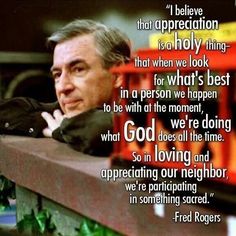
rogersappreciationWill you seek and serve Christ in all persons, loving your neighbor as yourself?

Today’s Gospel lesson is just one of many places in the Gospels where Jesus tells his followers that following his Way is all about servanthood. He says, I didn’t come to be served, but to serve others. He says, Love your neighbor as you love yourself. He says, When you care for the sick, the hungry, the naked, the prisoner, it is as if you are caring for me. He says, I have washed your feet as an example to you, that you should serve each other humbly as I have served you. And he says, Whoever wants to be the greatest and the first, must be least and last, and be the servant of all.

He must have been so fed up with them! He’s just been talking about what’s ahead for him, about the road of suffering he must walk. He knows that speaking out against the unjust and cruel political, economic, and religious status quo is going to get him killed. He is bracing himself for it, and trying to prepare his friends. And they are missing the point so, so profoundly. He’s talking about vulnerability and solidarity and sacrifice and they’re arguing amongst themselves about who’s the BEST disciple.  When he asks them what they’re talking about, there’s this … silence. I know that silence. A child might say, “I don’t want to tell you.” So he schools them – again.

In the way of Christ, greatness is found in servanthood, in loving action in response to the needs of another.

Will you seek and serve Christ in all persons, loving your neighbor as yourself? That’s how our church states this aspect of the Way of Jesus, in our baptismal covenant, the set of five questions outlining the life of faith – faithfulness in worship and study, repentance when we fall away, sharing God’s good news, serving and loving our neighbors, and working for a more just and peaceful world.  We join in these vows every time we celebrate a baptism, and we renew them several times every year. Will you seek and serve Christ in all persons, loving your neighbor as yourself?  – and the people say: I will, with God’s help!…. 

Back at the beginning of the month, all Episcopal churches were invited – called, really – to a Sunday of confession, repentance, and commitment to end racism. We were called into this observance – along with other churches and denominations – as a sign of solidarity and support for the African Methodist Episcopal Church nationwide, following the racially-motivated murder of nine people at a prayer meeting at Mother Emanuel AME Church in Charleston on June 7; and also as a sign of our shared commitment, as a denomination, to confronting racism in our society, our institutions, and ourselves.

Our Presiding Bishop, Katharine Jefferts Schori, and the Chair of the House of Deputies, Gay Jennings, wrote a joint letter to the Episcopal Church, in which they write, “‘The Church understands and affirms that the call to pray and act for racial reconciliation is integral to our witness to the Gospel of Jesus Christ and to our living into the demands of our Baptismal Covenant’ [quoting Resolution C019 of the 78th General Convention]…. Racial reconciliation through prayer, teaching, engagement and action is a top priority of the Episcopal Church in the [years ahead].”

Right now, some of you – I won’t guess the percentage are thinking, Oh, no, another racism sermon. Maybe because you think we shouldn’t really be talking about this in church, maybe because you feel like we’ve done enough talking and it’s time to move on to some action. I probably wouldn’t have chosen this topic for this Sunday, this season, on my own. I already postponed it for two weeks; we were asked to observe this Sunday of prayer and repentance on Sunday the 6th. I wanted to get into the new season together; I wanted to find a Gospel lesson that reinforces this call to costly love of neighbor; I wanted to find something fresh to say.

I’ve preached before about why racism is a sin. I think you’ve heard that before, even if you haven’t been around St. Dunstan’s for long. And I’ve preached before about why racism is an urgent issue here in Madison. I think you’ve heard that before, even if you haven’t been around St. Dunstan’s for long.

If you’re waiting for the sermon in which I offer the one neat trick that will eliminate unsightly racism forever,  well, it’s not gonna happen today. Racism is embedded in our institutions and economy, our media and culture, our minds and souls in ways that will take a couple of generations of hard, persistent, broad-based work to undo. I am just informed enough to know how hard this really is, and just faithful enough to believe we’ve got to try anyway. May God empower and encourage us.

Will you seek and serve Christ in all persons, loving your neighbor as yourself? Seek and serve…  What makes it hard for us to find Christ in our neighbors, so that we’re moved to respond with loving service?

A big piece of my perspective on anti-racism work comes from my parents. We’re all shaped by our first families. For me, in particular, that includes the fact that my father is a social psychologist. He’s a scientist who studies the way humans think about difference. The ways we form ingroups and outgroups – the ways we stereotype and judge others – all that stuff. I’m not an expert by any means; I’m just related to one. But I can tell you that if you’d like a deeper understanding of the roots and dynamics of racism, the field of social psychology is one  fruitful path to follow.

Social psychologists tell us that there are a lot of ways in which the structures and habits of our brains contribute to the persistence of racism. I want to introduce you to one of them: the Fundamental Attribution Error. The Fundamental Attribution Error is our habit of explaining our own behavior by looking at the situation, and explaining other people’s behavior as a result of the kind of person they are.

One writer explains it this way: “When we see someone doing something, we tend to think it relates to their personality rather than the situation the person might be in.” That article is called “Why we don’t give each other a break” – the answer? The Fundamental Attribution Error. Here’s what it looks like in practice. You snap at your child and you think, Phew, that wasn’t my best parenting moment, but I’m under so much stress right now. You might feel guilty, but you give yourself a break. Or if it’s a friend, you might do the same: I know his mom is sick right now; he’s stretched pretty thin. But when you see a stranger snap at her child, you think, What a terrible parent.

AND, if there are stereotypes in the mix as well – if that mom snapping at her child belongs to a group about which you carry some preexisting judgments – then you might go farther. You might go from, What a terrible parent, to, They just don’t care about their children. Why do they have so many kids, anyway? My neighborhood school is full of them, and it’s a real problem for the teachers, because they’re so disruptive.

But what if, what if that mom is not so different from you? What if she’s stretched thin because of job- or family-related stress? What if this is her worst parenting moment of the week? Or what if her circumstances are such that she is stretched that thin all the time? What if your heart, instead of closing in judgment,

could open with compassion? …

The Fundamental Attribution Error, that habit of our lazy brains to go for the simplest explanation, makes it harder for us to see Christ in our neighbor. It literally makes it difficult for me to love my neighbor as myself, because I think about self and neighbor differently. It makes us quick to judge, slow to reflect, empathize, understand. And when it’s compounded by stereotypes – when we have learned, willingly or unwillingly, that such and such a group of people is lazy, dirty, violent, dishonest, incompetent –  then our capacity to recognize God in another person is even more limited. We can’t see the divinity of our neighbor, God’s presence in them, if we can’t even fully see their humanity.

I want to tell you a little bit about one of our neighbors. I’ve changed her name, but I do have her permission to share a little bit of her story. Let’s call her Francine. Francine is an African-American woman in her forties. I’ve known Francine for about six months. I met her when she came to the door of the church, with her husband James, looking for some assistance. They needed help with the room fees for the cheap hotel where they were staying.

While I was talking to the hotel manager, Francine looked around the church a little. She found some of the information pages for our conversations on racism, and I think knowing that we had some awareness of those issues opened her up to telling me her story.  We’ve talked a number of times, over the past months. I’ve helped with hotel room charges, when I can, and sometimes when I can’t. We’ve wept and prayed together. And I’ve listened.

Francine and James had moved to Madison from Milwaukee the previous summer. They’ve now been here well over a year. They have two older sons who’ve graduated from college – Francine is really proud of that; she says, My kids didn’t go to jail; they went to college! They have a daughter who’s a college freshman this year. She wants to get her masters’ degree and be a forensic scientist. And their youngest daughter is starting sixth grade.

Francine has worked as a CNA and wants to go back to school. James is a skilled construction worker. He finds work easily, because he’s good. He’s also veteran. They came to Madison because they were hoping for a better life for their kids. They knew what the opportunities and limitations were in Milwaukee, and they thought they could do better. Better neighborhoods, better schools, a better future for their daughters.

With both Francine and James working, plus his veteran’s benefits, they should be able to afford a decent apartment in a safe neighborhood here. They should be able to live a stable life, and build towards that hopeful future for their family.

But here’s the thing. Madison has a housing crisis. Our occupancy rate is incredibly high, thanks to Epic, the university, and other factors. That means it’s a seller’s market for landlords and property managers.  They can be as demanding and as choosy as they like. And they don’t really have to tell you why they say No. They can just say No. Because you don’t look like the kind of tenant they want.

But they won’t say No right away. They’ll let you fill out an application, first. Did you know that you have to pay a fee to apply for an apartment? $20, $25, $30 per adult. One place Francine had to argue with them not to count her 18-year-old daughter as a third adult, so they’d have to pay another $20.

Francine and James have been seeking housing in Madison for fifteen months. And by seeking I don’t mean making a couple of calls a week. I mean pounding the pavement. Calling every possible lead from Craigslist or the paper. Driving around the city, looking for “For Rent” signs. Filling out application after application. Paying hundreds, thousands of dollars in fees. Meeting with property managers, week after week. Keeping in touch with case managers and counselors. Getting the funds and the references set up, only to get another No. Disrupting James’ work schedule and wages, because landlords have to meet him too.

All of this while living in a hotel room, for $70 a night. Almost twice what their rent would be, if they could get into an apartment.

Sure, they could go to the family homeless shelter in town. But they don’t want to. They tried it out. Francine says it was dirty, unsafe, and divides the family. What would you do?

Sure, they could probably find an apartment in the city’s poorest neighborhoods. Their case worker keeps pointing them there. Francine says they were offered one last week. But the place had been trashed by the previous tenants, and there’s no reason to think those landlords will fix anything. Francine and James don’t want to live in poorly-maintained low-rent housing. They can afford a better apartment, in a nicer location, and that’s what they want. What would you do?

The bottom line is, they shouldn’t have to settle. They have work. They have income – though if they could get into housing, it would do a heck of a lot to stabilize their financial situation. They have the support and advocacy of the Veteran’s Affairs folks, earned by James’s service to his country. Francine says, “It’s not like we don’t have means. We HAVE means.” But landlords in Madison have lots of applicants to choose from. And it’s easy NOT to choose a poor black family.

When I realized that I wanted to talk about Francine today, I had forgotten that our Old Testament lesson today is the wonderful description of the Resourceful Woman, from the Book of Proverbs. She’s the ideal wife and mother, working hard for the wellbeing of her family. Always busy, always striving for a safe and prosperous future for her children. It’s like cruel mirror for Francine’s story. That’s just what she is, what she does; and yet, her family is not prospering.

Francine believes, and James believes, that a big part of the reason for all those No answers is racism.

What do those landlords see when they look at Francine? … They see a black woman. She doesn’t have very polished speech. Her clothing and hair aren’t at their best; she looks poor. She gets upset easily, emotional.  She’s demanding – she wants to know, are you going to give my family a chance?

The Fundamental Attribution Error means that people read Francine and make assumptions about who and what she is. When in fact she’s in a situation – a long, grinding, heart-wrenching, exhausting situation – in which any of us would struggle. If I were going through what Francine is going through, I’d be unkempt.

I’d be demanding. I’d be emotional. I’d be roaring my frustration, rage, and grief to the world about a system that won’t let me house my kids.

We have a stereotype, a template, of the Poor Black Family. In the stereotype, there’s no father in the picture. The kids have different daddies. There’s a criminal record or two in the family. Nobody’s pursuing higher education. Nobody’s working a skilled job.  It is easy for the landlords looking at Francine and James to see them through that lens, and assume that’s who they are.

Now listen: I want those landlords, I want all of us, to have a lot more compassion towards families that DO match that profile. I’m not saying it’s OK to shut them out either.

But that’s NOT who Francine and James are. And they still can’t catch a break.

I don’t know how to be a servant to Francine and her family. I don’t have an apartment for them, or a solution. Sometimes I can pay for a night at the hotel from my discretionary fund, thanks to the generosity of this parish; sometimes I can’t.  But at least I see her. I see her dignity and her desperation. And I care. I think that matters to her, even when I have nothing to offer but my prayers.

When I talked to Francine this week to ask if it was OK to tell some of her story, she updated me on their ongoing, disheartening search. She wept. And she wondered, again, why the system seems to want her family – her family, which is ready to make it, to be OK, to get ahead! – why the system keeps seeming to push them down and out. She said, “Why would the world want that? I’ve got a real insight into the world now…”

I’ve got a real insight into the world now…

The Fundamental Attribution Error is fascinating and powerful to understand.

You might find that knowing this about yourself – about how your brain works, left to its own devices – helps you think twice and be more understanding of your annoying co-worker, your surly check-out clerk, your unreliable dogsitter.

It’s my hope that knowing this about ourselves might help us think past our received stereotypes and judgments about our neighbors living in poverty, and especially our poor neighbors of color.

What if we take on the discipline of trying to assume that everyone else’s actions and choices are strongly influenced by their situation and circumstances, just like our own? Then I might think about those circumstances, and how it would feel, and what choices I might make, were I standing in those shoes.

Recognizing her circumstances, hearing her story, I might be more prepared to recognize my neighbor’s humanity. To see her as a sister, to see myself in her.

And recognizing her humanity, I might be able to catch a glimpse of her divinity. Of Christ’s image reflected in her face. Of Christ’s heartbreak and outrage in her tears.

He sat down, called the twelve, and said to them, “Whoever wants to be first must be last of all and servant of all.”

Will you seek and serve Christ in all persons, loving your neighbor as yourself?

Sermon, Sept. 13

wisdom_womanMay God grant me to speak with judgement, and to have thoughts worthy of what I have received; For both we and our words are in God’s hand, as are all understanding and skill. (Wisdom of Solomon 7:15-16)

Let’s talk about Wisdom. For what could be a more worthy topic? Wisdom is a breath of the power of God, a pure emanation of the glory of the Almighty. She is intelligent, holy, generous, humane, steadfast, powerful, clear. She passes into holy souls and makes them friends of God, and prophets; and she orders all things well.

That Wisdom hymn that we spoke together – I’m sure I read it in seminary at some point, but it came before my eyes again early this year while the Saint John’s Bible was in residence at the Chazen Museum. That Bible – a contemporary hand-calligraphed and illustrated Bible – includes, among its other amazing images, a beautiful picture of Lady Wisdom, with the wrinkles and kind smile of a beloved elder. My colleague and friend Dorota Pruski, the associate rector at St. Andrew’s, mentioned to me that that image was meaningful to her -so meaningful that she wrote a thesis in seminary about the images and language of Divine Wisdom in Scripture.

I invited her to come and speak about this image and how it touched her heart and her life at our Thursday evening Sandbox Worship, where the heart of our gathering is often somebody’s sharing of a piece of their life or faith journey. Dorota brought us this text, to read and reflect on together. And it blew me away. And when I realized that it was an option in the lectionary in September – today – I thought, I really want to spend more time with this text, and I hope some other folks will fall in love with it too, and find something fresh and joyful here.

So, let’s talk about Wisdom. First, just to get it out of the way, the Bible scholar bit. Like the Song of Solomon, the Wisdom of Solomon is in King Solomon’s voice – it talks about being a king, and about asking God for wisdom, as Solomon did in the court history of the Book of Kings. But this text wasn’t written by Solomon, who lived in the tenth century before Jesus. This is a very late Old Testament text, originally written in Greek. It was most likely written not long before the life of Jesus, or even around the same time – in the late first century before Christ, or the early first century A.D.

The Wisdom of Solomon is very Jewish,  drawing on deep textual traditions throughout the Hebrew Bible of naming and celebrating Divine Wisdom, and personifying Her as a beautiful woman, who invites the seeker to eat at her table and receive her gifts. The Wisdom of Solomon is also very Greek, in its high, almost philosophical language, its sense of the ideal and the abstract, its elevation of wisdom and understanding as the highest of divine qualities.

The text was probably written by a Hellenistic Jew – a pious member of the people Israel who had been educated and steeped in Greek scholarship and thought.  The word it uses for Wisdom is Sophia, but all those feminine pronouns aren’t just a grammatical accident. The text is very clear and intentional in describing Wisdom as a feminine aspect of God. For instance, in chapter 8, just a few verses after the end of this text, it casts Wisdom as a beautiful woman, desirable as a metaphorical bride; and also as a close companion of God and helper in God’s work.

In exploring this image of God’s Wisdom, I’m going to dig into two questions: What is wisdom, and what might it mean to integrate Wisdom into our image of God and our practices of prayer?

So, what is Wisdom? … Well, to begin with, there are different kinds of wisdom. Several places in the Bible, both Old and New Testaments, a distinction is drawn between divine and earthly wisdom, or the wisdom of the current age.

One of those places is in the letter of James,  in the text that will come to us next week: “Who is wise and understanding among you? Show by your good life that your works are done with gentleness born of wisdom. But if you have bitter envy and selfish ambition in your hearts, do not be boastful and false to the truth. Such ‘wisdom’ does not come down from above, but is earthly, unspiritual, devilish. For where there is envy and selfish ambition, there will also be disorder and wickedness of every kind. But the wisdom from above is first pure, then peaceable, gentle, willing to yield, full of mercy and good fruits, without a trace of partiality or hypocrisy.”

As James describes it, earthly wisdom is tied up with envy, selfishness, pride, ambition. It’s driven by our wants and cravings. We might call it savvy or cunning. It’s the kind of wisdom that knows how to manipulate people and systems to get what you want, to gain or protect advantages for yourself or your group.

In contrast, Divine Wisdom is gentle, generous, pure, merciful, peace-making.   Does James’s list of the qualities of Divine Wisdom remind you of the Wisdom of Solomon? I don’t know whether James knew that text or not, since it’s possible they were written around the same time! But both were drawing on the same Old Testament themes and traditions.

Listen to more of the Wisdom of Solomon, to that text’s description of divine Wisdom:  “For it is God who gave me unerring knowledge of what exists, to know the structure of the world and the activity of the elements;  the beginning and end and middle of times, the alternations of the solstices and the changes of the seasons, the cycles of the year and the constellations of the stars, the natures of animals and the tempers of wild beasts, the powers of spirits and the thoughts of human beings, the varieties of plants and the virtues of roots…  (chapter 7)  She teaches self-control and prudence, justice and courage; nothing in life is more profitable for mortals than these. And if anyone longs for wide experience, she knows the things of old, and infers the things to come; she understands turns of speech and the solutions of riddles; she has foreknowledge of signs and wonders and of the outcome of seasons and times.”  (chapter 8) 

Wisdom has to do with understanding the patterns of things, the big picture; the inner meanings and deep purposes; with knowing both self and world. Sometimes Wisdom is found in perspective, looking at the present in light of the past and the future, seeing how a particular thread fits into the great tapestry. Sometimes Wisdom is found in seeing to the true nature of things, telling it like it is, like James’ words on the power of the tongue in today’s Epistle. “The tongue is a small part of the body, but it can boast of some large accomplishments. How great a forest may be set ablaze by a small flame!” Truth.

And sometimes Wisdom is found in comprehending how little we know, in making peace with paradox and mystery,  with divine riddles like these: The person who saves their life will lose it, while the person who loses their life for the sake of Christ will save it. And: What good does it do a person to gain the whole world, and lose their soul?

So, what is Wisdom? … It’s hard to define neatly.  And sometimes things that sound wise turn out to be bogus, like, If you live a good and pure life and only eat organic food, nothing bad will ever happen to you.  The Internet, pop culture and advertising firms offer us all sorts of pseudo-wisdom, though once in a while they hit on something true, like the stopped clock that’s right twice a day. But I think often we know wisdom when we see or hear it, and when we’re not sure, we can take James’ advice and look to the fruits. Does this so-called wisdom yield good things? Does it produce mercy, peace, justice, kindness? Or… not? You could take home this text from the Wisdom of Solomon, post it on your fridge or near your desk, refer to it to remind you what divine Wisdom looks like.

Now, having failed to define Wisdom, I’ll move on to the “so what” question. What do we do with this? Why does it matter, beyond appreciating a poetic text? What might it mean to integrate Wisdom into our image of God and our practices of prayer? I have often prayed for wisdom, in the course of my forty years. Here’s the new idea I want to offer to you, and to myself: that we can pray TO Wisdom.

If this image touches you – if you are moved by this vision of a loving and lovely Lady who takes up residence in our souls and strives for order and grace in the world – you can claim this as your image of the Divine. You can pray to her, reflect on her, honor her.  And in doing so, you are not creating a new, prettier, nicer God. You are not departing from the Trinitarian theology, Father, Son, and Holy Spirit, taught by our church.  You are simply giving a new, ancient name to the aspect of God better known to us as Jesus Christ.

Okay. Lemme back that up. Throughout Scripture, Wisdom is described as an attribute, an emanation, a companion of God the Father, the Creator and Source. It would be easy to see Wisdom as another name for the Holy Spirit, that breath of the Divine that blows through our world and lives. You’ve already heard me use feminine language for the Spirit – not because I imagine that the Spirit of God is actually a girl, any more than I imagine that God the Father is a boy, but in order to strive for a little complexity and balance in our images and language of the divine.  So it would be easy to identify Wisdom with the Holy Spirit.

But there’s actually a LOT of overlap in Scripture between the way Wisdom is described, and the way Christ is described. If you want a nice chewy beautifully-written thesis to read about it, let me know & I’ll ask Dorota for permission to share her thesis!  I’ll just give you the clearest and best example: the Christological hymn or poem at the beginning of John’s Gospel.

“In the beginning was the Word, and the Word was with God, and the Word was God. He was in the beginning with God. All things came into being through him, and without him not one thing came into being. What has come into being in him was life, and the life was the light of all people. The light shines in the darkness, and the darkness did not overcome it…  And the Word became flesh and lived among us, and we have seen his glory, the glory as of a father’s only son, full of grace and truth.”

Can you hear the similarities? The Companion of God, the Light from God that shares in God’s work and passes into the world to dwell among humans? It’s even clearer if you read more of the Wisdom of Solomon, which describes Wisdom as God’s presence in the world throughout the history of God’s saving work for humanity, very much the way John describes Jesus, the Christ. If you replaced “Word” with “Wisdom” in John’s hymn, and changed the pronouns, it would sound like another chapter of the Wisdom text. But John used a different Greek term: Logos, Word. Maybe that’s a theological choice: he sees Jesus as the creating and prophetic Word of God, made flesh. Maybe it’s because Logos was a masculine word and let John avoid the messiness of using feminine language for Jesus. Who knows? …

The point is that here and elsewhere, there are close parallels between parts of the New Testament that describe the divine and cosmic nature of Jesus, and the Wisdom language of the Old Testament. And there’s a rich strain in Christian history, theology and liturgy that picks up on that and names Christ as Divine Wisdom. It’s most dominant in the Orthodox Christian tradition, but we have one very familiar example in our hymnal, in an Advent hymn based on a holy poem from the 6th century: O Come, thou Wisdom from on high, that orderest all things mightily… That hymn, that some of us have sung for decades, names Jesus Christ, Emmanuel, as Wisdom – Sapientia in Latin, Sophia in Greek.

And just as you could easily read the first verses of John’s Gospel as a hymn to Wisdom, so you can easily read some of the Wisdom texts as hymns to Jesus Christ.  Consider this passage from chapter 9:  “And thus the paths of those on earth were set right, and people were taught what pleases [God], and were saved by Wisdom.”

Here’s why I think this matters. It matters for some people who’ve never quite found their own way to approach Jesus in prayer. Maybe it’s a gender thing. Maybe the Jesus of the Gospels just doesn’t feel God-dy enough to them. If the image and language of Divine Wisdom opens a door for you which allows you to approach Jesus Christ in a new way, I hope you’ll walk through it, with joy. But naming and claiming Sophia as legitimate holy language matters for all of us, because it helps us have a broader sense of who and what Jesus Christ really is: Both the ragamuffin prophet of Galilee, and the cosmic Christ, present before and after and in and beyond. The divine Logos, yes, the Word that creates life; and the holy Sophia, yes, the Wisdom that orders Creation.

And it offers us, too, a fresh and wider vision of what Christ active in our lives looks like:  a Spirit that is intelligent! holy! generous! humane! free from anxiety!that forms us as friends of God! I talked with the kids a couple of weeks ago about seeing the love in their lives as signs of the presence of God, as manifestations of God’s presence. What about if we think of wisdom the same way? Look for it, note it, honor it, seek it. Wisdom, Sophia, Logos, Christ is calling out to us, asking us to be her guests, her students, her friends.

Vestry & Parish Goals, ’15-’16

Leadership Goals for the Year Ahead, as discerned by the Vestry of St. Dunstan’s at our Workday on May 31, 2015

The Vestry offer these to the parish in the hopes that others will join us in taking on these goals, identifying areas of opportunity or challenge in the life of our parish in relation to these goals, and sharing the work of moving together in these hopeful and holy directions. We expect these goals to guide our work through the spring of 2016, and perhaps beyond.

1. Deepen our mutual life of prayer.

We will look for ways to deepen our life of mutual prayer, and to extend it to the wider community.

Some possibilities for pursuing this goal:

  • explore weekday prayer, in person and/or virtual
  • explore fresh approaches to the prayer list
  • explore seeking prayer requests from neighbors

2. Move some recurring tasks from Work towards Ministry. 

We will give thoughtful attention to some of the areas in our common life where a person or ministry is often recruiting or going short-handed, such as grounds work, coffee hour, Sunday school helpers; and others which may come to our attention. We will explore how to re-engineer the work itself so that perhaps it is less, and simpler; and then how to re-market the tasks as easy-entry, low-commitment ministry opportunities.

These goals are intentionally broad and open-ended. We hope for input, ideas, and help from members of the parish (and beyond!) to help us put them into practice. 

Sermon, Sunday, Sept. 6

This Sunday’s Bible readings may be found here

Happy Lammas!

What is Lammastide? No, it doesn’t have anything to do with those funny long-necked animals you sometimes see hanging out with the sheep or goats in a field by the side of the road…

Lammas is an ancient harvest festival that became a church festival in our mother church, the Church of England. The word means “loaf mass.” It was originally held at the time of year when the first grain ripened enough to be made into fresh loaves of bread, at the end of the summer.

At Lammastide, the people of God offer the first fruits of the growing season to God with thanks for the harvest. It’s a practice grounded in the Hebrew Bible, and followed in various forms by peoples around the world who name the Divine in many different ways. When the harvest comes in, you give some of it back to God. You don’t take it for granted. Nature is uncertain. Life is uncertain. But here we all are again. Thanks be to God.

When you start poking around the Bible to see what it says about bread, you run pretty quickly into the connection between bread and justice – by way of the obvious connection between bread and hunger. Just as surely and persistently as Scripture calls God’s people to offer bread to God, as a sign of thanksgiving; so just as surely and persistently does Scripture call God’s people to share bread with the hungry. Our lesson from Proverbs today puts it plainly: Those who are generous are blessed, for they share their bread with the poor.

In fact, there’s a strain of thought in the Hebrew Bible that giving to others is actually another way to give to God, in addition to making offerings at the Temple. Maybe even a better way. That idea appears both the books of the Law, laying out God’s ways for God’s people, and in the Prophetic books, in which the prophets call God’s people back to those ways.  It’s even in the Psalms – In Psalm 50, God asks, Do you think I eat the food you offer? If I were hungry, I have all Creation with which to feed myself. Make your offering to me by living justly.

And then there’s James, with his rather pointed counsel to treat people fairly, and never to dishonor or persecute the poor. It’s hard to imagine a more fitting text for Labor Day Weekend, if we hold in mind the origin and intentions of that holiday. Beyond the school supply sales, beyond the last weekend for summer travel,  Labor Day began as a holiday to honor the historic achievements of the Labor movement in its heyday, in advocating for and protecting working people and especially the working poor. Like pushing for the Fair Labor Standards Act, which established a limited work week with time for rest and leisure; for minimum wage and overtime laws; for the Occupational Safety and Health Act, better known as OSHA, which holds employers responsible for their workers’ safety; for helping to establish employer-based health insurance; pushing for the Family and Medical Leave Act, which protects your job if you have to take time off for a medical or family situation; and helping to end child labor.

People of good faith hold varying views on the labor movement today, but I am very glad to live in a country in which these policies and protections for working people are the law the land, and I’m grateful to those who worked and fought to make them so.

The Bible didn’t envision a democratic society, in which the people can organize to shape the laws that govern their lives. But those who have done that work, in our nation and others, have plenty of Scriptures they can quote – including the letter of James.  Jerry Folk, a Lutheran pastor and scholar who teaches at Edgewood College, has this to say about the witness of James:

“James and many other biblical authors believe that all workers have a God-given right to a just wage, safe and humane working conditions, and time for life with their families and friends; [and] that they have a God-given right to a life of dignity with some measure of comfort and security.”

My first thought on reading that sentence was, Wow, that’s pretty radical; surely he’s putting words in the Bible’s mouth. Then I started thinking about and looking up all the passages in the Bible – especially in the Torah, in the Prophets, the Gospels and, yes, James – that deal with justice, work, rest, human wellbeing, and with the obligations of the wealthy, and of the community as a whole, towards the poor.

And I realized, Nope, Professor Folk is not stretching a point. The Bible, our sacred text, really says that workers should be paid fairly, enough that they don’t go hungry and can care for their families; that work should not become bondage; that workers should have dignity; that everyone is entitled to time for rest; and that those unable to work should be cared for by the community. That is the Bible’s witness about God’s intentions for human society and economy.

James seems to be addressing these matters in a situation in which some Christian communities are treating the rich and the poor differently. There’s an ancient tradition that James may actually be the brother of Jesus – and, honestly, it could be true. There’s a lot here that sounds close to Jesus’ own teachings.

James warns those who are trying to follow Jesus that they must not shame the poor or treat them as less important than the wealthy. He reminds them that God sides with the poor, when the interests of the rich and the poor are at odds:

“Listen, my beloved brothers and sisters. Has not God chosen the poor in the world to be rich in faith and to be heirs of the kingdom that he has promised to those who love him? Yet you have dishonored the poor… If you show favoritism in this way, you commit sin.” His words echo the Book of Proverbs:  “The LORD pleads the cause [of the poor] and will take from those who take from the poor.”

And James offers these words, which challenge and convict me every time (2:14 – 17):

“What good is it, my brothers and sisters, if you say you have faith but do not live out that faith in action? If a brother or sister is naked and lacks daily food, and you says to them, ‘Go in peace; keep warm and eat your fill,’ and yet you do not respond to their needs, what is the good of that? So faith by itself, not shown in action, is dead.”

In last week’s lesson, the first chapter of James, he writes,  “Be doers of the Word of God, not just hearers.”

What good is your faith if you don’t live it out in action?  What’s the use of your good wishes for those who don’t have enough, those who live with want and worry as constant companions, if you don’t act to improve their circumstances?  Those are questions that haunt my days, my years. It puts me mind of a famous quotation from C.S. Lewis that makes the rounds of the Internet from time to time: “If you want a religion to make you really comfortable, I certainly don’t recommend Christianity…”

We live in a time of massive and increasing economic inequality in America. By some measures, our country has the greatest income inequality in the developed world. And when we look at wealth instead of income, the disparities are even greater. An article in Scientific American earlier this year reported that the top 20% of US households own more than 84% of the wealth of our country, and the bottom 40% of households own just 0.3%.

To some extent, we Americans tolerate this stark inequality because we believe that anyone who works hard can make good. And some do, of course. But we sharply underestimate the barriers and overestimate our society’s capacity for social and economic mobility. Mobility is measurable, just like income and wealth, and America has less, not more, social mobility than other developed nations. 

That’s a really brief snapshot of a huge, messy issue. Google “economic inequality America” to learn more than you want to know.

Massive and increasing economic inequality in America is a fact. How to understand it, and solve it, are issues on which smart and good-hearted people can hold differing views. One way or another, it is already one of the central themes of the year’s political debates.

But while the answers are complex, I believe the question for people of faith is pretty simple:  How do we live as God’s people in the face of these realities?  In the face of a social and economic order that is, from God’s point of view, disordered?

If indeed we accept the Bible as our witness to God’s plans and purposes for humanity, then we have to face the fact that God has told us again and again that the wellbeing of the poor matters. That having people in grinding poverty, hungry, struggling, vulnerable, hopeless, is NOT OK WITH GOD. And we have to come back to James’s words, those words that cling like a burr: what good is your faith if you’re not acting on it?

Just as surely and persistently as Scripture calls God’s people to offer bread to God as a sign of thanksgiving; so just as surely and persistently does Scripture call God’s people to share bread with the hungry.

Our parish is already generous with our charity. But the scope of inequality and need in our nation is such that charity isn’t going to solve it. I’m pretty sure those in our congregation who are most deeply involved with the charitable ministries of our city, like MOM and IHN, would agree. Charity can feed a family for a day or week, but most of the time it can’t prevent the hungry days from rolling around again.

The Biblical call to sharing and generosity is about more than charity. It’s about how we order our common life. Consider an example from the Old Testament, from Leviticus, the Book of the Law of God that tells God’s people the Jews how to live in God’s ways of holiness, mercy and justice. One of the laws of Leviticus is the law of gleaning – an appropriate topic for a harvest festival.

In a nutshell, gleaning means that landowners – the wealthy elite, in that context – weren’t supposed to take everything when they harvested their fields, orchards and vineyards. They were supposed to leave the edges and corners unharvested. Then those without land or work could come and gather from those edges and corners, to feed their families.

The Theology of Work Commentary says, “We might [see] gleaning as an expression of compassion…, but according to Leviticus, allowing others to glean… is the fruit of holiness. We do it because God says, “I am the Lord your God” (Lev. 19:10). This highlights the distinction between charity and gleaning. In charity, people voluntarily give to others who are in need. This is a good and noble thing to do, but it is not what Leviticus is talking about. Gleaning is a process in which landowners have an obligation to provide poor and marginalized people access to the means of production… and to work it themselves.  Unlike charity, it does not depend on the generosity of landowners. In this sense, it was much more like a tax than a charitable contribution. Also unlike charity, it was not given to the poor…  Through gleaning, the poor earned their living the same way as the landowners did, by working the fields with their own labors. It was simply a command that everyone had a right to access the means of provision created by God.”

The Commentary goes on to note, as I have, that our Biblical models don’t provide easy solutions for our circumstances:   “Certainly Leviticus does not contain a system ready-made for today’s economies.” There aren’t straightforward answers in Scripture to today’s socioeonomic dilemmas, and I won’t pretend that there are.

The people of the Bible didn’t live in a democracy, so we have to do our own work discerning how to participate in civic life as people of faith, and what it looks like to work towards God’s justice in a secular society.

The people of the Bible didn’t live with advanced capitalism. Exploitation of the poor by the rich was a clear and unvarnished reality in those times and places. It’s messier now, with questions about how a business’s profits relate to the wellbeing of its employees, or which poor people we should prioritize in a global economy, and many other complexities and ambiguities.

The people of the Bible lived in a world of rich and poor, starkly defined. Most of us here are more or less middle-class. We know that we are privileged, rich by global standards. But we also don’t feel wealthy or powerful enough to make much difference in the status quo. When the Bible talks about rich and poor, we often don’t know where to find ourselves in those stories and teachings.

In the face of all those questions and uncertainties, here is what we can hold onto, as concrete and crusty as a loaf of good bread. What we do with what we have, matters. What is ours, isn’t really ours in an absolute sense. Whether we were born into it or worked hard for it or a little of both, it comes to us as a resource for our own flourishing, yes, but also for the flourishing of others, and of the whole cosmos. (Did you know that word, cosmos, which means the system, the great big encompassing dynamic whole, that’s the word that’s translated “world” in the New Testament? As in, God sent his Son into the system, not to condemn the system, but that through Him the system might be saved?… That’s a whole nother sermon.)

I’m not just talking money here; we have all kinds of assets, resources, privileges. For example, I suspect that I am comparatively more wealthy in education and institutional position than I am in financial resources. That means that when I’m passionate about something, I may be able to advance it further by committing time and skill than by committing money. You know what your resources, your assets are.

What we do with what we have is one of the themes of our fall season. It’s not a liturgical season, though if it were I suppose green would be the appropriate color! But it’s the season of harvest, so deep deep in the rhythms of the year, it’s a time when we think about bounty, about offering, thanking, giving, sharing. It’s a season when the winter’s hardships loom, so our hearts and minds turn to the needs of those who may go hungry and cold in the months ahead. It’s the final quarter of the fiscal year and time to plan for the next one, so organizations and institutions are soliciting commitments and setting budgets.

In October we’ll have three weeks in a row with invitations to engage with the needs of the wider community – Backpack Snack Packs, Bread for the World’s Offering of Letters, and CROP Walk – we’re calling it the Hunger Weeks. And of course, right after that, we’ll kick off our parish pledge drive, our shared conversation about your choices to use some of your resources to support this church, and about how this church should use its resource to support God’s mission.

What we do with what we have, matters. We often don’t know how best to use our resources to forward God’s dream of an economy of human dignity and wellbeing. But maybe that’s one of the things that church is for.

Maybe it’s through our common prayer, through reading and talking about Scripture together, through shared learning and service, and through our conversations with one another – the kind where we see things the same way but push each other to go deeper, and the kind where we see things differently but discover our underlying shared hopes and fears – Maybe it’s through all that, the substance of our life together as a community of faith, that we’ll find the way to be doers of the Word of God, and not just hearers.


Kids’ sermon, August 30

We just heard a beautiful poem, full of wonderful images, like lilies and doves and flowers and apple trees. It is called the Song of Solomon because it talks about King Solomon, David’s son. People who study the Bible think it was written much later, and just used King Solomon as a character in the poem.

This is a poem about love.But not just any kind of love.This is a romantic poem. It’s the words of two people very much in love, in the spring, getting ready for their wedding. Two people who want to be as close to each other as possible. (I know; gross, right?)

In English, the language we use,there is just one word for love. That’s it: love. I saw a cartoon once where a lady got madbecause her husband said “I love lobster” and then he said, “I love you.” You could say, I love my mom, and I love gummi bears. But do you feel the same way about your mom and gummi bears? Not really!

In the language called Greek, which some of the Bible was written in, they had different words for different kinds of love .Eros is like boyfriend/girlfriend love, romantic love. Storge is like the love in a family. Philio is like the love we feel for our friends. Agape is like the love we have in a community or a team or a group of people that know each other and take care of each other. The kind of love where you share happy times and hard times, and where you try to help somebody even when it’s hard. This is the kind of love that Jesus tells us to have for each other. I don’t know what word the Greeks would use for how people feel about lobster or gummi bears! …

Okay, so coming back to this love poem we just heard. Why are we reading a love poem in church? Well, because it’s in the Bible. So why is a love poem in the Bible? A lot of people have asked that question, over the years. Some people have felt like it just doesn’t really belong here.It’s about romance… and some of it is pretty kissy-kissy… reading it might make people think about things other than God… so let’s just skip that part of the Bible. And certainly don’t read it to the children!

Other people have said, What is wrong with you? This isn’t a poem about romance at all. It’s a poem about the love between God and God’s people. The sweet, tender adoration that God has for us. And if you see something kissy-kissy there, that’s your issue.

I wonder if we can say that it’s kind of both? It’s kind of about the romantic love of two people, and also about the tender love God feels for us? I wonder if all kinds of love -Eros and Storge and Philia and Agape – I wonder if all those kinds of love, deep down, are really the same love?

At least, I wonder if all the good kinds of love we feel are really the same love, deep down. Because sometimes we get attached to things that aren’t really good for us, but it might feel like love. One word we use for that is addiction.That’s when you want something all the time, and it feels really important to you, like you need it to be yourself, and it feels like you love it; but the thing you’re attached to is unhealthy for you. Or at least it’s not truly adding anything to your life, it’s just taking your time and energy without building you up. The best example for kids might be computer or video games. Maybe you’ve felt a little bit addicted yourself, or you have a friend who’s kind of addicted. For grownups it might be cigarettes or alcohol or online shopping, or even a person who’s really exciting but who does hurtful things. People can get addicted to lots of things.

So not everything that feels like love, is good for us. Real love does good things in our hearts and minds and lives. And that’s true whether it’s the love of a friend, or a parent, or a pet, or a teacher, or a girlfriend/boyfriend someday. Real love doesn’t always feel good every minute. Sometimes we hurt each other, or we feel sad when someone we love leaves or gets sick. And sometimes we have to tell people we love something that they don’t want to hear. Like, come do your homework! …

But even if it doesn’t feel good all the time, real love is good, and we need it. Let me tell you a story about King Solomon, because it is also a story about love. Remember, King Solomon was King David’s son, and he was famous for being very, very wise. This is one of the stories that people told about how wise he was.

There were two women, sisters, who both had new babies. And one of the babies died. Very sad! So now there was only one baby, but both mothers said that that baby was theirs. The babies looked alike so nobody could tell for sure, and both women said, This is my baby. So they argued and argued, and finally they took the baby to King Solomon the Wise. They said, How can we solve this?

And King Solomon thought about it, and then he said, All right, I know what to do. We have to cut the baby in half. Each of you can have half of the baby. Was that a good solution?…

It doesn’t sound like a good solution, does it? But let me tell you what happened. One of the mothers said, All right, fine, that seems fair. But the other mother said, NO! Don’t hurt the child! She can have him. Just – let him live.

And King Solomon said, Let the baby go to this woman. She is the baby’s mother. He saw that she truly loved her baby. The other woman was so broken by her sadness and jealousy that she didn’t care what happened. But this woman loved the baby with such big, deep, strong love that she would rather let the baby go with somebody else than be hurt. (Now do you think King Solomon was wise?)

So that’s real love! And all that kind of love comes from God. That’s what we mean when we say that God is love. Have you heard people say that? God is love? The woman who draws the Sunday Papers is named Gretchen. And the way she draws God – it’s hard to draw God, nobody knows what God looks like! – so the way Gretchen draws God is as a heart with hands. Love that reaches out to us and touches the world, and our lives.

What do you think about that idea? That the love in your family, the love of your pet, the love you share with your closest friends, the love you feel for a special place like a lake or woods, the love you feel for doing something you’re really good at, all of that real, good love is holy? Comes from God? That it’s one of the ways God is in our lives, every day?

I’m going to give you all some hearts. I want to notice love in your life today, okay?Notice where there is love in your life. Put a heart on it if it’s a thing, or if it’s a person you could give them a heart. And say in your heart, Thank you, God! Thank for all the love in my life!

Hoops for Housing: Success!

Thanks to all the volunteers, donors, and participants in Saturday’s Hoops for Housing basketball tournament and kids’ fair at Westmoreland Park! We had a great time and raised over $2000 for Briarpatch Youth Services, which serves the needs of homeless teens in Dane County.  Biggest thanks go to the 11-year-old member of our congregation who brought us this idea, told us why it mattered, and led us all along the way to this great event.

Sermon, August 9

Almighty and everlasting God, who didst enkindle the flame of thy love in the heart of thy holy martyr Jonathan: Grant to us, thy humble servants, a like faith and power of love, that we who rejoice in his triumph may profit by his example; through Jesus Christ our Lord, who liveth and reigneth with thee and the Holy Spirit, one God, for ever and ever.

One of the interesting questions I get, now and then, from folks who have come to the Episcopal Church from other traditions, is: How do y’all handle the matter of saints? As a church, we have a calendar of commemorations, people to honor on particular days of the church year. And at St. Dunstan’s, we’ve got our little wall of holy people, back there overlooking the baptismal font; our iconostasis, the name they use in the Orthodox churches. In a couple of months we’ll celebrate All Saints’ Day, one of the great feasts of the Christian year. So clearly we have some practice of honoring saints, more so than most Protestant churches. But the definition of a saint, what makes somebody a saint, is nowhere near as clear as it is, for example, for our Roman Catholic brothers and sisters.

We Episcopalians and Anglicans tend to live with, and in, the tension between the two ancient definitions of sainthood. The one we see in the New Testament, which uses “saints” to mean the whole fellowship of believers, called and holy. And the one that evolved in the early centuries of the church, which uses “saints” to mean those special individuals whose lives and often deaths bore witness in a particular way to their faith, virtue, and courage. Our church’s Standing Commission on Liturgy and Music, the body that oversees our calendar of commemorations, has been wrestling with this conundrum for several years, trying to find a clear and theologically-grounded way to explain why we name and set apart certain people for remembrance, while we still affirm that every Christian life can and should show forth the love of God in Christ Jesus. The Commission’s solution is to hold up the idea of witness. That the people we hold up and honor are people who demonstrated, lived out, witnessed to their faith, in a way worth honoring and remembering. In a way that may inspire us as we strive to live our faith in the face of today’s challenges.

The introduction to our latest volume of commemorations, called “A Great Cloud of Witnesses,” says, “Following the broad stream of Christian tradition, there are no formal criteria for defining saints. Rather, sanctity is celebrated locally by a decision that [certain] individuals… shine forth Christ to the world… As illustrations, they mirror the myriad virtues of Christ, in order that, in their examples, we might recognize those same virtues and features of holiness in people closer to our own times and stations and neighborhoods. And, seeing them in those around us, we may be more able to cultivate these virtues and forms of holiness—through grace—as we strive to imitate Christ as well.”

Today I’ve got a new picture to add to our wall, our iconostasis. (No, it’s not Art Lloyd, though it’s a kindred spirit.) This is Jonathan Myrick Daniels – known to his friends as Jon. He died fifty years ago this month, on August 20, 1965. His feast day on our calendar is August 14, the date of his arrest. Jon was born in 1939 in Keene, New Hampshire. He became Episcopalian as a young man, after struggling with faith in his teens. He attended the Virginia Military Institute, where he was valedictorian of his graduating class in 1961. He received a fellowship to study English literature at Harvard, but he discerned a call to ordained ministry and left Harvard to study at my alma mater, the Episcopal Divinity School in Cambridge, Massachusetts, then known as ETS.

In 1965, Jon Daniels was 26, and America was torn by a deepening struggle over civil rights. In March of ’65, the Rev. Dr. Martin Luther King Jr. called for people to come to Alabama to help, to stand with African-Americans in their fight for freedom. Who went to see the movie Selma, earlier this year? On March 7, civil rights activists had tried to march across the Edmund Pettus Bridge in Selma, as the first step of a march to state capitol in Montgomery to highlight the disenfranchisement of African American voters. As you may have seen in the movie – or, for some of you, on the news, fifty years ago -the marchers were beaten back by so-called law enforcement. King’s call was for allies, black and especially white, to join the marchers for a second attempt.

Dr. King’s call was much-discussed at ETS. One day at Evening Prayer in St. John’s Chapel – where today there hangs an icon of Jon Daniels, surrounded by other martyrs of the world’s long struggle for freedom and equality – during Evening Prayer, Jon heard the Magnificat, Mary’s prayer of joy and hope. And it spoke to his heart in a new way, a transformative way. He wrote later: “As the lovely hymn of the God-bearer continued, I found myself peculiarly alert, suddenly straining toward the decisive, luminous, Spirit-filled “moment”… Then it came. ‘He hath put down the mighty from their seat, and hath exalted the humble and meek…’ I knew then that I must go to Selma.”

Jon joined a group of other ETS students on a weekend trip to Alabama, to help with community organizing work there. But Jon missed the bus home – and took that as a sign that he should stay longer. His friend Judith Upham, who took this photo of Jon, back at ETS, wrote later about how they spent their time: “After the march, Jon and I just hung around, doing what we could to help.” If a demonstration needed marchers, they marched. They helped students complete college applications, played with children, helped voter-registration efforts, visited schools. They attended the local Episcopal church every Sunday and spent about an hour each week lobbying the rector to act, without success. Upham says, “He was too steeped in the ways of the South, and he had his job to consider.” Upham concluded, “We were in our 20s, young and naïve, assuming that if people knew the right thing to do, they would do it.” It also was, she said, “one of the few times in my life I was 100 percent positive that I was doing what God wanted me to do. If it cost me my life, that was all right. After all, there are worse things than death.”

On Aug 13, 1965, Jon Daniels, with about 30 others, went to Ft. Deposit, AL, a small rural town, to picket segregated businesses. On Aug 14, they were all arrested, and taken to the nearby Hainesville jail. They were held for 6 days. On August 20, they were released with no warning – meaning there was no ally ready to pick them up and take them to safer territory. Friends have described it as a set-up. It was a hot bright day, 100 degrees, and a sense of danger hung heavy around. A small group – Jon Daniels, a white Roman Catholic priest, and two black protesters – approached a small store, hoping to buy a cold drink. They were met at the door by Tom Coleman, an unofficial sheriff’s deputy, wielding a shotgun. Words were exchanged. He threatened them, then pointed the gun at one of the black protesters, a young woman named Ruby Sales. Jon Daniels stepped between Ruby and the gun. Coleman fired. And on a dusty road in Hainesville, Alabama, Jon Daniels gave his life for a friend, for the world, for Christ.

Jesus says, The bread that I give for the life of the world is my flesh.

The author of the letter to the Ephesians says, Be imitators of God, as beloved children, and live in love, as Christ loved us and gave himself up for us, a fragrant offering and sacrifice to God.

In the weeks before his death, Jon Daniels wrote, “I lost fear… when I began to know in my Bones and sinews that I had been truly baptized into the Lord’s death and Resurrection, that in the only sense that really matters I am already dead, and my life is hid with Christ in God.”

The shooter, Coleman, got off on self-defense, through an absurd claim that Daniels had pulled a knife. But Jon’s death drew national attention to the protests. In particular, it mobilized the Episcopal Church to engage the civil rights movement, to take seriously the struggle for freedom and justice, and join God’s work by supporting that struggle. Jonathan Daniels is still remembered and honored for having shown the church where to stand – as close as possible to those facing unjust oppression. Judith Upham said later, “I know that Jon’s legacy made a huge difference in theological education,… in terms of how do we practice what we say we believe.”

Why honor, why remember Jon Daniels? There are a lot of names on our calendar of witnesses. Most of them don’t get a Sunday sermon, in this church or any church. Jon Daniels became an important witness for me for various reasons – a fellow alumnus of my seminary, and a child of New Hampshire, where I served for three years. But I think there are good reasons to hold up his witness. Not just because Miranda likes him, but because his story indeed speaks to the ongoing struggles of our time and place.

I preached about Jon three years ago, in 2012. It was interesting looking back at that sermon. I alluded to the ongoing existence of racial inequity, but my only concrete example was the shootings at the Sikh temple. We continue to see the murder of those who seem racially or ethnically other, around our country. But since 2012 we have also become much more keenly aware of the real and lasting and life-compromising forms that structural racism takes right here, in our beautiful, beloved Madison.

The Race to Equity report, released in 2013, showed us a stunning reality. The United States has some of the worst racial disparities in the world, measured in things like differences in arrest and incarceration rates and educational outcomes across racial groups. Wisconsin has some of the worst disparities in the nation; and Madison has some of the worst disparities in the state. What that means, friends, is that by some measures, Madison has one of the biggest gaps in wellbeing, opportunity, and quality of life between racial groups, and especially between whites and blacks, of anyplace in the world.

And it’s not just that communities of color here fare about the same as communities of color elsewhere, and that the gulf exists because Madison is such a great place for white people. No. The data show that Madison is an actively bad place to be African-American. Jobless rates, poverty rates, and other measures of wellbeing for African-Americans in Dane County are all markedly worse than national averages for the same population.

I know that it continues to be uncomfortable, for some of you, to hear these issues held up in a sermon, as demanding Christian engagement and response. I truly honor that each of us has to work out for ourselves where the rubber of the Gospel gets traction on the roads of our lives, and when, where, and how we’re called to live out the faith we claim. At the same time, the many discomforts that the issues of racial equity stir up for us may be discomforts with which we need to get comfortable. Because racial inequality and systemic racism have been identified by our denomination and diocese as matters of urgency for our common life as followers of Jesus.

Our General Convention, our church’s legislative gathering, which met earlier this summer, passed a resolution [A182] that acknowledged that many Episcopalians find it challenging to understand or know how to respond to systemic racial injustices; that affirmed that the Gospel, our Baptismal Covenant, and the Five Marks of Marks of Mission call the Church and its members at every level to find more effective and productive ways to respond to racial injustice as we love our neighbors as ourselves, respect the dignity of every human being, and seek to transform unjust structures of society; that directs the Church at every level to commit to further study, teaching, training, and shared prayer and practice that specifically addresses racial injustice; and urges the Church at every level to increased engagement with civic conversations about racial injustice. Our Convention also committed two million dollars to this work, over the next three years.

I do believe, wholeheartedly, that this is one of the great projects – possibly THE great project – that God has for God’s churches in this nation, in this time: striving for more fairness and flourishing for all God’s children, and especially for African-Americans, who have struggled under the burden of racism in its many forms for so long. I also believe, wholeheartedly, that not everybody here is called into that work; and that even for those who are, there are many ways and levels at which to engage. A life like Jon Daniels’ draws our eyes and minds and hearts to the urgency and depth of the matter; it doesn’t lay out a course to follow or a model against which to measure ourselves. Being called into engagement with the corporate sin of structural racism doesn’t mean being called to take a bullet.

And here I’d like to circle back around to the ambiguity of sainthood. Earlier I named two types of saints: ordinary saints like all of us, claimed and called by God to live out holiness in our own simple and humble ways; and extraordinary saints like Daniels, who lived and died publicly, powerfully, prophetically, as witnesses to the love and mercy and justice of God. It turns out that the line between those kinds of saints, those definitions of sainthood, that line is much finer than it seems, once we’ve packaged up those extraordinary lives and put them in the pages of a book.

Jon wrote a lot, during his time in Alabama. About what he was doing and thinking and feeling. And his journals reveal a young man who was both extraordinary and ordinary. Who found the work of following the Gospel sometimes exciting and sometimes boring; sometimes clear-cut and sometimes messy; sometimes joyful and sometimes heartbreaking; sometimes remarkable and sometimes trivial.

Listen to Jon’s own words about the ambiguity and necessity of sainthood… “There are good [people] here, just as there are bad [people]. There are competent leaders and a bungler here and there. We have activists who risk their lives to confront a people with the challenge of freedom, and a nation with its conscience. We have neutralists who cautiously seek to calm troubled waters. We have [people] about the work of reconciliation who are willing to reflect upon the cost and pay it. Perhaps at one time or another, the two of us are all of these. Sometimes we take to the streets, sometimes we yawn through interminable meetings, sometimes we talk with [other white folks] in their homes and offices… sometimes we confront the posse, and sometimes we hold a child. Sometimes we stand with men who have learned to hate, and sometime we must stand a little apart from them. Our lives in Selma are filled with ambiguity. We are beginning to see the world as we never saw it before. We are truly in the world, and yet ultimately not of it. For through the bramble bush of doubt and fear and supposed success we are groping our way to the realization that above all else, we are called to be saints. That is the mission of the Church everywhere. And in this, Selma, Alabama, [and Madison, Wisconsin] is like all the world: it needs the life and witness of militant Saints.”

When Jon delivered the valedictory speech at the Virginia Military Institute in 1961, an official introduced him, saying, “This young man has not only been outstanding as a member of the cadet corps, he is an outstanding man, and you will hear of him later on, as the years go on.” Jon ended his speech with a few words for his classmates that I’d like to claim, and offer, as his words to us. He said, “My colleagues and friends, I wish you the joy of a purposeful life. I wish you the decency and the integrity of which you are capable. I wish you new worlds and the vision to see them.”

Let us pray.

O God of justice and compassion, you put down the proud and mighty from their place, and lift up the poor and the afflicted: we give you thanks for your faithful witness Jonathan Myrick Daniels, who, in the midst of injustice and violence, risked and gave his life for another; and we pray that we, following his example, may make no peace with oppression, and may live with purpose, decency, and integrity, striving to bring into being the new world of God’s justice and mercy; through Jesus Christ the just one, who lives and reigns with you and the Holy Spirit, one God, for ever and ever. Amen.

Sources:

A detailed account of Jon’s arrest and death 

The Race to Equity report

Judith Upham shares some memories

A collection of Jon’s writings from his time in Alabama

Jon’s valedictory speech