Holy Week 2022

A note about plans in a time of pandemic… It is possible that Covid rates could rise again by Holy Week. In that event, we may take some steps to reduce the risk of in-person gatherings, such as increasing ventilation, limiting singing, encouraging advance sign-up to manage capacity, or even moving services outdoors. We will communicate clearly about any such measures. Please read our weekly Enews and/or check the website for the latest information. Zoom worship will always be an option. 

ALL ZOOM SERVICES will be on our usual Sunday Morning Worship link. Contact the church office ( or 608-238-2781) or subscribe to our weekly Enews to get the links. 

MAUNDY THURSDAY, April 14

ZOOM WORSHIP, 5 – 6PM: Join from the dinner table! Consider setting your table for a special occasion, with dishes you love, flowers, candles. Have bread and wine or fruit juice on hand. 

IN PERSON WORSHIP, 6:30 – 8PM: This year’s service will include an informal Eucharist (not a full meal, as we have done in the past); an opportunity for foot washing; and stripping of the altar. 

NIGHTWATCH: Keep vigil for an hour,  at home or at church, Thursday evening or Friday morning.  It’s appropriate to pray, sing, read the Bible or spiritual texts, or just sit in silence. Sign up for your chosen hour at this link. 

GOOD FRIDAY,  April 15

ZOOM WORSHIP, 1PM: A Zoom-adapted version of Good Friday worship, with passion Gospel. 

IN PERSON, 12PM and 7PM: We will read the Passion Gospel and pray the special prayers of this day. This liturgy does not include the Eucharist. 

IN PERSON Children’s Stations of the Cross, 4:30PM: A gentle outdoor exploration of the Stations of the Cross, for all ages. 

THE GREAT VIGIL, Saturday, April 16

ZOOM WORSHIP, 6:30 – 7:30: A service of story and song that prepares us for Easter Sunday. You might enjoy gathering by candlelight/dim light, and having bells or noisemakers on hand! 

IN PERSON, 8PM – 9:30PM: We’ll honor the Great Vigil, one of the Church’s most ancient rites, with fire and water, story and song, renewal of baptismal vows and the first Eucharist of Easter.  PLEASE NOTE: This service will BEGIN at the Parish Center, the green building at the end of the parking lot. We will walk to the church midway through the service. 

EASTER SUNDAY, April 17

ZOOM WORSHIP, 9AM: A festive Easter liturgy online!

IN PERSON, 8AM & 10AM: Gather for Easter worship with Eucharist.  All are welcome! We are planning an outdoor reception and an egg hunt after the 10AM service.

Bulletin for March 27

9AM Zoom online gathering: We use slides during worship that contain most of this information, but some prefer to follow along on paper.

Bulletin for March 27

The link for the Zoom gatherings is available in our weekly E-news, in our Facebook group St. Dunstan’s MadCity, or by emailing Rev. Miranda:  .

THREE WAYS TO USE AN ONLINE BULLETIN…
1. Print it out!

2. Open the bulletin on one device (smartphone or tablet) while joining Zoom worship on another device (tablet or computer).

3. On a computer, open the bulletin in a separate browser window or download and open separately, and view it next to your Zoom window

Sermon, March 20

A note about the readings: Today’s Epistle is transferred from next Sunday, March 27 (Lent 4C), because we will not read the Epistle next week due to our Scripture Drama. 

Today’s Old Testament lesson gives us the call of Moses – Israel’s great leader who led them out of bondage in Egypt and through a long wilderness journey. I’m always tickled by God saying, “I have heard my people’s cry, I have come to deliver them, I’m sending … YOU!” And Moses saying, “You have the wrong guy.” 

But this year my attention is caught by this sentence:  “I have come down to deliver [My people] from the Egyptians, and to bring them up out of that land to a good and broad land, a land flowing with milk and honey” – so far so good –

“To the country of the Canaanites, the Hittites, the Amorites, the Perizzites, the Hivites, and the Jebusites.”

That’s… a whole lot of people to already be living in the land that God plans to give to the Israelites. 

Two weeks ago, on the first Sunday in Lent, we heard a portion of Deuteronomy – a book that presents itself as Moses’ last words to his people before his death and their crossing over into this land, the land they believe God intends as their new home. 

That passage had resonances with our Thanksgiving myth. The people told to honor their first harvest season in this new land that God has given them by making an offering to God, then celebrating with a great feast. 

The only thing missing from the story are helpful native peoples… because the Israelites were supposed to wipe them all out. 

How do we deal with the places where the Bible says that God wants God’s people to destroy other nations? 

I find those texts to be in tension with some really central themes of Scripture – like that when God calls a particular people, be it the the Israelites, later known as the Jews, or the Christians, followers of Jesus, it’s so that they can bless other peoples, not destroy them. 

Both the Bible and archaeology tell us that the Israelites spent a long, long time being one small nation among other nations. There are lots of stories of conflict with neighboring peoples in the Old Testament. 

From that angle it makes some sense that as people compiled texts and traditions into their holy book, some language crept in there about how God definitely wanted them to destroy all those troublesome neighbors. 

There’s more to unpack and wrestle with there.  I don’t want to make it too simple. But there is room to faithfully question whether God has ever called God’s people to commit genocide. 

In March of 1848, a revolution was stirring in what is now Germany. The working classes and middle classes were joining forces against the ruling elites, to call for more democratic government and constitutional reforms protecting the rights of ordinary citizens. 

The revolution was ultimately quashed by military force. Discouraged and fearing reprisals, many young Germans who could afford emigrate, did – to places like Texas, Ohio, and Wisconsin. 

This wave of German immigrants, seeking a fresh start in a more free and democratic nation, became known as the Forty-Eighters. Among them were the Heim family – including two brothers, young men, Joseph and Anton, and Joseph’s fiancée Theresia. Arriving in New York in 1848, the Heims made their way to Wisconsin.

To a good and broad land, a land flowing with milk and honey – the land of the Ho-Chunk, the Sauk, the Menominee, the Ojibwe, the Potawatomi, the Oneida. 

There Joseph, Anton, and Theresia bought some land from the US government, built a home, and started a farm. I’m standing on that land right now. The brick house over there – that’s the home the Heims built. 

Another of those big, overarching themes of Scripture is that God wants people to be free – not in bondage. God seems to care about human wellbeing, human thriving. 

Our Presiding Bishop Michael Curry likes to talk about our loving, liberating, and life-giving God. 

I believe God wanted to free the Israelites from enslavement in Egypt. I believe, too, that God wanted the Heims to be free from the oppressive circumstances they faced at home in Germany. To have a chance to build a better life for themselves and their children. 

And: All these stories of making home in a new place, a place of freedom and plenty: all these stories have to reckon with who was displaced or killed, to free up the “promised land” for those new arrivals. 

We have to read against the grain of these received stories to notice those losses, those costs. It is work. Because these powerful myths of journey and arrival and home-making – they either demonize the people who were there already, or ignore them entirely. 

From the mid-15th century to the present, the legal principle of the Doctrine of Discovery has asserted that Christian,“civilized” Europeans had the right to any territory occupied by non-Christian peoples. The native peoples of the Americas, of Australia, of Africa – their millennia of presence and stewardship of the land simply didn’t matter. 

The United States government did negotiate many treaties with Native peoples – including the 1832 treaty that forced the Ho-Chunk nation to leave this land. 

Those treaties give the appearance of taking Native land rights seriously – but they were also overwhelmingly unfair and coercive, and usually made in bad faith on the American side. And the fundamental mindset was that land wasn’t truly owned, truly used, until white people were living and farming on it. 

It’s work to learn about all this, to take it on board. It’s hard and uncomfortable. 

And if Paul’s right that being followers of Jesus means being ambassadors of reconciliation – it’s part of our call to faithful living. 

Reconciliation. The Greek word Paul used is katalasso. It was most literally a word for exchanging money between currencies, making sure the values came out even.

We still use the word “reconcile” in financial contexts:  to reconcile accounts means you compare them, explain any differences, and get them to match up.

But in Greek and in English, we also use this word for relationships. For coming back together, working through differences, finding resolution and, perhaps, a shared way forward. 

These are timely words and ideas for this season. Reconciliation and repentance. Acknowledging harm, making amends. Mending… 

The financial meaning of “reconciliation” feels oddly apt for the learning some of us have been doing, through our parish Land Acknowledgement Task Force and other opportunities. 

We are, indeed, comparing accounts: the account of the history of this place that begins with people like the Heims claiming and taming the wilderness, and the account that begins much earlier, with the deep memories of peoples who stewarded this land for centuries or millennia. 

Comparing these accounts, seeking to understanding the differences between them – that’s the work that led us, as a first step, to commit $3000 of our 2022 parish budget as an offering to the Native peoples of this region.

Today’s Gospel is a complicated little passage. Some people want to know what Jesus thinks of this recent news story – a tragedy, an abomination, a war crime. He responds, then shares a short parable. 

On the surface, the teaching and the story seem like a mismatch: Tragedies don’t happen to people because they’re extra sinful, BUT: if you don’t start bearing fruit, you’re gonna get chopped! … 

Let me offer a paraphrase that I think holds the pieces together better. Jesus says, Look, those people didn’t have it coming, any more than anybody else ever has it coming. Get that way of thinking out of your head. That’s not how things work.

Everyone is bound by sin. And death is coming for us all, eventually, one way or another. The question is: what will you do with the time you have? 

It’s very easy for us to read this Gospel text in terms of consequences – of punishment. The tower falls, the tree gets chopped down: bad things will happen… unless, maybe…! 

But I truly believe that what Jesus wants from us, and for us, is very different from dread and the kind of rigid and fearful righteousness that grows from fear of punishment. Rather, Jesus invites us to take an unflinching look at the brevity and uncertainty of life – and asks us: 

In a world where a random building might fall on you at any time, where you never know if this may be your last fruitful year: How will you live? What do you choose? 

May God bless us to be a blessing.

May God give us the fertilizer we need to bear fruit. 

May God strengthen us, each and all, to be ambassadors of reconciliation – to have skill and courage and hope for the work of mending, in its many shapes and sizes. 

May we find that work – however it manifests for us, each and all –  to be both our duty and our joy. Amen. 

Bulletin for March 20

9AM Zoom online gathering: We use slides during worship that contain most of this information, but some prefer to follow along on paper.

Bulletin for March 20

The link for the Zoom gatherings is available in our weekly E-news, in our Facebook group St. Dunstan’s MadCity, or by emailing Rev. Miranda:  .

THREE WAYS TO USE AN ONLINE BULLETIN…
1. Print it out!

2. Open the bulletin on one device (smartphone or tablet) while joining Zoom worship on another device (tablet or computer).

3. On a computer, open the bulletin in a separate browser window or download and open separately, and view it next to your Zoom window

Bulletin for March 13

9AM Zoom online gathering: We use slides during worship that contain most of this information, but some prefer to follow along on paper.

Bulletin for March 13

The link for the Zoom gatherings is available in our weekly E-news, in our Facebook group St. Dunstan’s MadCity, or by emailing Rev. Miranda:  .

THREE WAYS TO USE AN ONLINE BULLETIN…
1. Print it out!

2. Open the bulletin on one device (smartphone or tablet) while joining Zoom worship on another device (tablet or computer).

3. On a computer, open the bulletin in a separate browser window or download and open separately, and view it next to your Zoom window

Saints Perpetua and Felicity

See some beautiful images of these saints here and here.

This biography was prepared for us by Sister Pamela Pranke. 

The young women clung to one another with courage as the wild animal charged them. This story is that of Perpetua and Felicity, companions, Christian heroes and martyrs who faced a violent death rather than deny God by worshiping the Roman Emperor. Their compelling story captured the attention and imagination of Christians for 1800 years as an example of unwavering faith in God while facing torture and death with grace. Perpetua, a Christian noblewoman of Carthage, in North Africa, with an infant at her breast, told us in her own words through a diary she kept while in prison of the friendship with her dear pregnant slave, Felicity, and, fellow catechumens, Revocatus, Saturninus, and Secundulus. This is their enduring story.

In the second century people under Roman rule were required to worship the emperor and the Roman gods. Refusal to do so could result in imprisonment and death. That is exactly what happened to Perpetua and her companions.

Perpetua’s parents were not Christian so they could not understand their daughter’s decision to disregard the Roman law especially since her infant stayed in prison with her. Perpetua’s father pleaded with her to change her mind about Christianity to save her life. This was her response, “‘Father,’ said I, ‘do you see this vase here, for example, or waterpot or whatever?’ ‘Yes, I do’, said he. And I told him: ‘Could it be called by any other name than what it is?’ And he said: ‘No.’ ‘Well, so too I cannot be called anything other than what I am, a Christian.'”

Perpetua’s outraged father left the prison in a fury, returning several days later desperately pleading with Perpetua to offer a sacrifice to the emperors. Even the governor pleaded with her to do the same. Over the next days, her father continued to plead with Perpetua until he was beaten back by the guards. Still, Perpetua remained faithful to Christianity.

Felicity was 8 months pregnant when the group was imprisoned. Since pregnant women were not allowed to be executed, her date for execution was postponed until after delivery. This caused her great distress since she would not be executed with her companions. The group gathered in supplication to the Lord that Felicity would deliver her baby so they could all die together. Their prayer was answered two days before the scheduled execution when Felicity delivered a baby in the prison.

The small group of Christians was determined to die rejoicing in the Lord with dignity. Their last meal together was a love feast shared with family and friends. The group of Christian companions approached death with faith and celebration of victory knowing that they were in the Lord’s hands.

The day of execution arrived. Perpetua entered the arena singing psalms. The men faced the wild beasts first, after being attacked by a bear, boar, and leopard, they waited for Perpetua and Felicity to face their beast, a wild heifer that was symbolic of their young womanhood.

Perpetua and Felicity, clinging to each other, were stripped, and dragged in a large net into the arena. The crowd, after seeing that Perpetua was a very young woman and that Felicity had just given birth, called for them to be clothed. Perpetua was tossed into the air by the wild heifer that trampled Felicity. Perpetua pulled Felicity up so they could face the wild animal together. Perpetua, concerned with her Christian dignity, covered an exposed thigh and straightened her hair.

The crowd indicated that it was taking too long for the Christians to die, so in compassion, they called for a rapid death. The Christians stood in silence together after sharing a blessed kiss. A gladiator killed each in turn, excluding Perpetua. A soldier thrust a sword at Perpetua and hit bone rather than killing her. Perpetua dramatically reached for the sword guiding it to her neck to aid her executioner.
This narrative became so well-known in the early Church that it was read during liturgies. Even today, Perpetua’s diary is read in church services or their brave story retold.

O God the King of saints, who strengthened your servants Perpetua and Felicity and their companions to make a good confession, staunchly resisting, for the cause of Christ, the claims of human affection, and encouraging one another in their time of trial: Grant that we who cherish their blessed memory may share their pure and steadfast faith, and win with them the palm of victory; through the same Jesus Christ our Lord, who lives and reigns with you and the Holy Spirit, one God, for ever and ever.

Further Reading and References
Acts of Christian Martyrs, The Martyrdom of Saints Perpetua and Felicitas, untitled (ssfp.org) This includes Perpetua’s Diary.

Keifer, J., Perpetua and her companions: Martyrs at Carthage. Biographical sketches of memorable Christians of the past. http://justus.anglican.org/resources/bio/117.html

Peterson, A.R. (2004). Perpetua: A Bride, a Martyr, a Passion, Relevant Books.

Shewring, W, (2021). The Passion of SS. Perpetua and Felicity, Hassell Street Press.

YouTube has a number of videos about these saints.


Bulletin for March 6

9AM Zoom online gathering: We use slides during worship that contain most of this information, but some prefer to follow along on paper.

Bulletin for March 6

The link for the Zoom gatherings is available in our weekly E-news, in our Facebook group St. Dunstan’s MadCity, or by emailing Rev. Miranda:  .

THREE WAYS TO USE AN ONLINE BULLETIN…
1. Print it out!

2. Open the bulletin on one device (smartphone or tablet) while joining Zoom worship on another device (tablet or computer).

3. On a computer, open the bulletin in a separate browser window or download and open separately, and view it next to your Zoom window

Homily, All-Ages Worship, Feb. 27

Today we heard stories about two people who came so close to God that it made them GLOW. Like a light bulb! 

First was Moses. God chose Moses to be the great leader of God’s people. To lead them to freedom, after they had been enslaved in Egypt; though their long journey in the wilderness until they finally come to a land where they could settle. 

Who remembers how long that journey was? …  

During that wilderness time, Moses talks to God to learn how the people are supposed to live as God’s chosen people. And he teaches them. 

There’s a lot that happens in this story, isn’t there? Moses and God are talking up on the holy mountain, and I guess they lose track of time, and the people get impatient.  “Why are we just sitting here in the literal middle of nowhere? How do we know that there’s actually a god who is leading and protecting us? Maybe we should just make our own god…” 

That doesn’t work out so well, does it? … 

But at the end of the story, Moses comes down from the mountain after talking to God again, and his face SHINES.  So much that people feel afraid to go near him! So much that he wears a veil – a fabric covering – to hide the light. 

It seems like he’s been in God’s presence so much that a little of God’s divine glory has rubbed off on him. Or maybe it’s like glow in the dark stuff, where you have to hold it near a light source for a while to charge it before it will glow. Maybe Moses is a special kind of glow in the dark that is activated by being near God’s light. Maybe we all are!

And then we have a story about Jesus being up on a mountain, and coming close to God. Jesus’ friends, Peter and James and John, see him speaking to two men – Moses and Elijah, two great prophets and leaders of God’s people. 

When this story happens, Moses and Elijah had lived a long, long time ago, so I don’t know how Jesus’ friends knew who they were. They didn’t have photographs! Maybe Jesus told them. 

And God is there, too – God the Father, Creator, and Source. God is in the mysterious cloud, and in the Voice that says, “This is my Son, the chosen one; listen to him!” 

Now, Jesus is a human being, but Jesus is also God. So it seems like what happens here is that some of Jesus’ inner Godness shines out. And that made me think about a little project we did at my house recently. 

We found out that if you pour melted chocolate on something called a diffraction grating, then the chocolate becomes very special. 

Look, here’s the diffraction grating. And here’s some chocolate. It just looks like normal chocolate right now…. But when I tilt it so that a bright light is shining on it, you can see all these rainbows! It doesn’t look ordinary any more, does it? 

So maybe Jesus was a little like that. Most of the time when you looked at him you just saw an ordinary person. But when the light of God the Father and Creator shined directly on him, it made him shine too… 

So far we’ve been talking about special people: Moses and Jesus. 

But the apostle Paul says that these stories are about us, too. That coming close to God and shining with God’s light is for all of us. 

In one of his letters to the church in Corinth, Paul writes, “All of us with face unveiled are mirroring the Lord’s glory, and we are being transformed into the same image, from glory to glory, as by the Lord’s spirit.” (Hart) 

Paul is drawing together these two stories, here! He’s thinking about Moses’ veil. And he’s thinking about Jesus being transformed on the mountain top, so that he shines with holy light 

When Paul says “the Lord,” he means Jesus. So he’s saying, We can be mirrors that reflect Jesus’ glory, Jesus’ brightness, Jesus’ goodness. We can embrace that, without veiling our faces or hiding the light. And over time we might reflect Jesus better and better, as our lives and hearts match his life and his heart more and more. 

So, Paul says, Let God’s light shine through you! Reflect Jesus’ light! 

I wonder how we could do that? 

Maybe by trying to be patient, and kind, and understanding, like we heard in Paul’s letter about love, last week. 

Maybe by being generous to others without worrying about what will come back to us, and praying for our enemies, and loving people even when they’re kind of hard to love, like Jesus said in the part of his sermon that we heard last week. 

We get lots of guidance from the Bible about how to live as God’s people and as followers of Jesus. Today’s texts tell us that when we try to make those kinds of choices and live that kind of life,  it’s not JUST that we’re following God’s hopes for us. It’s not JUST that these choices help us be people who add to the amount of wholeness and love and joy in the world. 

It’s also that when we let ourselves reflect the light of Jesus, the light of God, we might shine a little light into somebody else’s life. That light might bless them or comfort them. 

And if they’re looking for God, that light, the light of God that you are reflecting, might help them start to find their way towards God. Like it says in the song we sometimes sing: Let your little light shine, shine, shine – there might be somebody down in the valley trying to get home! 

Today is the last Sunday in the season of Epiphany. We talk a lot about light in Epiphany! The light of the star that leads the Wise Ones to find the baby Jesus… the Light of God’s promises dawning on God’s people… the Light of God’s presence in the face of Jesus, shining on the mountaintop. 

Let’s end Epiphany by singing about letting our little lights shine, one more time… knowing that we don’t have to make the light; we just have to let God’s light shine through us… 

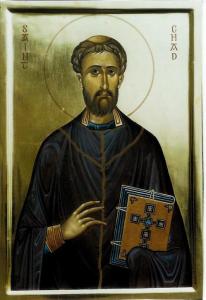
Chad of Lichfield

Chad of Lichfield, 634-672  (Feast Day – March 2)

Written by Sr. Pamela Pranke, OPA

In the mid600s, a father transported his four sons across Northumbria in Britain to the Holy Island where the newly build, solid stone Lindisfarne Abbey guarded the North Sea. There, the youngest son, Chad, and his older brother, Cedd, said farewell to their father and were turned over to the care of Abbot Adain to learn and live the life of a Celtic monk. Thus began their legendary saintly lives.

At Lindesfarne, the boys lived in community, praying, studying, and working together. Those early years shaped Chad to the rhythms of the sea and prayer, obedience, humility, Celtic spirituality, memorizing psalms and gospel, singing, and playing clapping word games. A call and response game went something like this, one boy called out, “God is_,” followed by a couple of claps. The other boys would shout a response such as, “Omnipotent.” Chad was especially known for his loud thunderous claps. 

The North Sea churned about the Holy Island as a constant reminder of the power of nature, especially during fierce storms. When the sea roared, Chad humbled himself before God by lying prostrate praying for protection and deliverance.  

When the boys were old enough to travel alone, Chad and some of the other young monks were send to a monastery in Ireland, Rath Melsigi. Following the instructions of Abbott Aidan and the way of Celtic monks they were told to keep their feet on the ground walking rather than riding a horse. Chad always refused a horse until a time when as a Bishop his superior, Archbishop Theodore, picked him up and put him on a horse, forcing him to ride.

Chad and his companions traveled from monastery to monastery on foot in the wet and cold of Ireland, sharing with people living in extreme poverty, hunger, and deprivation, until they reached Rath Melsigi. Chad would go out of his way to meet every poorest distant home or farm to preach the gospel and teach them to sing and chant simple Celtic tunes like, “Come, Lord. Come down. Come among us.” As the chant was repeated, he would tell them gospel stories over the rhythm of the chant. 

When the young monks first saw Rath Melsigi they were like hobbits seeing the elven city of Rivendell for the first time. They were awe struck, especially by the large number of books housed there. At Rath Melsigi, the day was divided into three parts, first, study of early Church writers, second, work for their upkeep, third, work for the good of others, no matter what that might mean. No task was considered beneath their dignity, from mending a fence, or teaching the psalms. The monks completely lived a life of service. This rhythm formed their days until the time when they would be sent back out into the world.

Every time and place have its upheavals and conflicts. For Chad these took the form of political conflict within Christianity between the Roman and Celtic Christians, and the 664 A.D. plague in Ireland and Britain. As we know well, pandemic impacts every part of one’s life.  This plague gave rise to deadly devastation that decimated the population to an extent beyond our understanding, while chaos ruled the day.

Needing assistance, Chad’s older brother, Cedd, who was Bishop of London and Abbott of Lastingham in Yorkshire, sent for his brothers, including, Chad. As Chad traveled to Lastingham his journey slowed to care for the sick and bury the dead. Sadly, death greeted Chad at Lastingham. All of his brothers, including Cedd, died of the plague, leaving Chad to serve as the Abbot of Lastingham.

Sadly, and ironically, while the population died, the rulers and church hierarchy were most concerned with the date of Easter and how to cut a tonsure. Despite the plague, The Synod of Whitby was called to settle the disputes. Unfortunately, most of those attending the Synod died from the plague.

A bishop or priest could not be found in all of Britain resulting in a power void that added to the chaos. For example, a priest named Wilfred was selected to be Bishop of York, but three bishops could not be found to consecrate him since all were dead. So, Wilfred went to Gual in search of bishops. There he lingered to be safe from the deadly plague.

With Wilfred in Gual, a bishop was still needed. Chad was selected for this position, but he experienced the same problem as Wilfred, no bishops were available to consecrate him as a bishop. Finally, the King had him unofficially consecrated. Still, it was not proper or official.

Just like a twisted, concocted tale, Wilfred returned wanting his bishop seat back. This is where Chad’s humility and holiness shined through brilliantly. Chad humbly gave the bishop seat back to Wilfred. Because he was so humble, and saintly, Chad was made Bishop of Lastingham where he served as Abbott. 

Learning of a massacre of martyrs on the fields of Lichfield under the Roman Emperor Diocletian in 303. Chad moved his See to Lichfield where a cathedral and monastary were built on the exact spot of the massacre.

Bishop Chad maintained his untarnished reputation as a humble, holy man. Sometimes he retreated to the bottom of a well to find a quiet space for prayer. It was said that light poured from the well when Chad prayed within. Ultimately, Chad, too, died of the plague. While the Lichfield monks prayed, they heard singing like that of angels. They scrambled outside to learn the source of the singing, instead they found their Bishop dead.

Chad was canonized shortly after his death. Many miracles and healings were attributed to him. The well where he prayed became a site of pilgrimage. His relics reside in the cathedral at Birmingham, England. 

We have much to learn from the life of St. Chad about humility, prayer, living in rhythm with the hours and nature, and care of the least during times of pandemic. Fortunately, one of Chad’s monks taught Bede, the famous British historian. From this monk, Venerable Bede learned intimate details about Chad’s life and Celtic Christianity. To learn more about this interesting saint, here are a few references.

Bede’s Ecclesiastical History of England, by The Venerable Bede, https://ccel.org/ccel/bede/history/history?queryID=15001896&resultID=952

Lichfield and the Lands of St Chad: Creating Community in Early Medieval Mercia (Studies in Regional and Local History Book 19) Kindle Edition, by Andrew Sargent

Life and Legends of Saint Chad, Bishop of Lichfield, (669-672) With Extracts From Un-edited mss., and Illustrations – September 3, 2015 by Richard Hyett Warner

On Eagles’ Wings – The Life and Spirit of St Chad, Mass Market Paperback – by Revd David Adam

Saint Chad (Caedda), Bishop of Mercia (Lichfield) † 672 http://ourvillagechurch.org.uk/wp-content/uploads/2017/03/Saint-Chad-Booklet-WWH.pdf

http://saintchads.weebly.com

Bulletin for February 27

9AM Zoom online gathering: We use slides during worship that contain most of this information, but some prefer to follow along on paper.

Bulletin for February 27

The link for the Zoom gatherings is available in our weekly E-news, in our Facebook group St. Dunstan’s MadCity, or by emailing Rev. Miranda:  .

THREE WAYS TO USE AN ONLINE BULLETIN…
1. Print it out!

2. Open the bulletin on one device (smartphone or tablet) while joining Zoom worship on another device (tablet or computer).

3. On a computer, open the bulletin in a separate browser window or download and open separately, and view it next to your Zoom window

6205 University Ave., Madison WI

St. Dunstan's Episcopal Church